 Signs & Large Format Print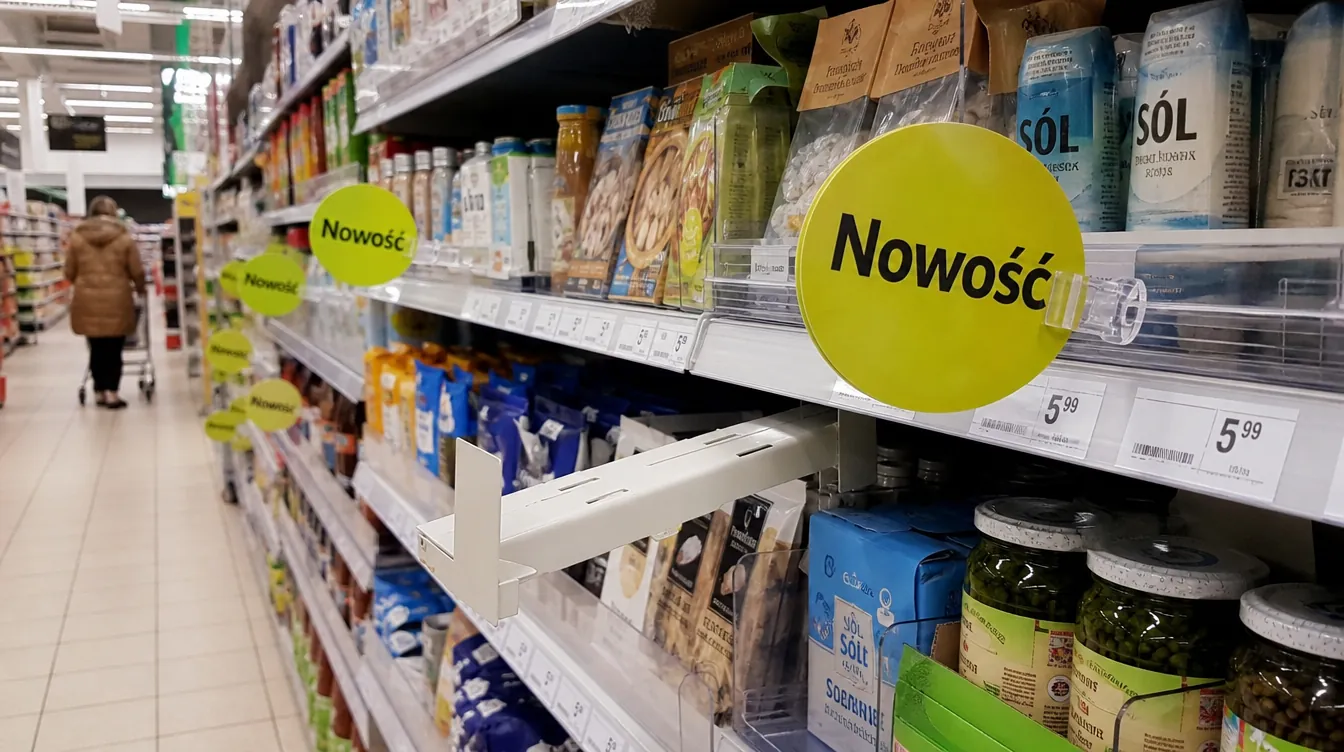
Where the name comes from and who needs it
POS stands for point of sale. You will also see POP (point of purchase) – in practice it means the same thing. POS materials are everything that stands, hangs or lies in a shop telling the customer: here is a promotion, here is something new, pick me up.
Why does it work? Because a large share of purchase decisions are made at the shelf. A customer comes in for bread and leaves with bread and a chocolate bar, because by the till there was a stand with something they had not planned. In a self-service shop the shelf is the only salesperson who talks to every customer – POS gives it a voice.
POS materials are ordered by three groups: manufacturers who want their goods to stand out in other people's shops, retail chains running promotions, and individual shops, pharmacies, drugstores and showrooms that want to sell more of what is on their shelves.
Types of POS material and what they are for
| POS item | Where it works | Usually made from | Printed material price |
|---|---|---|---|
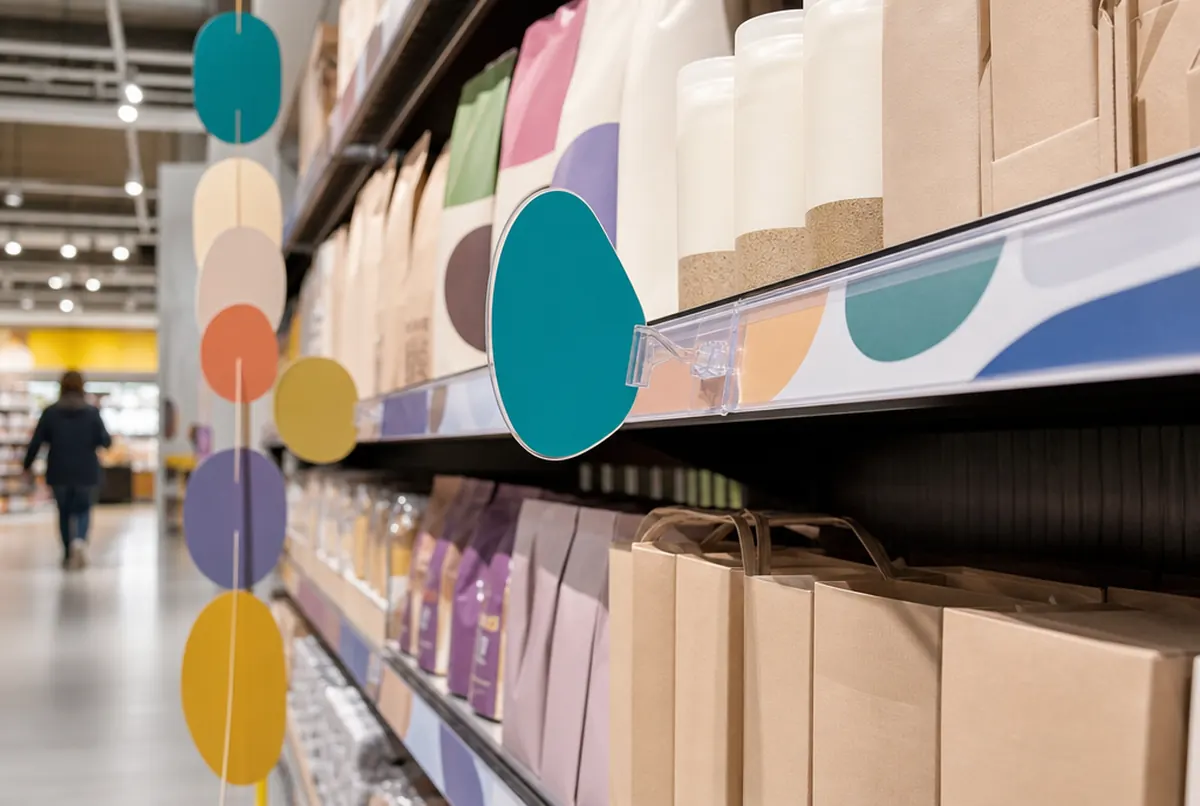
| Wobbler | sticks out from the shelf on a flexible arm | HIPS 0.8 mm | approx. €16–24/m² |
| Shelf stopper | sticks out at right angles from the shelf, visible from the aisle | HIPS or 3 mm PVC | approx. €16–33/m² |
| Shelf edge / price strip | the shelf front, the full length of the fixture | 160 g synthetic paper or HIPS | approx. €10–24/m² |
| Shelf stand | on the counter or shelf, holding products | 3.5 mm corrugated board | approx. €13–21/m² |
| Counter display | by the till | board or 3 mm acrylic | approx. €13–60/m² |
| Dump bin | on the floor, loose goods | corrugated board | approx. €13–21/m² + cutting |
| Totem / cardboard cut-out | entrance, aisle | board or 10 mm honeycomb board | approx. €13–45/m² |
| Floor graphic | the floor in front of the fixture | vinyl with R10 laminate | approx. €19–30/m² |
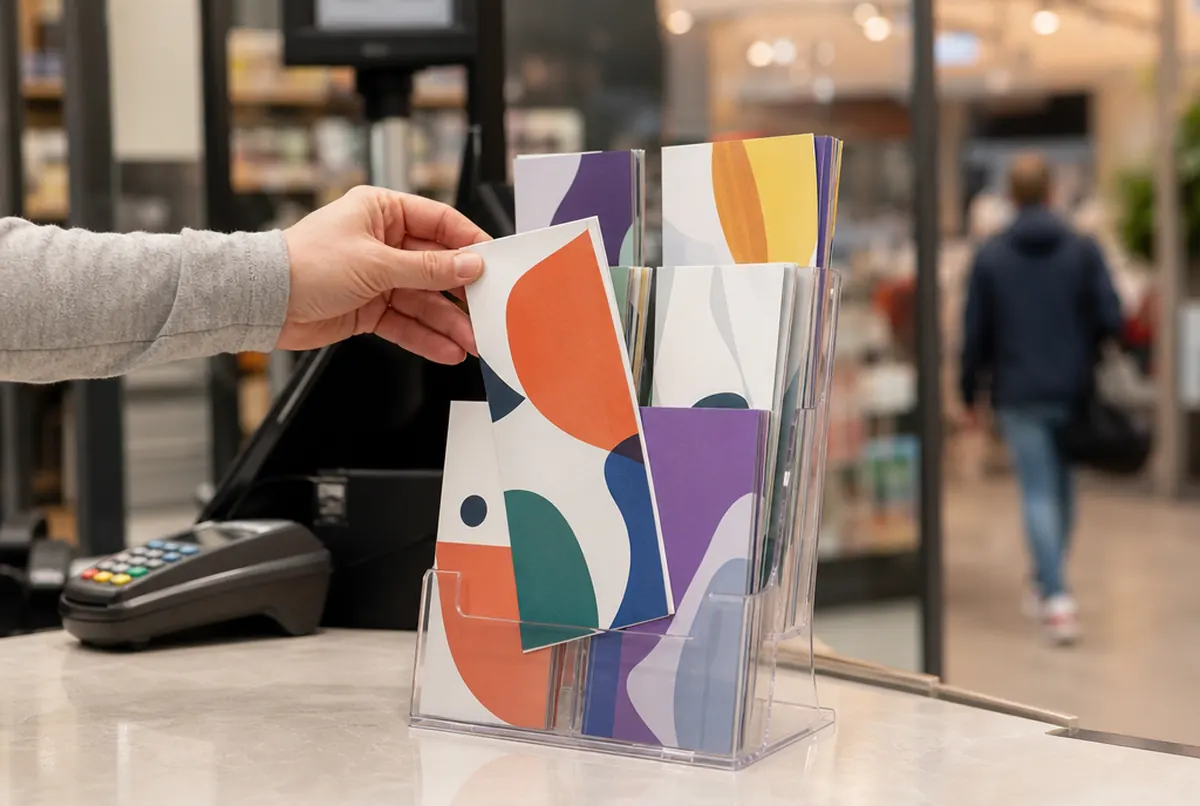
| Leaflet holder | counter, reception | 3 mm clear acrylic | approx. €43–60/m² + bending |
The lower rate in each range applies to larger areas. Cutting to shape comes on top – e.g. HIPS approx. €0.95 net per linear metre of tool path, board cut to a die line approx. €0.70 net per metre, creasing fold lines approx. €0.50 net per metre. Details and options are on the wobblers, shelf stoppers and price tags and shelf stands pages.
Example: what wobblers cost for one shop
Let us cost a simple case. A shop wants to mark 100 promoted products with round 10 cm HIPS wobblers.
- Area: 100 × 10 × 10 cm is 1 m², and with bleed and an allowance for cutting we count approx. 1.2 m².
- Print on 0.8 mm HIPS at 1–4 m²: 1.2 m² × approx. €24 = approx. €29 net.
- Cutting to shape: the circle's perimeter is approx. 0.3 m, so 100 pieces is approx. 31 m × €0.95 = approx. €29 net.
- Total approx. €58 net, i.e. approx. €0.60 each, excluding the mounting arms.
Small formats carry a minimum print and finishing value, so 10 wobblers will not cost ten times less than a hundred. That is why we usually advise grouping several promotions into one order – e.g. wobblers for the next two promotions plus posters.
- 01Brief
Description, sizes, site photos and deadline — a few sentences are enough.
- 02Design and quote
Our designers prepare artwork or a visualisation and you get a price.
- 03Approval
You approve the design; for brand colours we provide a proof.
- 04Production
35+ machines in our own plant in Poland: 3.2 m UV print, CNC, laser, 3D, sewing.
- 05Installation or delivery
Own crews and vehicles across Europe, partner network, couriers worldwide.
Board, PVC or acrylic – choosing the material
The simplest rule: choose the material for how long the POS is meant to stay in the shop.
Corrugated board – activities lasting a few weeks: a promotion, a season, a product launch. Light, cheap, fully recyclable and folds flat, so it is cheap to ship. After the promotion it goes for recycling. It does not like moisture – by fridges, freezers and outdoors it will not last.
HIPS and foam PVC – a few months to a few years. Wobblers, strips and shelf stoppers that will survive shelf wiping and the odd knock from a trolley.
Acrylic – permanent and more elegant items: leaflet holders, tester stands, counter presenters in a pharmacy or jeweller's. More expensive up front, but they last for years.
Honeycomb board, plywood – larger, sturdy stands and fixtures that should look like furniture, not cardboard.
A common mistake: a cardboard stand ordered as a permanent fixture. After three months its corners are worn and it looks worse than having no stand at all. If something has to stay for a year, make it from a more durable material from the start.
What makes POS sell
We see a lot of POS material – some of it works, some is just a colourful piece of plastic. The difference usually lies in a few details:
- One message. The price, the discount or 'new' – not everything at once. '−30%' legible from the aisle does more than a paragraph about ingredients.
- The right height. The zone at eye and hand level sells best. A wobbler on the bottom shelf is seen mainly by children.
- Contrast with the surroundings. If the whole shop is red and yellow with promotions, a red wobbler gets lost. Sometimes a calm, dark graphic stands out better.
- Direction. A floor graphic with an arrow to the fixture, or a totem at the entrance, leads the customer where you want.
- Order. Too many materials at once is tiring and nothing stands out. Fewer, but in the right places.
- Timing. Material for a promotion that ended two weeks ago damages credibility. Decide who removes the POS after the promotion, and when.
POS for retail chains – kitting and dispatch
With a dozen or a few dozen sites, printing is only half the work. The other half is splitting the materials by shop and sending them so they arrive before the promotion starts. We do this in-house: kitting a set per site costs approx. €3.30 net, and assembly with multi-point dispatch approx. €2.80 net per site.
Example: a chain of 20 shops, each receiving a kit with wobblers, a poster and a floor graphic. On top of the print cost comes 20 × (€3.30 + €2.80) = approx. €122 net for packing and dispatch to 20 addresses. Each kit is labelled with the shop's address, so the manager does not have to sort anything. More in the description of campaign kits for chains and in our guide shipping to many shops.