 Signs & Large Format Print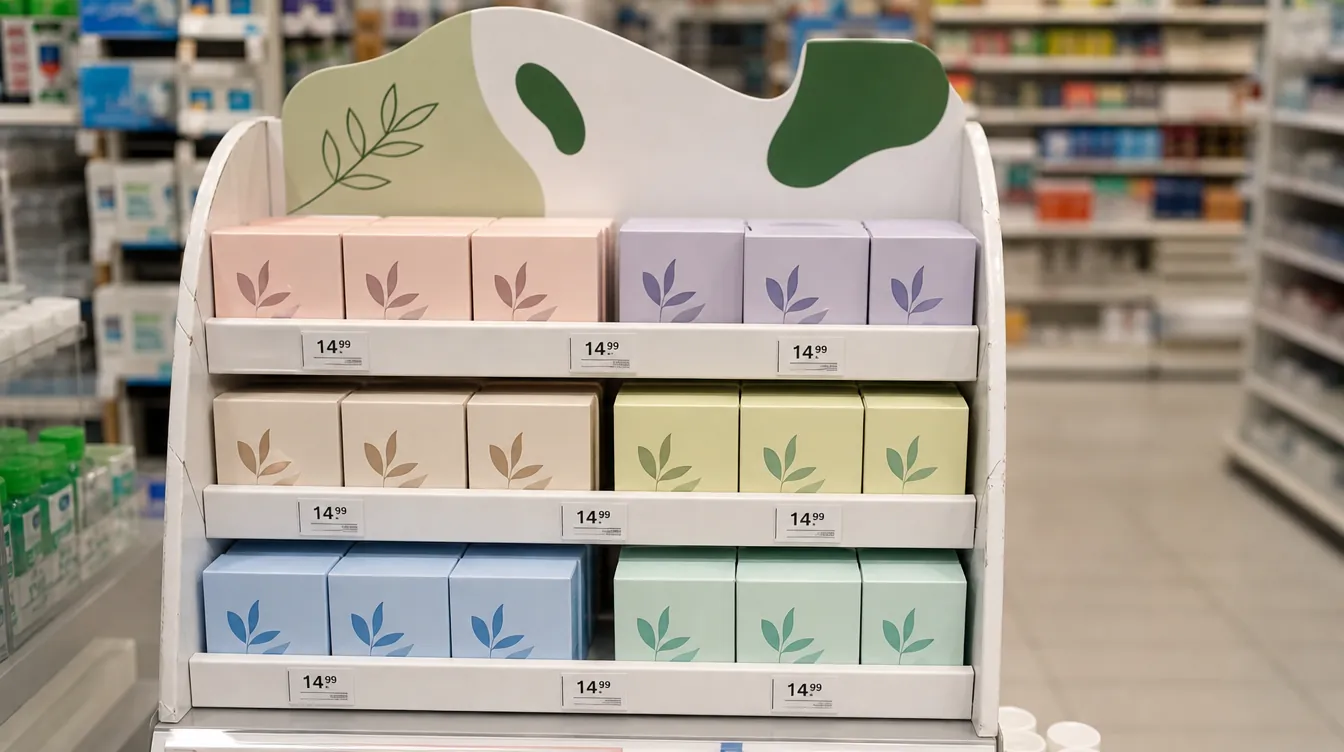
What we mean by a cardboard display
The term covers quite a range. What they share: all are made of corrugated board, printed, cut to a die line and then folded along crease lines. We most often make:
- shelf displays: small counter or shelf units for a few to a dozen products,
- counter displays by the till: for small impulse items,
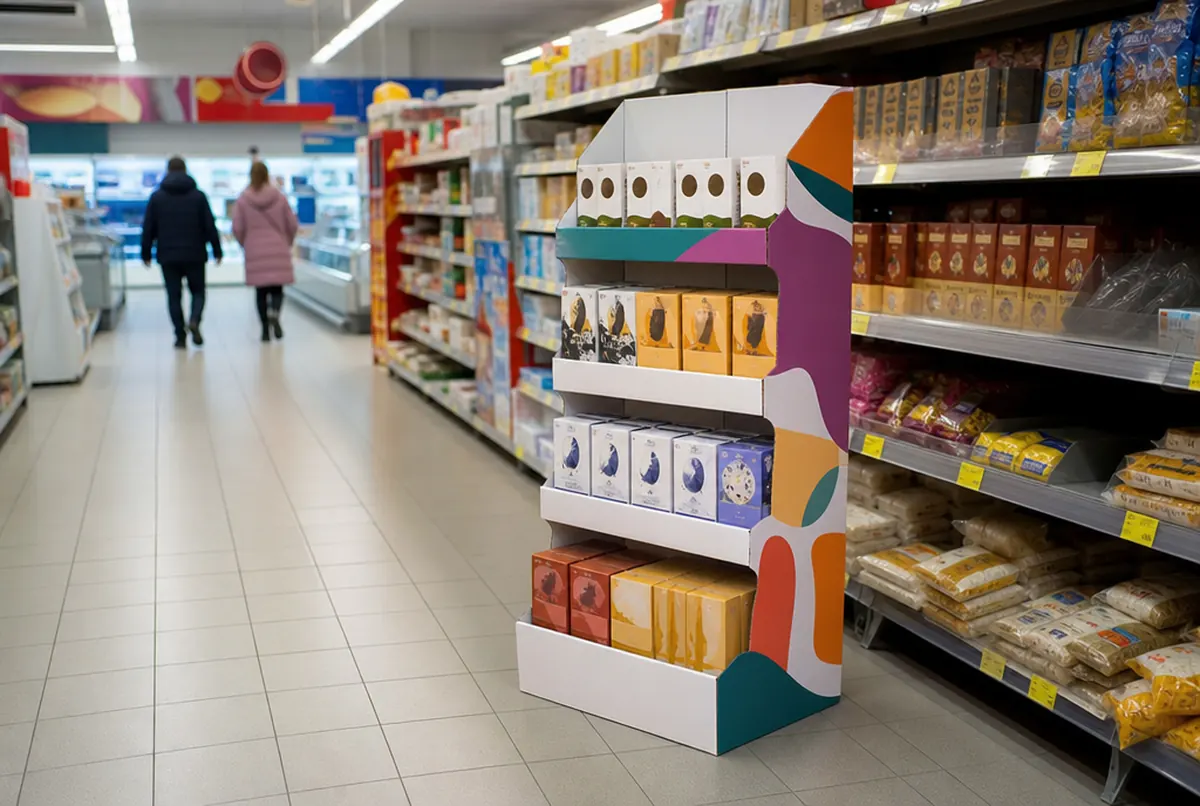
- floor-standing displays with shelves: freestanding units for products in the aisle,
- dump bins: for loose goods and promotions,
- cardboard totems and cut-outs: life-size figures, product silhouettes,
- cubes, tables and plinths for events and stands.
When cardboard is a good choice
Cardboard is a campaign material, not a fit-out for years. We recommend it when:
- The campaign is short. A launch, a promotion, the Christmas season, a campaign of a few weeks. Afterwards the display goes for recycling and nobody has to store it.
- The display is going to many stores. It folds flat, weighs little and fits in an ordinary parcel. With dozens of outlets, shipping costs matter enormously.
- Unit price matters. In a run of dozens, cardboard usually works out several times cheaper than PVC or acrylic.
- The eco argument counts. Cardboard is fully recyclable, and clients in food and cosmetics often ask about it.
- You need a quick test. We make a cardboard prototype quickly and cheaply, so the shape can be checked on the shelf before deciding on a run.
When cardboard will not work
Sometimes a client wants cardboard because of price, and we advise against it. The most common reasons:
- Moisture. A chilled zone, a store entrance, floors mopped every morning: the bottom edge of the board soaks up water and the display starts to lean.
- Heavy products. Bottles, cans, large household chemicals. Cardboard can cope, but needs reinforcement and well-thought-out construction, and sometimes it is better to use board from the start.
- Permanent display for months or years. Corners get knocked and print wears where people touch it. Then hook displays in PVC, honeycomb board or acrylic are better.
- A premium display. For high-end cosmetics or electronics, plain cardboard can look too modest, though well printed it can surprise.
Material and finishing prices
| Material / service | Price | Used for |
|---|---|---|
| 3.5 mm corrugated board, UV printed | approx. €13–21 / m² | displays, stands, bins, totems for campaigns |
| HIPS 0.8 mm, UV printed | approx. €16–24 / m² | wobblers, light stands, single-use elements |
| Foam PVC 3 mm, UV printed | approx. €21–33 / m² | longer-use stands, small signs |
| Honeycomb board 10 mm, UV printed | approx. €30–45 / m² | light, rigid exhibition stands and fixtures |
| Die-line cutting of board | approx. €0.70 / lm of path | display shape |
| Creasing fold lines | approx. €0.50 / lm | folds, assembly |
| Kitting a set per outlet | approx. €3.30 / outlet | packing sets for stores |
| Multi-address picking and dispatch | approx. €2.80 / outlet | shipping to a chain |
A single-piece example: a 180 × 60 cm cardboard cut-out is about 1.1 m² × approx. €21 = approx. €23 for the printed board, plus about 5 m of outline × €0.70 = approx. €3.50 for cutting. Total approx. €27 net, excluding the easel back and design.
In a run, the price per metre falls. Twenty such cut-outs are about 22 m², i.e. the 16–49 m² band, where board costs approx. €15/m². That gives approx. €330 for printed material and approx. €70 for cutting, or about €20 each instead of €27.
- 24 hexpress printing (UV inks need no drying)
- approx. 3 daysstandard lead time
- up to 14 dayslarge and custom projects with installation
Plus courier delivery. Tell us your date — we plan production around it.
How to order a display, step by step
- Describe the product. Pack dimensions, weight, how many units the display should hold, where it will stand (counter, floor, shelf).
- Construction and die line. We choose the display type and prepare the die line. For new shapes we usually make a prototype first, plain or with a test print, to check dimensions with real product.
- Artwork on the die line. The artwork is laid out on the flat die line, allowing for folds and which faces will be visible. We can design it in-house or supply a template to your designer.
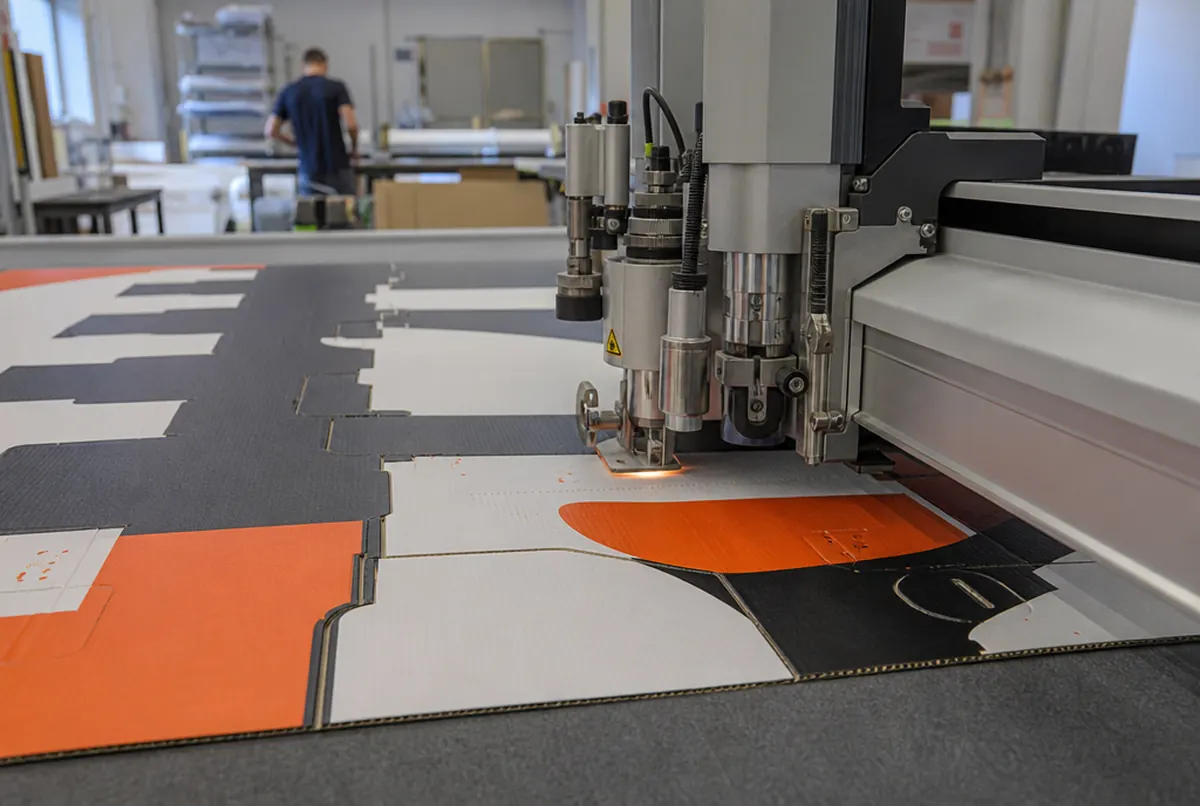
- Production run. UV printing directly on board, cutting and creasing on the plotter, folding or packing flat.
- Shipping. To one address or to many stores, with sets kitted per outlet; more in shipping to multiple stores.
A prototype adds a few days, but it is the best money spent in the whole project. A display the product does not fit by 3 mm is a classic mistake that is easy to avoid.