 Signs & Large Format Print
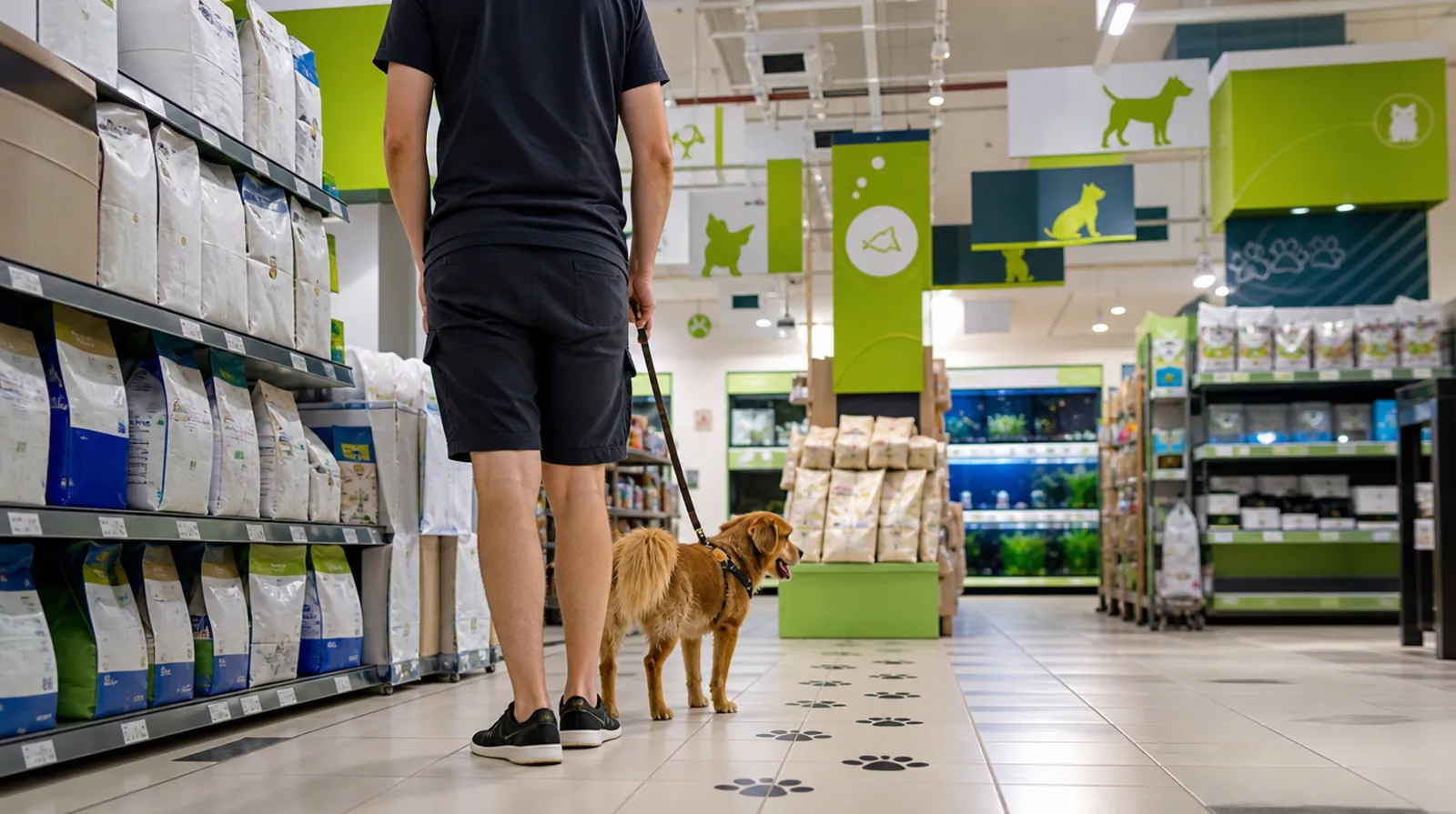 Illustrative visualisation
A pet shop has a lot of small stock and very different customers. One comes every month for the same bag of food and wants to find it in a minute. Another is buying an aquarium or a hamster for the first time and needs advice. A third walks in with a dog on a lead. Signage must let regulars serve themselves, so staff have time for those with questions.
It is also a trade where people feel strongly about the subject – animals, photos of pets, paw prints, warm colours. You can afford more humour than at a pharmacy or a jeweller's. Pet shops also have a high share of regulars and repeat food purchases, so anything that ties customers to the shop works well: a loyalty card, a branded bag, a calendar for the new year.
1. Fascia, window and car park
Pet shops are often in units next to supermarkets or on the ground floor of blocks of flats. A sign that clearly says 'pet shop' or 'pet food' matters more than the shop's own name – people look for what they need.
- Light box over the entrance→Readable in the evening, when people pop in for pet food on the way home. Single-sided from approx. €320 net per m².
- Window graphics with animals and product range→Dog, cat, fish, birds – it's immediately clear who the shop is for. A 'dogs welcome' sticker works well on the door.
- Feather flag at the entrance or in the car park→In a unit next to a supermarket, a flag shows the shop to people who are just parking. Winder Midi from approx. €75 net.
2. Departments and in-store navigation
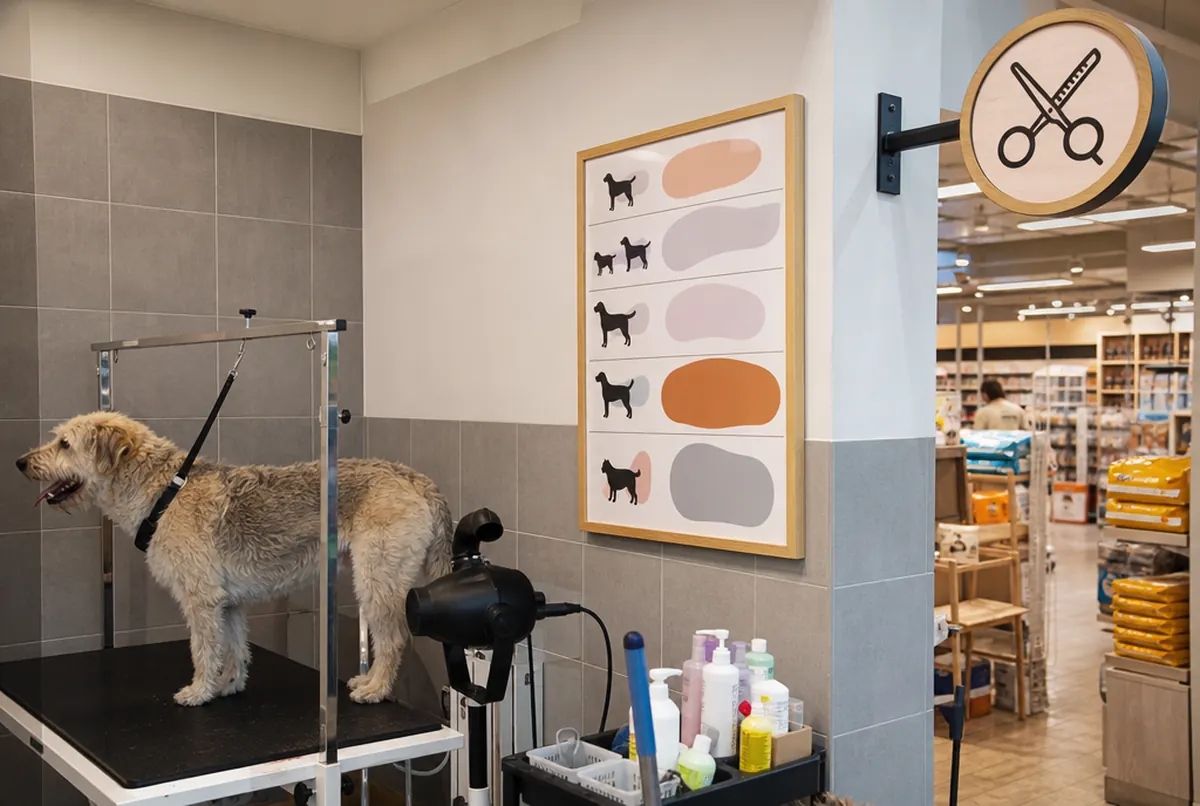
First the list of departments, then the signs. Hanging signs with a big animal pictogram can be read from the entrance. Paw prints on the floor are something owners rarely think of, but children follow them, and parents follow the children.
- Hanging department signs with pictograms→Dogs, cats, small animals, birds, aquatics, reptiles. One style for all signs, PVC or dibond on wires.
- Paw prints and trails on the floor→Vinyl with R10 anti-slip laminate, cut to shape. Leads to aquatics at the back of the shop or to the grooming salon.
- Grooming salon signage and price list→If the shop offers dog grooming, every customer should know about it. A price board by the entrance sells the service without a conversation.
- Advice posters: first aquarium, first hamster→A 'what you need to start' list hanging in the department saves staff dozens of identical conversations, and customers bring it to the till anyway. A2 posters, 10 pcs approx. €28 net.
3. Shelves, display and promotions
This is where most gets used up. Price cards, wobblers and pet food offers change every week or month. It pays to have a fixed format and order in bulk, rather than printing something on the office printer every few days.
- Price strips for pet food shelving→Uniform strips in department colours. With frequent changes we print inserts on synthetic paper that doesn't tear.
- Wobblers and shelf stoppers for offers→'Food of the month', 'new', '20% off two bags'. In HIPS, cut in the shape of a paw or a bone.
- Hook stands for leads, collars and toys→Small items on hooks sell on impulse, by the till. A stand with graphics organises them better than random mesh panels.
- Dump bins for chews and toys→A printed cardboard bin by the till or in the aisle is the simplest way to sell low-priced extras.
4. Regular customers
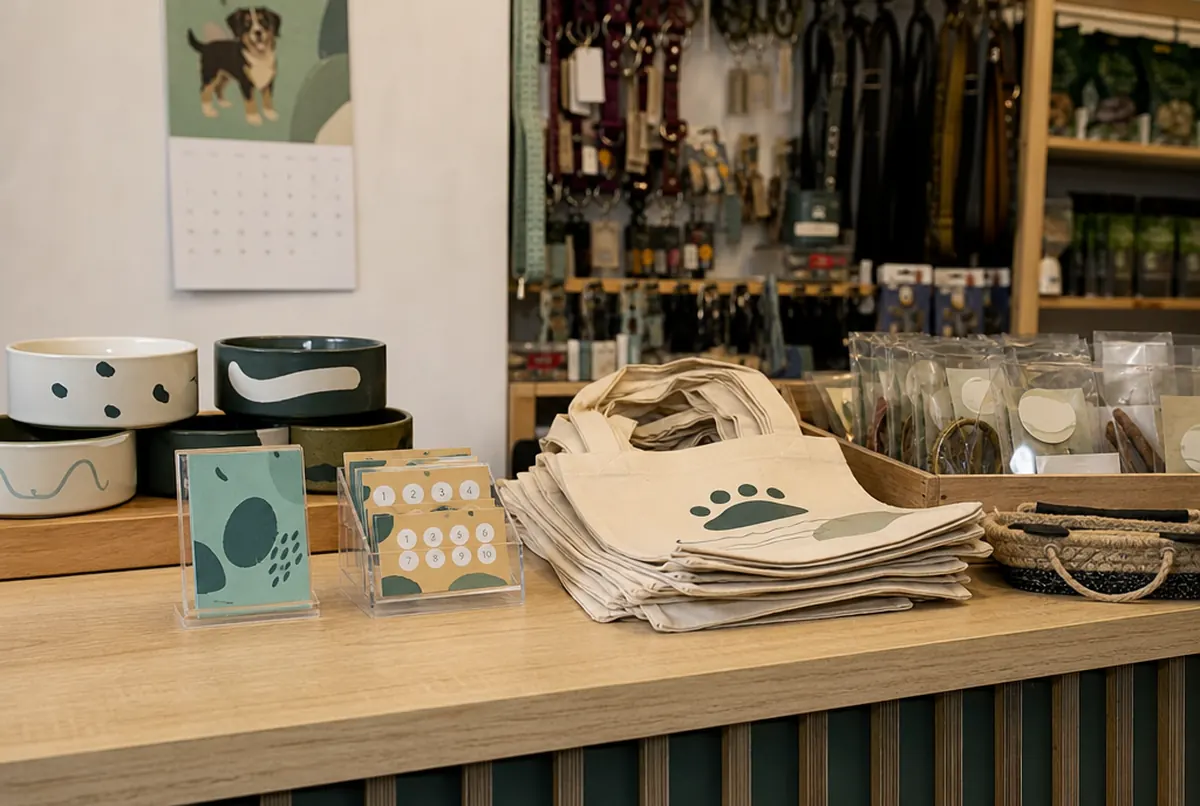
A dog owner buys food a dozen or more times a year. All you need is for them to come to you each time rather than the supermarket next door. Cheap branded items remind people of the shop for longer than a single leaflet.
- Numbered loyalty cards→Stamps for purchases or a numbered discount card. We print with sequential numbers or variable data.
- Branded cotton bags→For bags of food and shopping. Customers carry them for years. With a 1-colour print, 100 pcs from approx. €210 net.
- Calendar with customers' pet photos→A pet-of-the-month photo competition, and in December a calendar handed out at the till. Customers come in specially for it and show it to friends.
5. Pet shop chains
Chains and franchises receive campaigns centrally, but every shop has a different shelf layout. We prepare sets for each branch according to its own list (a different number of wobblers, a different window size) and ship everything on the same day.
- Campaign kits for every shop→Posters, wobblers, price cards and vinyls packed separately for each branch. Kitting approx. €3.30, multi-drop shipping approx. €2.80 net per site.
- 01Brief
Description, sizes, site photos and deadline — a few sentences are enough.
- 02Design and quote
Our designers prepare artwork or a visualisation and you get a price.
- 03Approval
You approve the design; for brand colours we provide a proof.
- 04Production
35+ machines in our own plant in Poland: 3.2 m UV print, CNC, laser, 3D, sewing.
- 05Installation or delivery
Own crews and vehicles across Europe, partner network, couriers worldwide.
To start with — an indicative package
An example for a shop of about 100 m² in a retail unit – easy to add to or take away from.
| Single-sided LED light box 300 × 60 cm (1.8 m² × approx. €320) | from approx. €576 net |
| 5 department signs 100 × 30 cm, 5 mm PVC, single-sided print (1.5 m² × approx. €39) | approx. €59 net |
| 20 floor paw prints approx. 30 × 30 cm with R10 laminate (1.8 m² × approx. €30) | approx. €54 net + contour cutting approx. €1.40/linear metre |
| Winder Midi 70 × 340 cm with cross base (approx. €75 + approx. €14) | from approx. €89 net |
| Cotton bags with 1-colour print, 100 pcs | from approx. €210 net |
| Installation – 2-person crew (approx. €42/hour, min. 4 hours) | from approx. €168 net + travel |
Indicative net prices; an exact quote follows a short description and photos of the site. Wobblers, stands and bins are quoted by shape and quantity.
From our experience — what to watch out for
- Give department signs a big animal pictogram and smaller lettering. The pictogram can be read from the other end of the shop; the words only up close.
- Always laminate floor stickers with anti-slip film. Ordinary vinyl at the entrance, where dogs come in with wet paws, becomes slippery and wears quickly.
- The aquatics department is darker and more humid. Use PVC or synthetic paper for price cards and descriptions there, not ordinary paper.
- Design wobblers and shelf stoppers without specific prices where possible. 'Food of the month' lasts a year; a wobbler with a price only until the next price change.
- Order next year's calendar in September or October – December gets busy, and a calendar handed out in January pleases nobody.