 Signs & Large Format Print
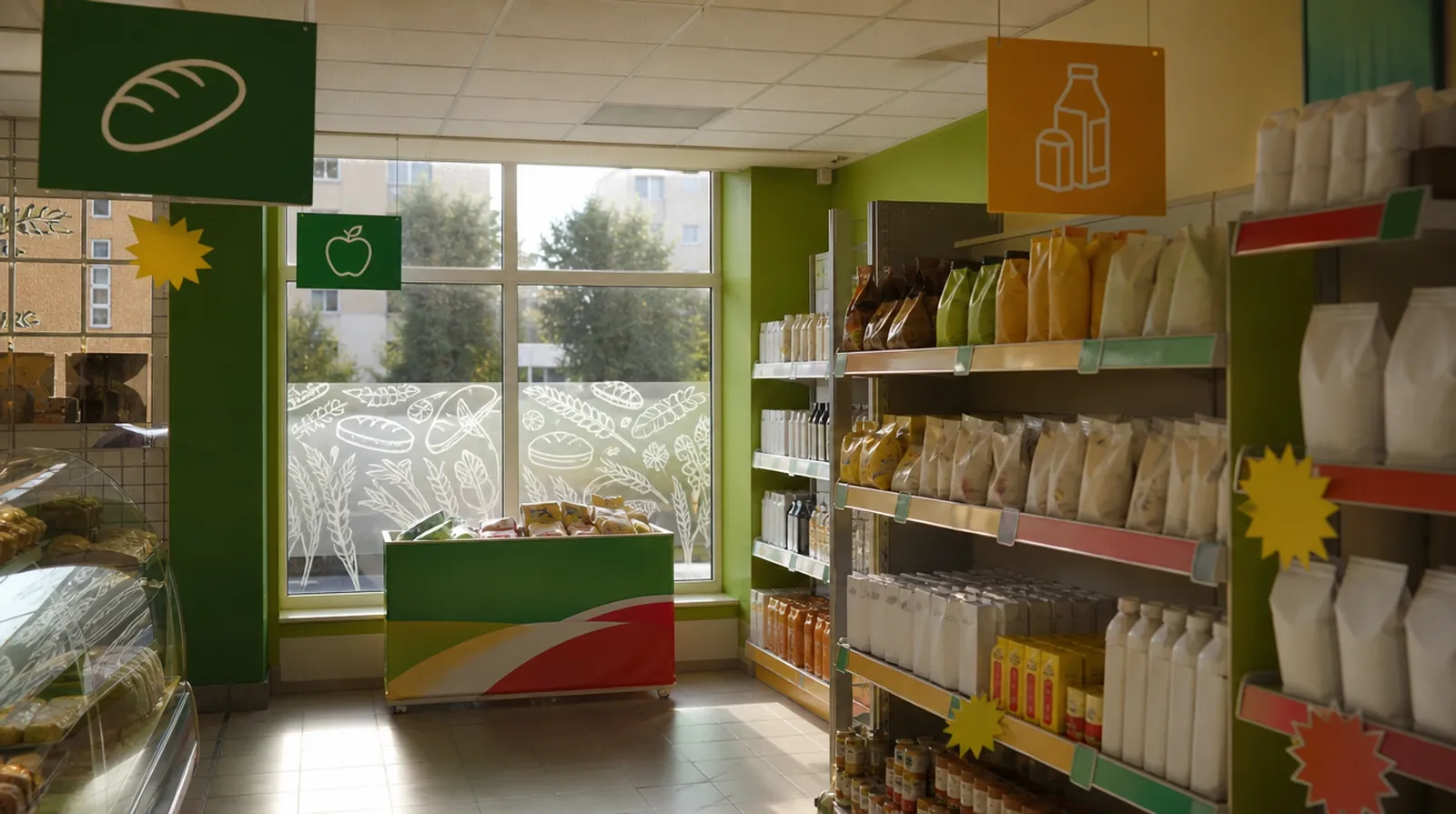 Illustrative visualisation
A grocery store wins on proximity and habit. A local customer comes in every day for bread and picks up whatever catches their eye between the door and the till. So in this trade an impressive fascia matters less than dozens of small displays on the shop floor: shelf strips, wobblers, promo bins, aisle hangers. They wear out, go missing and change every week along with the leaflet.
Outside the job is simple: the shop must be visible in the evening, and the window must not show the street the backs of shelving and cardboard boxes. For supermarkets and franchise chains there is consistency on top – the same message in a dozen stores, on the same day.
1. Facade and entrance
A neighbourhood shop is often on the ground floor of a block of flats or in a parade, where the frontage is narrow. A projecting sign at right angles then works better than a flat fascia. Opening hours on the door are the first thing customers ask about – especially around Sunday trading and bank holidays.
- Light box over the entrance→Shop name visible in the evening, when most customers come in after work.
- Double-sided projecting sign→For a shop in a block or a parade it can be seen from the pavement in both directions, even when the frontage is tucked away.
- Opening hours and information on the door→Vinyl with opening hours, card payments, holiday hours. Easy to replace when the hours change.
2. Shop windows
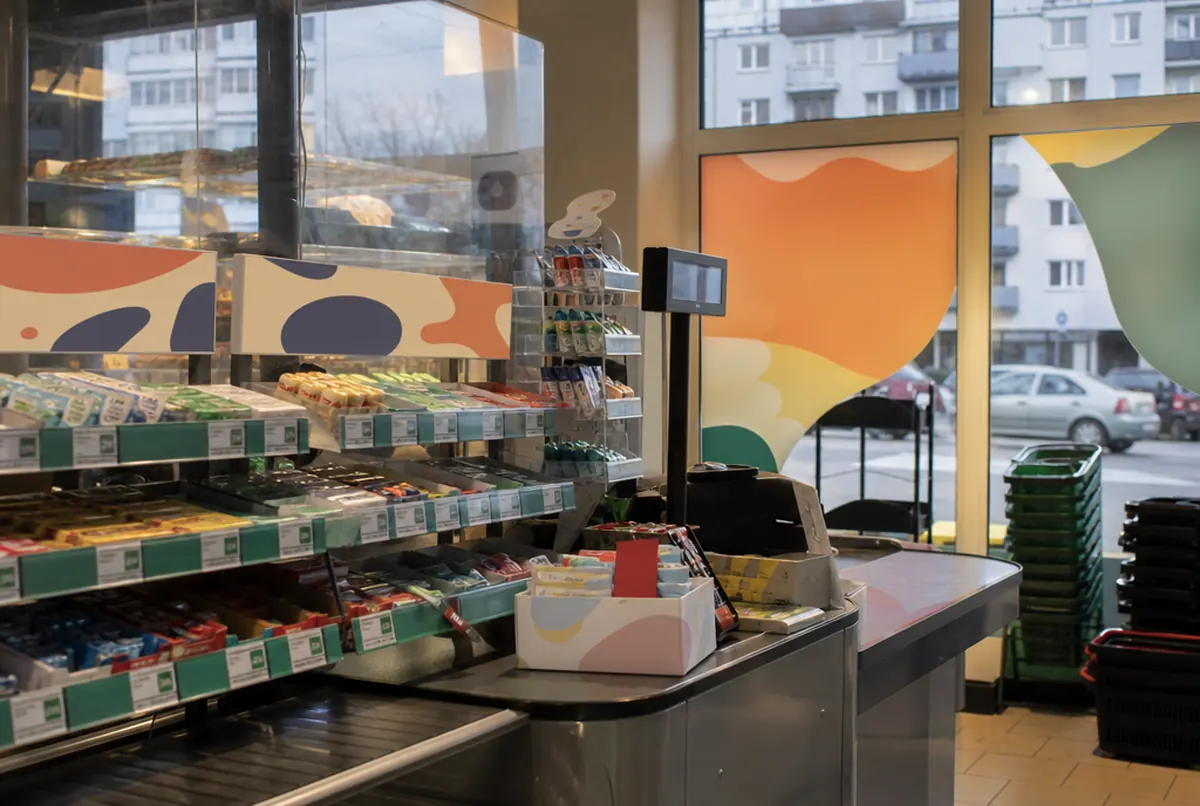
A grocery store window usually loses out to the shelving – from the street you see the backs of the shelves and boxes. Instead, cover the lower band with printed vinyl and keep the upper part for posters with the week's offers.
- Window graphics that hide the shelving→Printed vinyl (vegetables, bread, the shop name) hides the back of the shelving and keeps the window tidy. The interior is still visible through the upper glass.
- Posters with the week's offers→A2 or A1 behind the glass or in a frame by the entrance. Short runs are printed digitally, so even 10 copies make sense.
3. Shop floor
This is where there is most to do and the most consumables. Shelf strips get dirty and peel, wobblers break against trolleys, hangers fade under the fluorescent lights. It pays to keep a stock and one consistent design for the whole store, rather than every item looking like it came from a different shop.
- Aisle hangers with department names→Bakery, dairy, household – suspended signs over the aisles. Customers find products without asking staff.
- Shelf-edge and price strips→A strip along the shelf edge in the promotion or brand colour. On synthetic paper that can be wiped clean.
- Wobblers and shelf stoppers→They stick out from the shelf at right angles and catch the eye along the aisle. The cheapest way to make an offer stand out.
- Printed dump bins→For volume promotions – drinks, sweets, seasonal products. Cardboard, for the duration of the campaign.
- Counter displays at the till→Chewing gum, batteries, small confectionery. A cardboard or acrylic counter display sells while people queue.
- Floor graphics→Arrows to offers, queue markings at the till. R10 anti-slip laminate is essential here.
4. Own products and bags
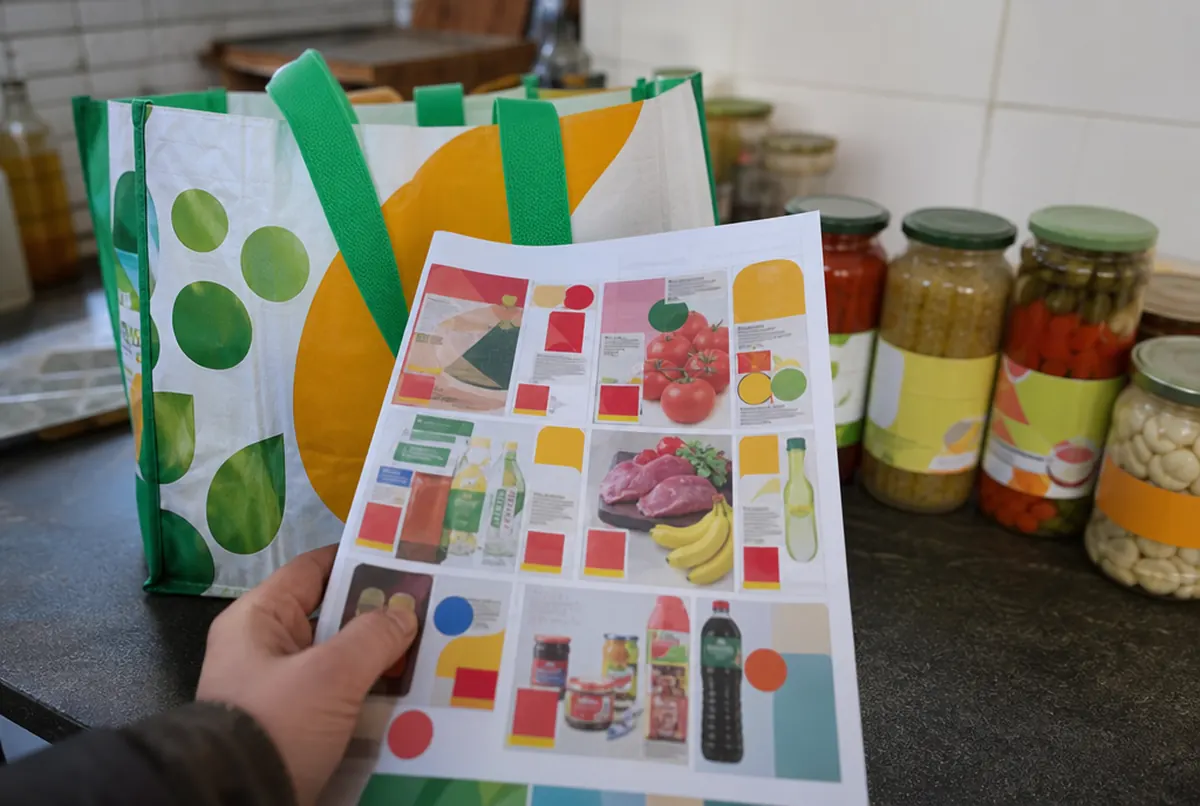
Many shops have a deli counter, ready meals, their own baking or salads. A proper label with the shop name looks far better than handwriting on cling film. A branded reusable bag stays with the customer for years, and goes with them to your competitors.
- Labels for own-made products→Salads, cakes, sliced meats. Labels with fields for date and weight; agree the required information with your food safety authority or scale supplier.
- Branded reusable bags→A printed cotton bag as an add-on to the shopping or as part of a loyalty scheme.
5. Leaflets and store chains
A promotional leaflet still brings people into the shop, especially older customers. With a chain of several or a dozen stores, logistics comes on top of printing: every store gets its own set, on time, without phone calls about missing items.
- Promotional leaflets→4–8 A4 pages every two weeks or once a month. With a fixed rhythm we plan the dates ahead.
- Campaign kits for every store→Wobblers, posters, shelf strips and leaflets packed separately for each address and sent by courier on the same day.
- 01Brief
Description, sizes, site photos and deadline — a few sentences are enough.
- 02Design and quote
Our designers prepare artwork or a visualisation and you get a price.
- 03Approval
You approve the design; for brand colours we provide a proof.
- 04Production
35+ machines in our own plant in Poland: 3.2 m UV print, CNC, laser, 3D, sewing.
- 05Installation or delivery
Own crews and vehicles across Europe, partner network, couriers worldwide.
To start with — an indicative package
Indicative prices for the most frequently ordered items for one store. For a chain, kitting and shipping per store are added.
| Single-sided LED light box 400 × 70 cm (2.8 m² × from approx. €320) | from approx. €896 net |
| Printed window vinyl, 6 m² (6 × approx. €8) | approx. €48 net + fitting |
| A2 posters, 170 g silk, 10 pcs | approx. €28 net |
| Shelf strips on synthetic paper | approx. €10–16 net / m² |
| Wobblers in 0.8 mm HIPS | approx. €16–24 net / m² |
| A4 leaflet, 8 pages, 1,000 pcs | approx. €280 net |
| Cotton bags with 1-colour print, 100 pcs | from approx. €2.10 net / pc |
Indicative net prices; an exact quote follows a short description and photos of the site. For chains: kitting approx. €3.30 and shipping approx. €2.80 net per store.
From our experience — what to watch out for
- Don't cover the whole window. Customers want to see that it is bright and clean inside – cover the lower band and leave the upper part clear.
- Order hangers and shelf strips in one style and colour. Five different typefaces on the shop floor look like a mess.
- Order 20–30% extra wobblers and strips. Some will be damaged during restocking and shelf cleaning.
- Always laminate floor graphics with anti-slip film. Details in our article on [floor stickers](/poradnik/naklejki-podlogowe).
- For fortnightly leaflets agree a fixed schedule with us: artwork deadline, print, delivery. Then nothing happens at the last minute.