 Signs & Large Format Print
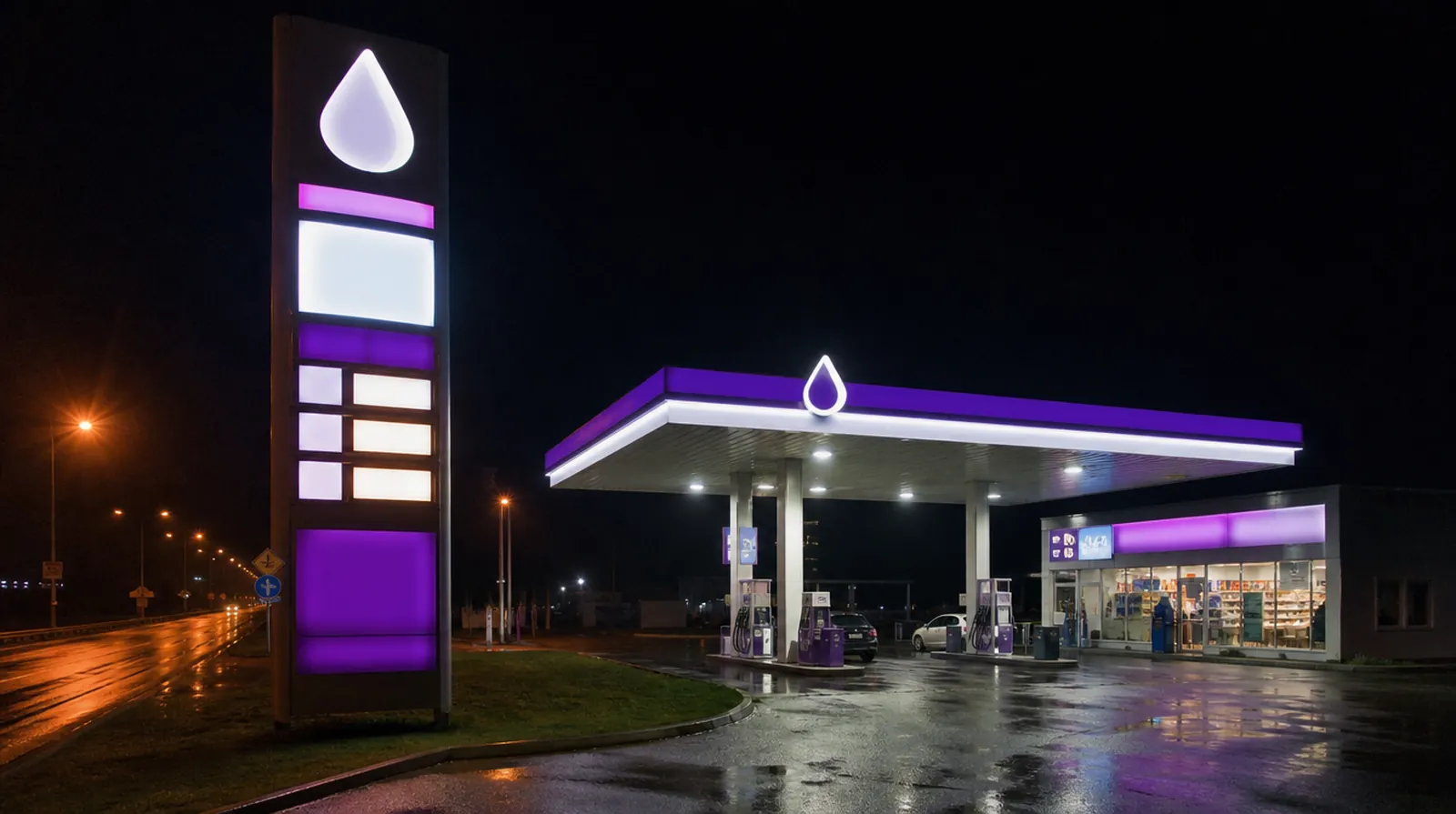 Illustrative visualisation
A petrol station is open from early morning to late at night, often 24 hours. Advertising has to be readable from a moving car, resistant to rain, sun and the jet wash, and replaceable without switching off the pumps. A driver decides to pull in within seconds, so the pylon and a lit canopy are the basics. The money, though, is made in the shop: coffee, a hot dog, screenwash. That is where wobblers, posters, the menu above the counter and floor signage do their job.
Network stations have their own brand manuals and campaign schedules. What counts there is consistent colour at every site, ready packs for each station and night-time installation. Independent stations usually need fewer elements, but well chosen ones – we cover both cases below.
1. Entrance and road
Here the winner is whoever is seen first. The pylon is placed so that the driver sees it before the slip road, not alongside it. Free-standing structures need foundations and permissions, so we produce the technical drawing before manufacturing.
- Double-sided illuminated pylon→Logo and name visible from both directions all night. We design the structure, face and lighting for the specific location.
- Flagpole flags→Flags with the logo or a campaign at the entrance – cheap to replace, and the movement catches the driver's eye.
- Directional signs on the forecourt→Car wash, air and water, HGV parking, exit. Signs on frames organise traffic on site.
2. Canopy and pumps
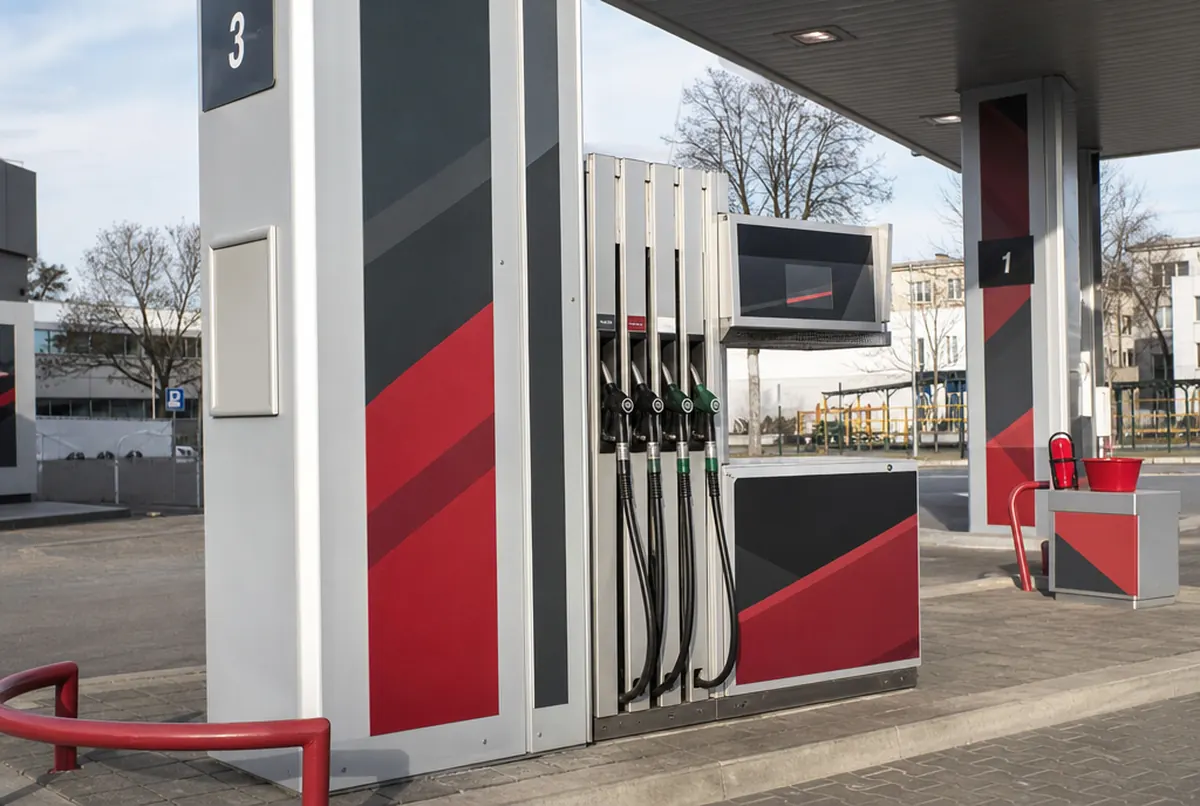
The canopy fascia can be seen from afar, by day and at night under the lights. Vinyl on the canopy and pumps works in harsh conditions: fuel, car wash chemicals, sun. That is why we use polymeric films with longer durability instead of the cheapest monomeric ones.
- Canopy fascia wrap→Brand colours and logo along the whole canopy. Polymeric vinyl holds its colour for 5–7 years.
- Canopy column graphics→Car wash offer, coffee for loyalty points, pay-by-app – drivers look at the column while they fill up.
- Pump numbers and pump messages→Large cut-vinyl numbers and message stickers. At the till the customer knows which pump they are paying for.
- New light box faces for a rebrand→Faded or outdated faces are replaced with new backlit film faces, without putting up a new structure.
3. Forecourt shop and coffee point
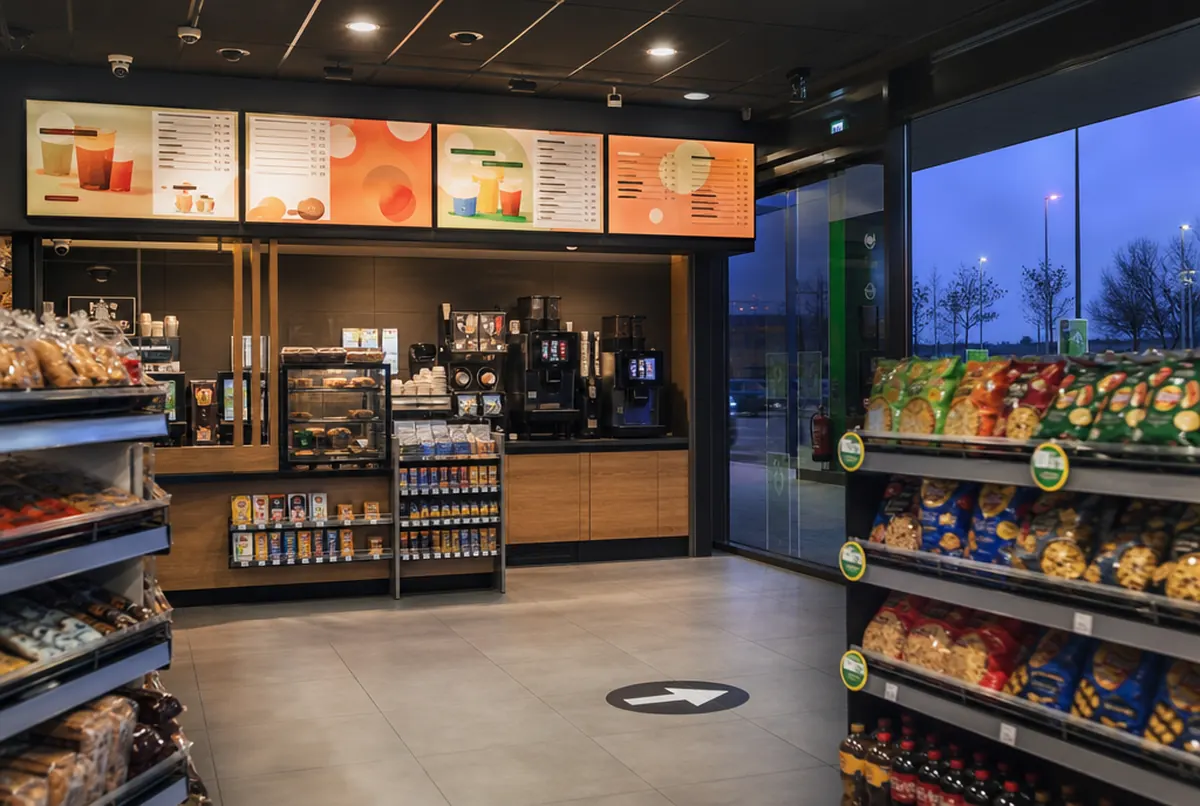
A forecourt shop sells on impulse. The customer comes in to pay for fuel and has a minute to decide on a coffee or a snack. The message has to be in their path: on the door, on the floor to the till, on the shelf, above the counter. These elements change with every campaign, so fast reprints matter.
- Window and door graphics→Opening hours, coffee offer, promotion of the month. On large glazing often One Way Vision film.
- Wobblers and shelf stoppers→Make promoted products stand out on the shelf. In HIPS they last the whole campaign.
- Shelf-edge strips→A message along the full length of the shelving, changed together with the promotional leaflet.
- Coffee and food menu in backlit frames→An ultra-slim LED frame above the counter, with the graphic changed when the offer changes – no electrician needed.
- Floor graphics→Path to the till, toilets, coffee area. R10 anti-slip laminate is a must here, as the floor is often wet.
- Station-branded cups→A printed travel mug is both merchandise and a loyalty scheme – cheaper coffee in your own cup.
4. Campaigns for station networks
With dozens of stations the biggest cost is not print but logistics and mistakes: the wrong pack, a missing wobbler, a colour different from the station down the road. That is why we print the whole campaign in one place, on the same materials, and pack separately for each site according to the list.
- Campaign kits for every station→A pack labelled with the station address, with the full set of materials and instructions on where everything goes. Multi-drop courier delivery.
- Rollout with installation and photo report→Crews install at night or off-peak, and head office receives photos from every site.
- 01Brief
Description, sizes, site photos and deadline — a few sentences are enough.
- 02Design and quote
Our designers prepare artwork or a visualisation and you get a price.
- 03Approval
You approve the design; for brand colours we provide a proof.
- 04Production
35+ machines in our own plant in Poland: 3.2 m UV print, CNC, laser, 3D, sewing.
- 05Installation or delivery
Own crews and vehicles across Europe, partner network, couriers worldwide.
To start with — an indicative package
Indicative prices for the items stations order most often. For networks we quote the whole campaign, with a cost per site.
| Double-sided illuminated pylon, 3 m high (excluding foundation) | from approx. €2,070 net |
| Flagpole flag 150 × 90 cm, hemmed, with snap hooks | from approx. €45 net |
| Printed polymeric vinyl for the canopy | approx. €9–16 net / m² |
| Ultra-slim LED A1 light box with menu above the counter | from approx. €165 net |
| Wobblers and shelf stoppers in 0.8 mm HIPS | approx. €16–24 net / m² |
| Kitting a campaign set + multi-drop shipping | approx. €3.30 + approx. €2.80 net / site |
| Night-time / out-of-hours installation | from approx. €65 net / hour |
Indicative net prices; an exact quote follows a short description and photos of the site. For network campaigns we give a cost per site.
From our experience — what to watch out for
- Before ordering a pylon, check with the local authority whether planning restrictions or advertisement consent rules apply to that location. General principles are in our article [does a sign need permission](/poradnik/czy-szyld-wymaga-pozwolenia).
- Don't skimp on the vinyl for pumps and canopies. Monomeric film exposed to fuel and the jet wash quickly loses colour and starts lifting at the edges.
- Always use anti-slip laminate on shop floor graphics. In winter customers bring in snow and mud.
- For network campaigns send us a list of stations with addresses and the sizes of the displays at each. One spreadsheet saves weeks of phone calls.
- Plan 5–10% spare material for a campaign. Something always gets damaged during installation, or a new station is added.