 Signs & Large Format Print
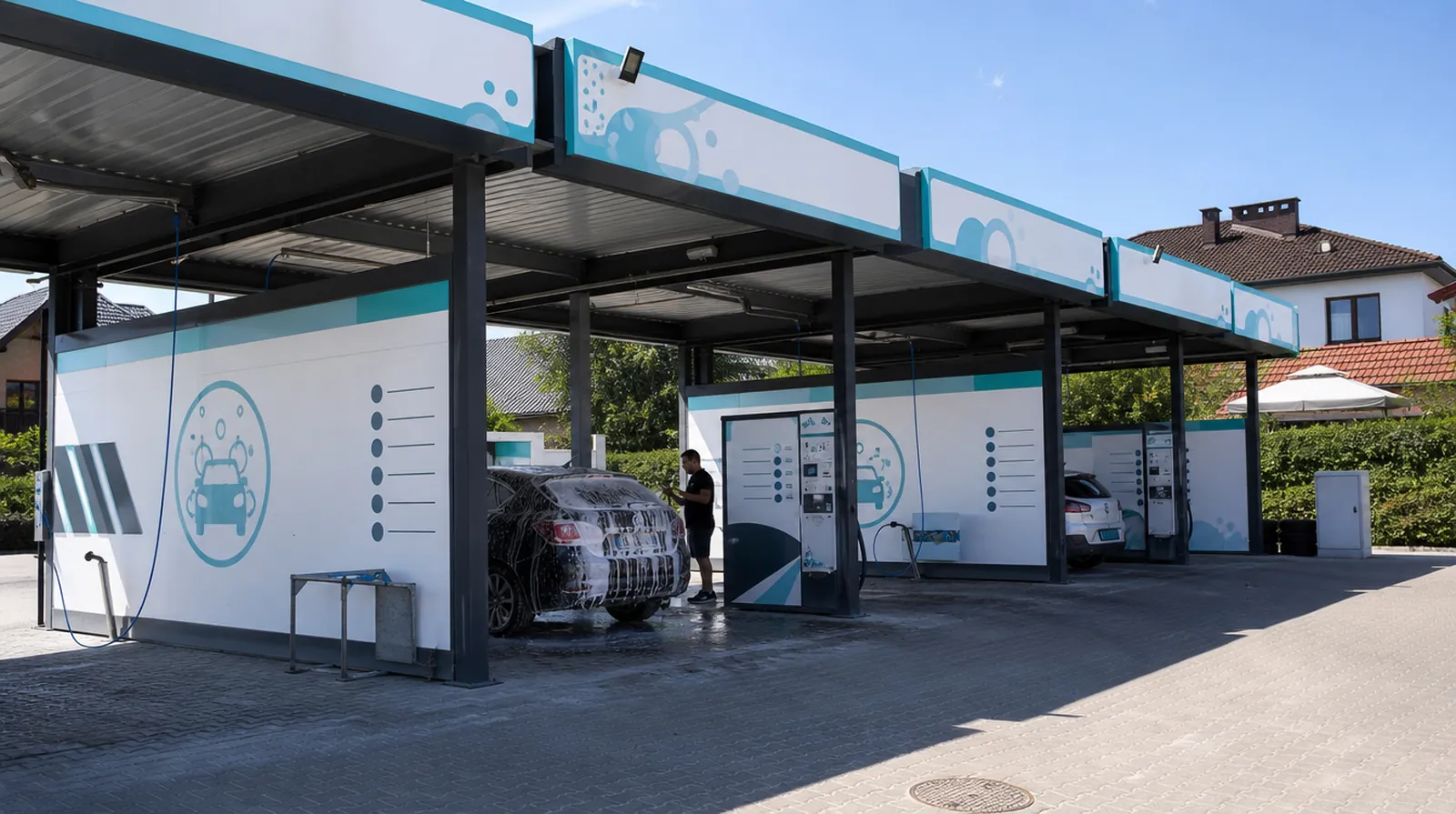 Illustrative visualisation
A car wash is the toughest place for signage we know of in the motor trade. Pressurised water, active foam, road salt in winter, frost, and sun in summer. A sign that would last ten years in an office looks fire-damaged after one season in a wash bay. That is why material choice matters more here than anywhere else: dibond instead of PVC, polymeric films, edges sealed against water creeping underneath.
The second point: a customer at a self-service wash is on their own. Nobody explains which programme to choose and what it costs. A clear instruction panel in the bay shortens the queue and cuts down on complaint calls. Hand car washes and detailers, on the other hand, live off regulars – this is where loyalty cards and gift vouchers come in.
1. Road and entrance
People often choose a car wash on impulse, while driving past. The driver has to see from afar that it is a car wash, whether it is open and roughly what it costs. Prices on the totem at the entrance work better than the nicest logo.
- Totem with name and programme prices→Stands by the road and is visible from a distance. Prices for the basic programmes answer the driver's first question straight away.
- Feather flags at the entrance→A few flags in the car wash colours – the cheapest way to make the site visible from the street.
- Banner on the fence or plant room wall→New programme, wax, underbody wash. A banner can be swapped every season for very little money.
2. Self-service bays
Everything hanging in a bay gets hit by water and chemicals. We make signs from dibond with UV print, bay wall graphics from polymeric vinyl, and we round the corners of stickers so the jet doesn't lift them. The light box over the bay entrance needs a sealed power supply – we fit IP67.
- Light boxes over the bays→Logo and bay number lit after dark. The car wash looks open and safe in the evening too.
- Bay walls and canopy fascia wrap→Brand colour and graphics across the whole site. Polymeric vinyl withstands chemicals and washing much longer than monomeric.
- Programme instructions in the bay→Programme order, time, price, pictograms. A dibond panel with UV print doesn't delaminate from water.
- Bay numbers→Large cut-vinyl digits visible from the entrance – the customer sees straight away which bay is free.
- Stickers for payment terminals→Payment methods, card, app, change. After the instructions, the terminal is the next place the customer looks.
3. Hand car wash and detailing
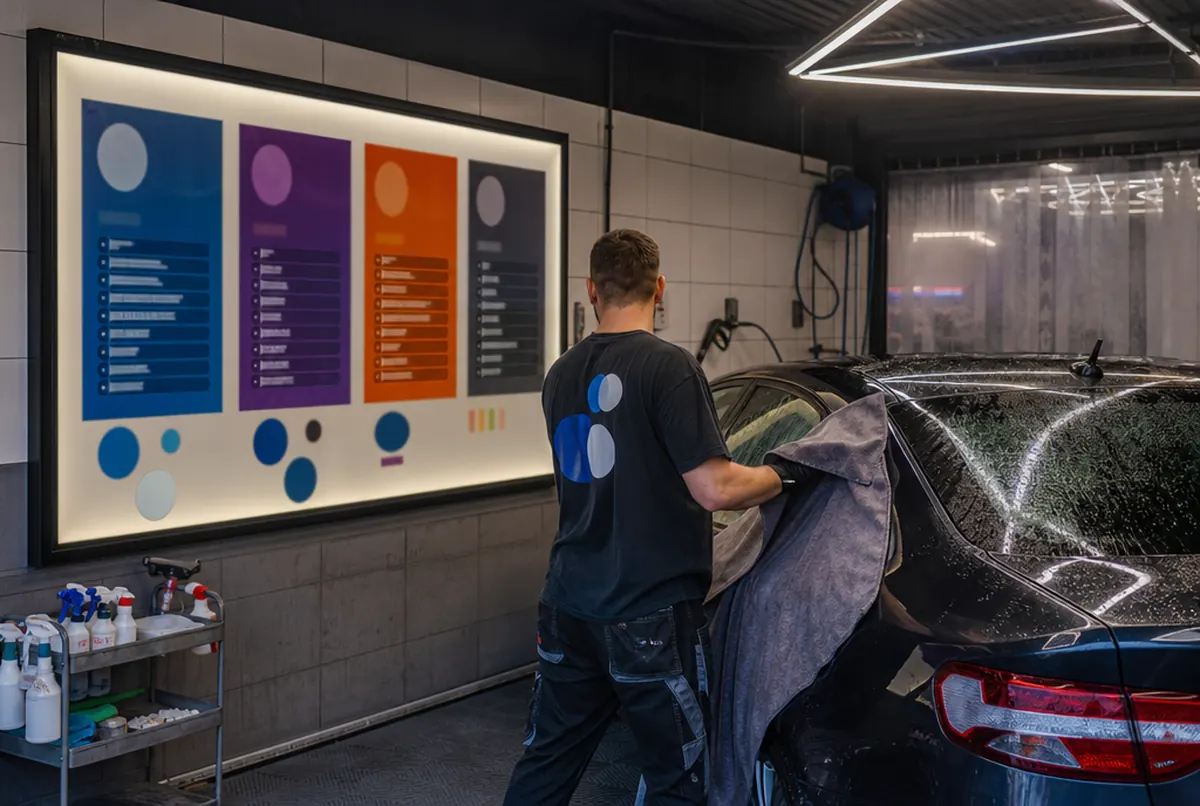
Here the customer waits, talks to the staff and compares packages. The price list must be clear and the staff easy to recognise. A small final touch (a hanger in the clean car) reminds them of you next time.
- Package price list in a backlit frame→Basic wash, upholstery cleaning, waxing, ceramic coating. An LED frame with a changeable graphic when prices change.
- Hanger in the clean car→A mirror hanger with the car wash name and a discount code for the next visit.
- Staff clothing→Branded T-shirts and sweatshirts. At a hand wash the customer sees the staff throughout the wash.
4. Regulars and the season
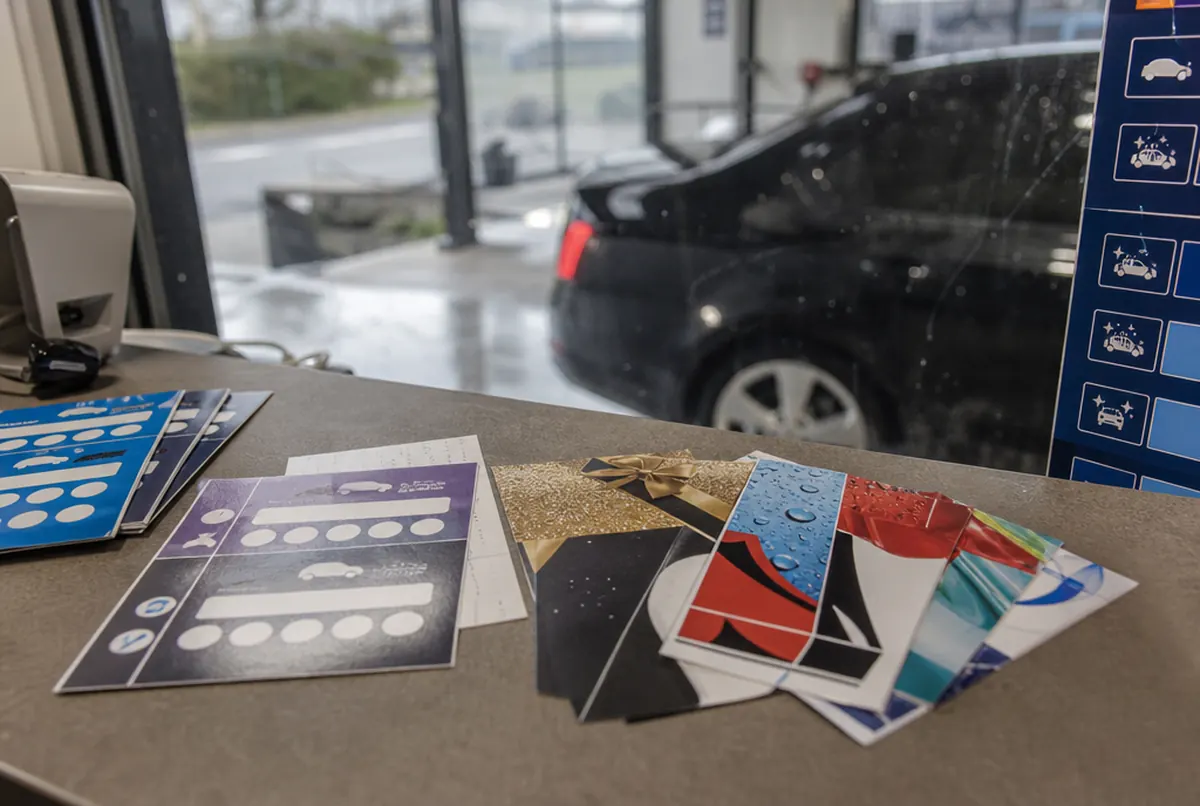
A car wash has two peaks: spring after the winter and autumn before it, plus every day after sandy rain. In between, regulars keep it going. Stamp cards and vouchers are a cheap way to make them come back to you rather than the competitor round the corner.
- Loyalty cards with perforation→Every tenth wash free – a card with stamp boxes or tear-off coupons.
- Gift vouchers→A detailing package as a Christmas or Father's Day present. Numbered voucher with an expiry date.
- Price list leaflets→To hand out at the nearby petrol station, garages and companies with fleets. A DL leaflet holds the price list and a location map.
- Winter banner: underbody wash after salt→A seasonal message that sells extra programmes in winter. The same banner comes back every year.
- 01Brief
Description, sizes, site photos and deadline — a few sentences are enough.
- 02Design and quote
Our designers prepare artwork or a visualisation and you get a price.
- 03Approval
You approve the design; for brand colours we provide a proof.
- 04Production
35+ machines in our own plant in Poland: 3.2 m UV print, CNC, laser, 3D, sewing.
- 05Installation or delivery
Own crews and vehicles across Europe, partner network, couriers worldwide.
To start with — an indicative package
Prices for the items most self-service car washes start with. For a site with several bays we quote the full set.
| Non-illuminated totem, dibond on a steel frame, 2.5 m high | from approx. €750 net |
| Single-sided LED light box 200 × 50 cm over a bay (1 m² × from approx. €320) | from approx. €320 net |
| 3 mm dibond signs with UV print (instructions, site rules) | approx. €35–55 net / m² |
| Printed polymeric vinyl for the bays | approx. €9–16 net / m² |
| Winder Maxi 90 × 440 cm (pole + flag) | from approx. €125 net |
| Perforated coupons 55 × 170 mm in pads, 1,000 pcs | approx. €75 net |
Indicative net prices; an exact quote follows a short description and photos of the site. Light box connection – by the client's electrician or by our qualified crew.
From our experience — what to watch out for
- Don't make bay signs from foam PVC. In a car wash it swells and warps after one season. Material comparison: [dibond or PVC outdoors](/poradnik/tablice-dibond-czy-pcv-na-zewnatrz).
- Design programme instructions for someone seeing them for the first time, in the rain, lance in hand. Big numbers, pictograms, few words.
- Make the prices on the totem changeable panels, not printed on the whole face. When prices change you only replace one piece.
- Check a car wash light box for water tightness once a year. Water in the power supply is the most common cause of failure.
- Replace roadside flags before they fray. A faded flag at a car wash signals that nobody looks after the place.