 Signs & Large Format Print
Lifespan by vinyl type
| Vinyl | Outdoor life | Net print price/m² | Sensible use |
|---|---|---|---|
| Monomeric | approx. 2–3 years | approx. €6–12 | Promotions, seasons, events, shop windows |
| Polymeric | approx. 5–7 years | approx. €9–16 | Signs, boards, crates, trailers with flat sides |
| Cast | approx. 8–10 years | approx. €19–29 | Vehicles, recesses, long-term signage |
| One Way Vision | a campaign film | approx. €10–18 | Shop windows, rear vehicle windows |
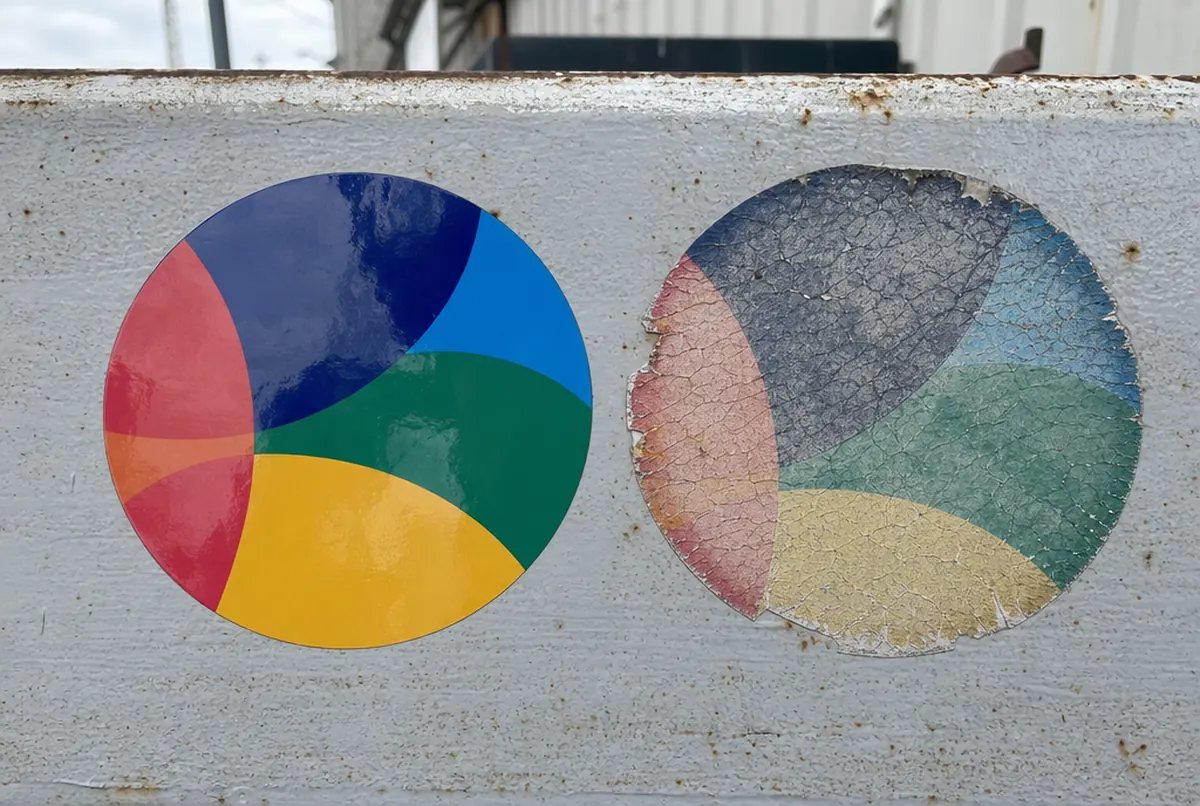
"Lifespan" here means the time during which the vinyl stays bonded and does not lose colour noticeably. After that, a sticker does not usually fall off overnight: first it fades, then it hardens, the edges start to lift, and finally the vinyl cracks and becomes hard to remove. That is why for longer displays it is worth choosing a stronger vinyl from the start: removing an expired graphic can cost more than the price difference. A detailed comparison is in cast, polymeric or monomeric vinyl.
What shortens a sticker's life: a list from our practice
- South-facing sun. A wall or vehicle side facing south gets the most UV. The same vinyl on the north side looks good for longer.
- Colours. Intense reds, oranges and yellows fade more visibly than blacks and navies. A solid red logo on a sunny wall looks different after a few years from the same logo in the shade.
- Surface. Rough render, masonry paint, concrete, unvarnished wood, plastics with silicone additives: the adhesive has nothing to hold on to. Glass, car paint, Dibond and sheet metal hold best.
- Fitting in the cold. Adhesive needs warmth to bond. A sticker applied in frost may look fine, then lift at the edges a month later.
- Washing. Brush car washes and a pressure washer aimed at the edges tear vinyl off faster than years of rain.
- Salt and road chemicals: on the lower parts of vehicles and on roadside boards.
- Edges and rivets. A sticker cut across a door edge or laid over a rivet without the right vinyl and technique lifts there first.
How to extend lifespan: 6 decisions before ordering
- Choose the vinyl for the duration, not the budget. For a year: monomeric. For five years: polymeric. For a vehicle and many years: cast.
- Consider laminate where there is friction. UV print is durable without laminate, but on vehicles, machines and surfaces touched by hands, polymeric laminate (approx. €8/m²) protects the print from abrasion. In public spaces, anti-graffiti laminate (approx. €10/m²) works well.
- Apply it to the right surface. If the wall is rough, it is better to print the graphic on a board (Dibond or PVC) and screw it to the wall. Choosing a board is covered in acrylic, Dibond or PVC for a sign.
- Fit in the warm: at above-zero temperatures, on a dry surface, ideally within the range the vinyl manufacturer specifies for application.
- Prepare the surface: wash, degrease with alcohol, remove old adhesive, wax and silicone.
- Give the adhesive time. Do not wash the sticker for the first few days, and keep the vehicle out of the car wash for at least a week.
Instructions for applying it yourself are in how to apply vinyl without bubbles.
A sticker inside behind glass: why it lasts longer
Glass blocks some UV radiation, and a sticker on the inside is not exposed to rain, frost or a cleaning brush. So a monomeric sticker behind glass looks good for much longer than the same 2–3 years outdoors.
There is one condition: artwork applied from the inside is printed mirror-reversed, and with full colour we add a white layer so the image is opaque. Mention this when ordering and we will prepare the file accordingly. When the graphic needs to be visible from both sides of the glass, double-sided window stickers are the answer.
- 24 hexpress printing (UV inks need no drying)
- approx. 3 daysstandard lead time
- up to 14 dayslarge and custom projects with installation
Plus courier delivery. Tell us your date — we plan production around it.
When to replace a sticker before it replaces itself
Signs that it is time for a new graphic:
- colours have clearly greyed and the white has turned yellowish;
- the vinyl is stiff and dull to the touch, though it used to be glossy;
- micro-cracks appear, especially at the edges and where the vinyl was stretched;
- edges lift and collect dirt.
At this stage the vinyl usually still comes off in sheets. In a year or two it may crumble into small pieces, leaving adhesive on the glass or paintwork; we cover this in how to remove old vinyl and adhesive from glass. We replace graphics, including removal of the old ones, in one crew visit.
We print all vinyls in-house in Wieluń using UV technology. The full offer is on the monomeric and polymeric vinyls page and in the contour-cut stickers section.