 Signs & Large Format Print
Before you start: check what you are dealing with
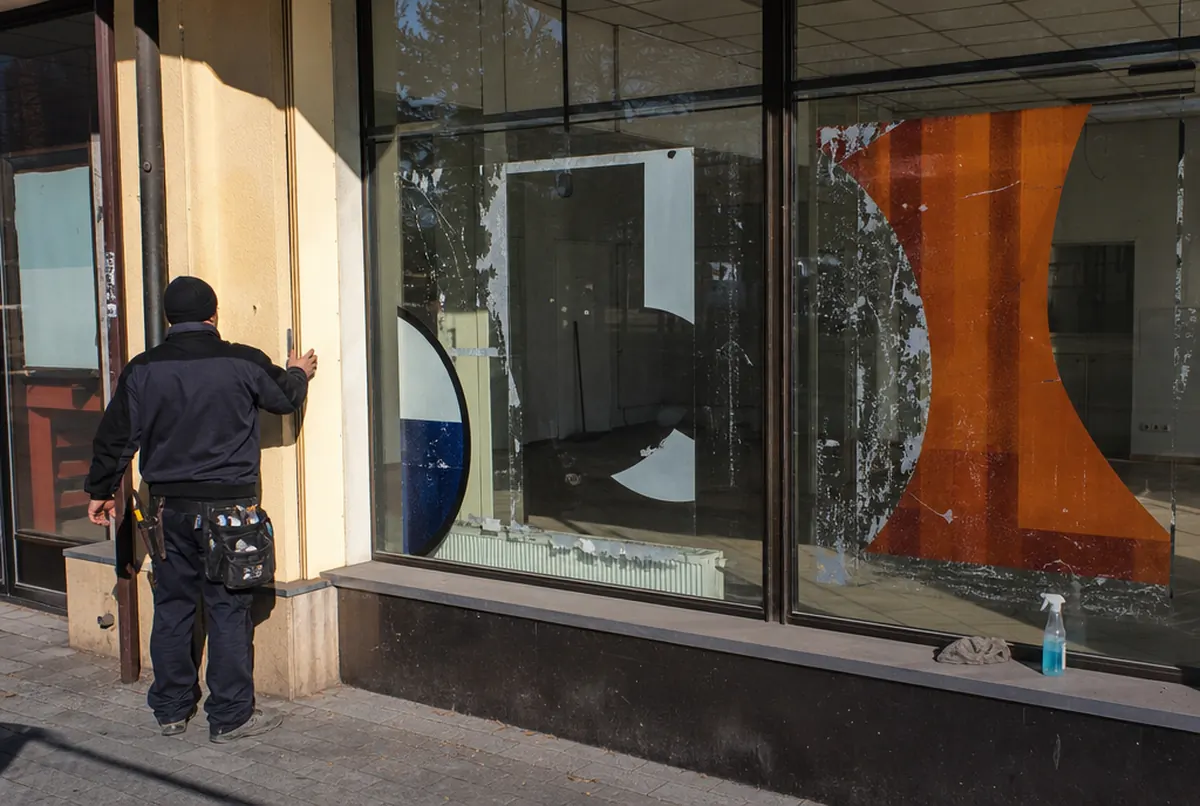
The same method does not work on every vinyl. A few minutes' inspection tells you how much work lies ahead.
- Vinyl one or two years old, still flexible: usually comes off in one piece, and after warming often without a trace.
- Vinyl after 5+ years in the sun: stiff, cracked, comes off in flakes a few centimetres across. Almost all the adhesive stays behind. This is the most tedious case.
- One Way Vision: perforated, it tears along the holes; pull it slowly and in a wide strip.
- Cut lettering: small pieces, but quick; most of the work is the adhesive around the outlines.
Also check the glass. On a car's rear window there are heating elements, and a blade will cut them. On coated glass, plastic covers and polycarbonate, do not use a blade or strong solvents either.
What you need
- a hairdryer or an adjustable heat gun (on the lowest setting);
- a scraper with a replaceable razor blade and a plastic scraper;
- a spray bottle of warm water with a drop of washing-up liquid;
- adhesive remover or isopropyl alcohol, or failing that, white spirit;
- paper towels or microfibre cloths;
- gloves and, with a heat gun, a little common sense.
You do not need acetone. It dissolves adhesive, but also seals, frame paint and plastic trims.
Step by step
- Choose the day. It is easiest in warm weather, with the glass above about 10°C. In winter, on frosty glass, do not heat one spot hard: a sudden temperature difference is bad for the glass.
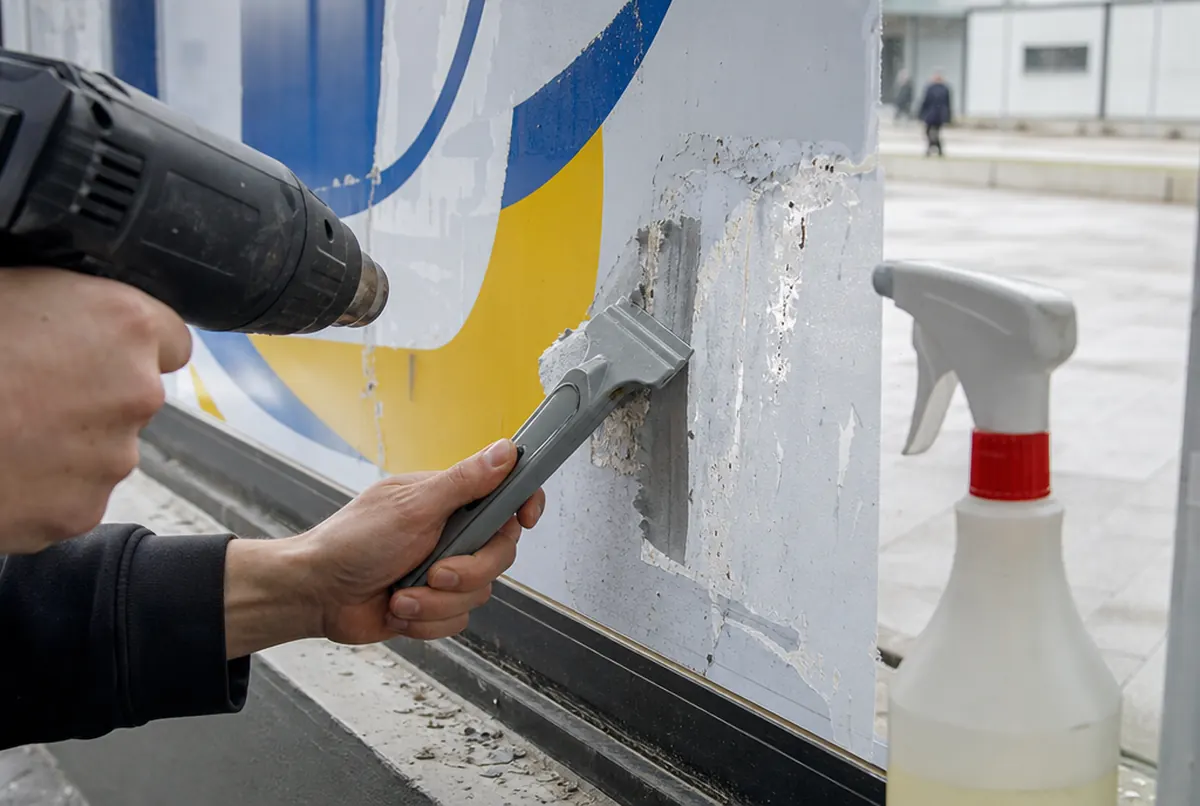
- Warm a section of about 30 × 30 cm from a distance of a dozen or so centimetres, with a circular motion, until the vinyl is soft and warm to the touch (not hot).
- Lift a corner with a fingernail or a plastic scraper.
- Pull low, almost parallel to the glass, at an angle of about 150–180°, slowly, keeping the peel point warm. A quick yank leaves more adhesive.
- Brittle vinyl: remove it with the razor scraper held flat (about 30° to the glass) on a wet surface. Dry, it is easy to scratch the glass with grit.
- Adhesive: spray with remover or alcohol, wait a minute, then collect it with the scraper and a towel. With a thick layer, repeat 2–3 times.
- Wash the glass with soapy water, then degrease with alcohol, especially if you are applying new graphics straight away.
If you are preparing the glass for new vinyl, also read how to apply vinyl yourself without bubbles.
Problems and solutions
| Problem | Cause | What to do |
|---|---|---|
| Vinyl tears into small pieces | Old, hardened by UV | More heat, wet scraping, patience, or hire removal |
| Adhesive smears instead of coming off | Too little remover, not left long enough | Soak again, lift with a towel, do not rub |
| Streaks after washing | Dissolved adhesive and detergent residue | Wash again with clean water, finish with alcohol |
| A "ghost" of the old graphic | The glass around the vinyl was dirtied and cleaned differently for years | Clean the whole pane thoroughly; new graphics usually cover it |
| Scratches on the glass | Dry scraping or the blade at the wrong angle | Prevention: always wet, blade flat, change blades often |
- 24 hexpress printing (UV inks need no drying)
- approx. 3 daysstandard lead time
- up to 14 dayslarge and custom projects with installation
Plus courier delivery. Tell us your date — we plan production around it.
What if the vinyl is on paintwork, a door or a sign board, not glass?
The principle is the same (heat, a low angle, patience), but the tools differ. On car paintwork and painted doors never use a razor blade; stick to heat, a plastic scraper and an adhesive remover safe for paint. After removing vinyl from a vehicle that has carried graphics for several years, you often see a difference in paint shade: the area under the vinyl was protected from the sun. That is normal and usually evens out with polishing, but it is good to know before deciding to remove a wrap.
On PVC and Dibond boards, removing old vinyl can cost more than a new board, so we usually advise printing the new graphic directly onto a new panel. On wood and furniture boards a strong solvent can damage the veneer, so always test on a hidden spot first.
When it is better to hire someone, or not remove it at all
You can take a few letters off a door in 20 minutes. A 10 m² shopfront covered in eight-year-old vinyl is many hours of work, sometimes a whole day. Then hiring it out is usually cheaper: removal of old signage with disposal is charged from approx. €16 net/m², and if we apply new graphics at the same time, it is done in one crew visit (approx. €42 net per hour, travel approx. €1/km both ways from Wieluń).
Sometimes the old vinyl does not need removing at all. If it is well bonded and only the content is changing, it can be covered with new grey-adhesive vinyl (blockout, approx. €8–14 net/m²), which fully hides what is underneath. We do not recommend this on vinyl that is already cracking or lifting: the new layer will come off with the old.
We quote new window graphics from measurements and a photo; see shop window graphics and the guide how much do shop window graphics cost.