 Signs & Large Format Print
How these vinyls differ, in plain terms
Monomeric and polymeric vinyls are calendered: PVC rolled out between rollers into a thin sheet. Such vinyl remembers being stretched and over time wants to return to its original shape. On a flat surface this does not matter, but pressed into a recess or stretched over a curve, after a few weeks it starts to lift. Monomeric shrinks noticeably; polymeric, thanks to long-chain plasticisers, much less.
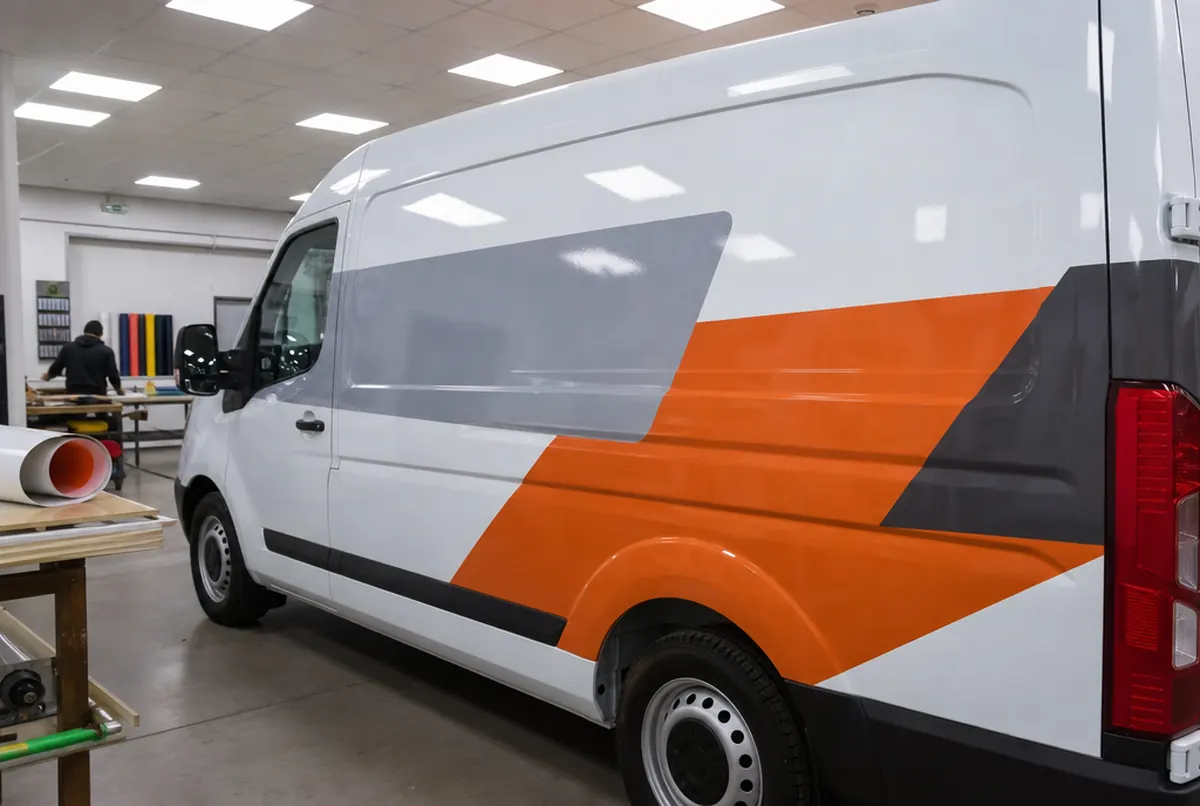
Cast vinyl is made differently: a liquid compound is cast onto a carrier and dried. It has no stresses and no shape memory. It is thinner (ours is 50 µm, against 80 µm for calendered vinyls) and can be laid into recesses, around rivets and over bumpers. That is why it is the standard for vehicle wrapping.
Comparison in one table
| Monomeric | Polymeric | Cast | |
|---|---|---|---|
| Thickness | 80 µm | 80 µm | 50 µm |
| Outdoor life | approx. 2–3 years | approx. 5–7 years | approx. 8–10 years |
| Surface | flat | flat and gentle curves | recesses, rivets, curves |
| Shrinkage | noticeable | slight | practically none |
| Price with print | approx. €6–12/m² | approx. €9–16/m² | approx. €19–29/m² |
| Typical uses | shop windows, boards, seasonal promotions, indoor stickers | signs, long-term boards, flat trailer sides, gentle curves | cars, vans, fleets, deep recesses |
Outdoor life is how long the vinyl keeps its colour and adhesion outdoors under normal conditions. A south-facing wall, a brush car wash every week or road salt shorten it; more in how long do outdoor stickers last.
A simple rule for choosing
Ask yourself three questions, in this order.
- Is the surface flat? If there is even one recess, rivet or strong curve (e.g. a bumper or wheel arch), only cast will do. There is no point saving here, because calendered vinyl will come out of the recesses anyway.
- For how long? Up to 2–3 years: monomeric. Longer: polymeric. A shop window with a seasonal promotion does not need a 7-year vinyl.
- Will it be rubbed? Car washes, wipers, hands touching it, floors: then you add laminate. Polymeric laminate (approx. €8/m²) for vehicles, anti-slip for floors, anti-graffiti (approx. €10/m²) in public spaces.
UV print is durable without laminate, so on an ordinary shop window or board we usually skip it: a saving of a few euros per square metre.
The mistakes we see most often
- Monomeric on a van. It still holds on a flat side, but at recesses and around door handles, after a few weeks it bridges: the vinyl lifts out of the recess and collects dirt. The fix costs more than the difference in vinyl price.
- White vinyl over old graphics. Ordinary white vinyl does not always hide dark lettering underneath; it shows through in sunlight. For covering old lettering there is grey-adhesive (blockout) vinyl, approx. €8–14/m².
- Cast where something cheaper would do. The opposite mistake happens too: on a flat pane inside a shop, cast is overpaying, by up to 2–3 times.
- No surface preparation. No vinyl sticks to wax, silicone or dust. Details in how to apply vinyl without bubbles.
- 24 hexpress printing (UV inks need no drying)
- approx. 3 daysstandard lead time
- up to 14 dayslarge and custom projects with installation
Plus courier delivery. Tell us your date — we plan production around it.
And speciality films? Briefly, so you do not mix them up
Monomeric, polymeric and cast describe how the vinyl is made. Alongside them there are films for specific jobs, and here you choose by function, not by lifespan:
- clear (approx. €7–14/m²): graphics on glass without a white background, a logo "on the glass";
- backlit (approx. €14–24/m²): for light box faces, with print corrected for LED lighting;
- One Way Vision (approx. €10–18/m²): perforated, for shop windows and rear windows, described in One Way Vision film;
- frosted (approx. €12–21/m²): imitates sandblasted glass;
- air-release, repositionable vinyl (approx. €11–19/m²): with air channels, for short displays and DIY fitting;
- floor vinyl with R10 laminate (approx. €19–30/m²): for floors.
If you are not sure which one fits, tell us where the vinyl will go and for how long, and we will choose it for you.
What it costs in practice: two calculations
Side of a food trailer, flat, 6 m², for 5 years. Polymeric at 5–15 m²: 6 × approx. €12 = approx. €72 net. Cast: 6 × approx. €24 = approx. €144. On a flat side, polymeric is enough.
A van with recesses, graphics on the sides and rear doors, approx. 10 m². Cast only: 10 × approx. €24 = approx. €240, plus polymeric laminate 10 × approx. €8 = approx. €80. Total approx. €320 net for printed and laminated vinyl, excluding fitting. More on costs in company vehicle wrapping.
We print all three types in-house on UV printers up to 3.2 m wide. Prices and options are on the monomeric and polymeric vinyls and cast vehicle vinyls pages.