 Signs & Large Format Print
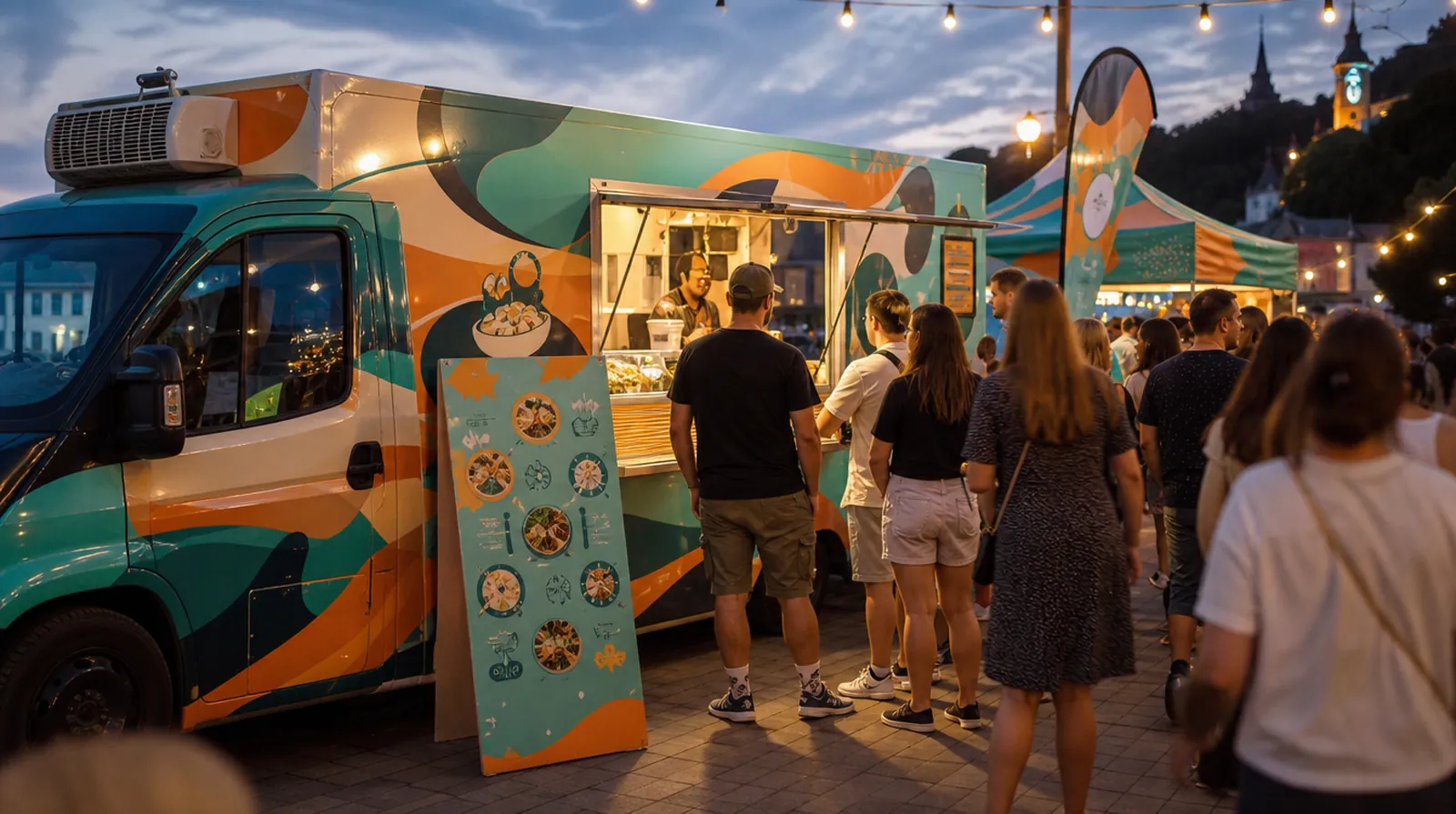 Illustrative visualisation
A food truck is the premises, the fascia and the billboard all in one. You have no window or facade – the bodywork, the hatch and whatever you set up next to it do all the work. At a festival you stand in a row with twenty other trucks and people choose in seconds, from tens of metres away. The winner is the one visible above the crowd, whose menu can be read from the queue.
The second thing is change. A different menu for a street food event, another for a wedding, another for winter. So we recommend putting the permanent elements (logo, name, colour scheme) on long-life cast vinyl, and everything that changes on [magnets](/produkty/naklejki-magnetyczne), interchangeable boards and light displays you carry inside. Before wrapping we always ask for photos and dimensions of the body, because every food truck is different.
1. Bodywork and conversion
Wrapping a food truck isn't the same as wrapping a company van. There are flaps, hatches, vents, rivets and areas that heat up near the kitchen. On such surfaces we use cast vinyl with laminate, and we lay out the design so important lettering doesn't fall on hinges or the edges of the flap.
- Full wrap for a food truck or trailer→The whole body in your brand colours – from afar people see it's you, not another white box.
- Cast vinyl with laminate→For contours, rivets and panels that heat up. The laminate protects the print from washing and grease.
- Lettering on the raised flap→The underside of the serving flap is only visible while you're trading – a good spot for the name and a slogan above the queue.
2. Hatch and menu
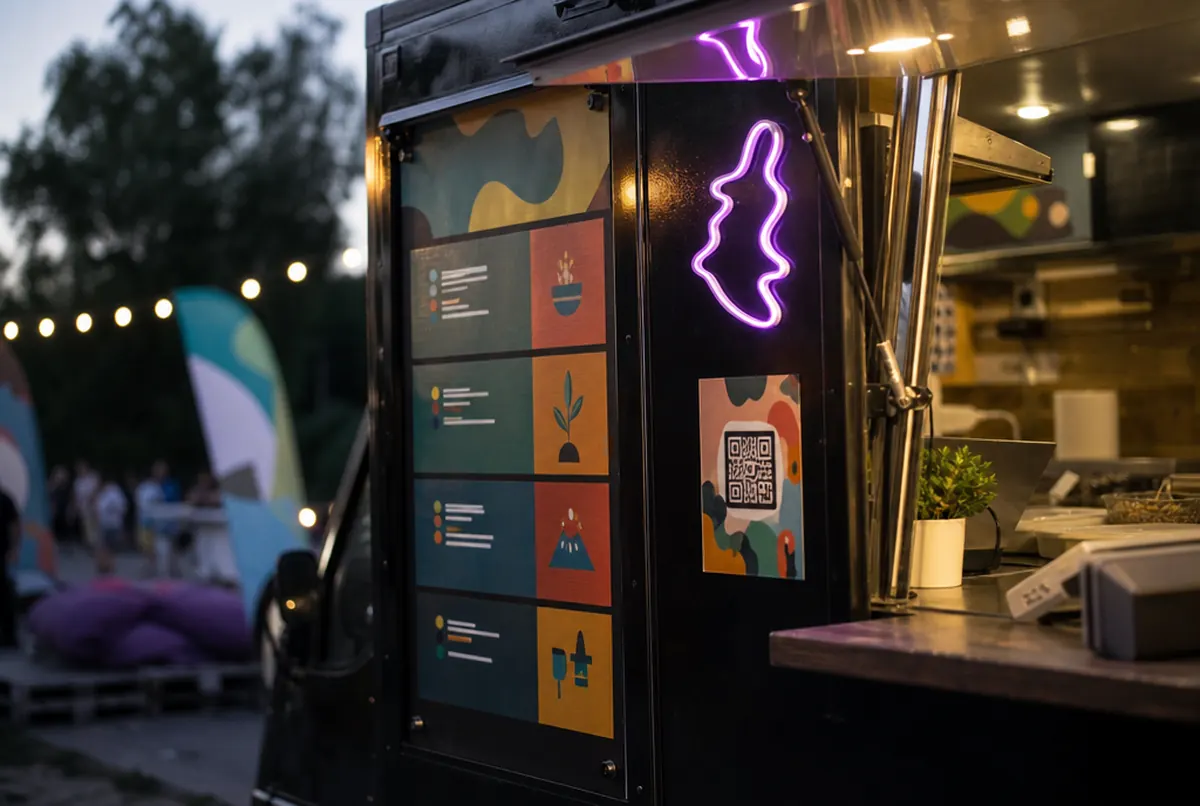
The menu by the hatch should be short and readable from 3–4 metres. People in the queue want three things: what you have, what it costs, and whether there's a veggie option. Keep prices and seasonal items on interchangeable elements.
- Menu board on a rigid panel→A rigid dibond or PVC board with UV print, fixed by the hatch or stood alongside. Rainproof and wipeable.
- Magnets with a changeable menu→Seasonal items and prices on magnets – one version for a festival, another for catering, without re-applying vinyl.
- LED neon by the hatch→At evening events an illuminated sign draws people like nothing else. You need 230 V power in the truck.
- QR code stickers→Online menu, social media profile, payment – a small waterproof sticker by the hatch.
3. Pitch at festivals and events
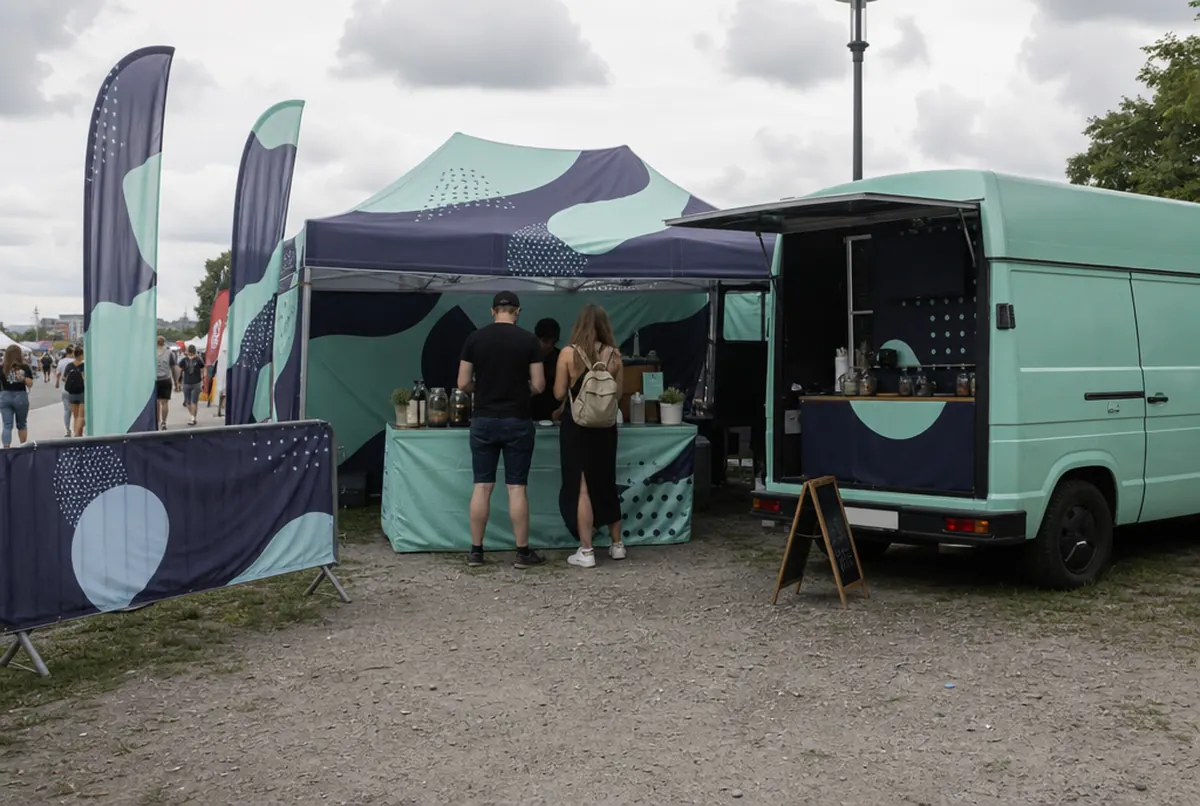
At a festival the space around the truck matters as much as the vehicle. [Feather flags](/poradnik/beachflaga-rodzaje-i-ceny) are visible above the crowd, a [gazebo](/produkty/namioty-reklamowe) gives shade for the queue and extra branded surface, and a banner hides untidy backs and the generator.
- Feather flags→The simplest way to be seen from the far end of the site. A ground spike for grass, a cross base with a weight for tarmac.
- Printed gazebo→Shade for the queue or tables, and another large surface with your name. Folds up in minutes.
- Banner for events and barriers→A light banner with eyelets for hanging on a barrier or fence or screening the generator. Rolls up and travels inside.
- Branded parasol→With a few tables next to the truck, a printed parasol creates a 'terrace' and can be seen from afar.
- Printed tablecloth→For the sauce table or a wedding station – a branded tablecloth instead of plastic oilcloth.
4. Serving and staff
Customers walk away from the hatch with food in hand and often take a photo of it. The logo on the cup, the sticker on the box and the staff T-shirt then go online at no extra cost.
- Branded cups and packaging→Printed cups for lemonade and coffee – with larger runs they make a difference to how the order looks.
- Packaging stickers→Your logo on a standard box or bag – cheaper than printed packaging for small runs.
- Branded staff clothing→Printed T-shirts, sweatshirts and caps – at events the staff are part of the brand.
- Business cards for catering→A food truck for weddings or corporate events is a common side business. A business card at the hatch brings in those bookings.
- 01Brief
Description, sizes, site photos and deadline — a few sentences are enough.
- 02Design and quote
Our designers prepare artwork or a visualisation and you get a price.
- 03Approval
You approve the design; for brand colours we provide a proof.
- 04Production
35+ machines in our own plant in Poland: 3.2 m UV print, CNC, laser, 3D, sewing.
- 05Installation or delivery
Own crews and vehicles across Europe, partner network, couriers worldwide.
To start with — an indicative package
A sample kit for a food truck heading out for the event season. Prices from our price list; wrapping and fitting are quoted separately from photos of the vehicle.
| Wrap of approx. 15 m² in cast vinyl + laminate (15 × approx. €24 + 15 × approx. €8) | approx. €480 net |
| Dibond menu board approx. 100 × 70 cm (0.7 m², up-to-4 m² rate) | approx. €35 net |
| 2 Midi feather flags 70 × 340 cm with poles | from approx. €150 net |
| 3 × 3 m pop-up gazebo with full print | from approx. €750 net |
| Coated banner 3 × 1 m for a barrier (3 m² × approx. €13) | approx. €39 net |
Indicative net prices; an exact quote follows a short description and photos of the vehicle. Feather flag bases are chosen to suit the ground – charged separately.
From our experience — what to watch out for
- Before wrapping, send dimensions and photos of all sides of the body with flaps open and closed. Without them the design always needs correcting.
- The name should be visible high up – at a festival the crowd hides the lower part of the vehicle.
- Keep prices and seasonal items on magnets or interchangeable boards, not on vinyl on the bodywork.
- Feather flags on grass need a ground spike; on tarmac, a weighted base. Without one, the first gust lays the flag on top of people.
- Wash a wrapped vehicle without aiming a pressure washer at the vinyl edges. It's the most common cause of lifting corners.