 Signs & Large Format Print
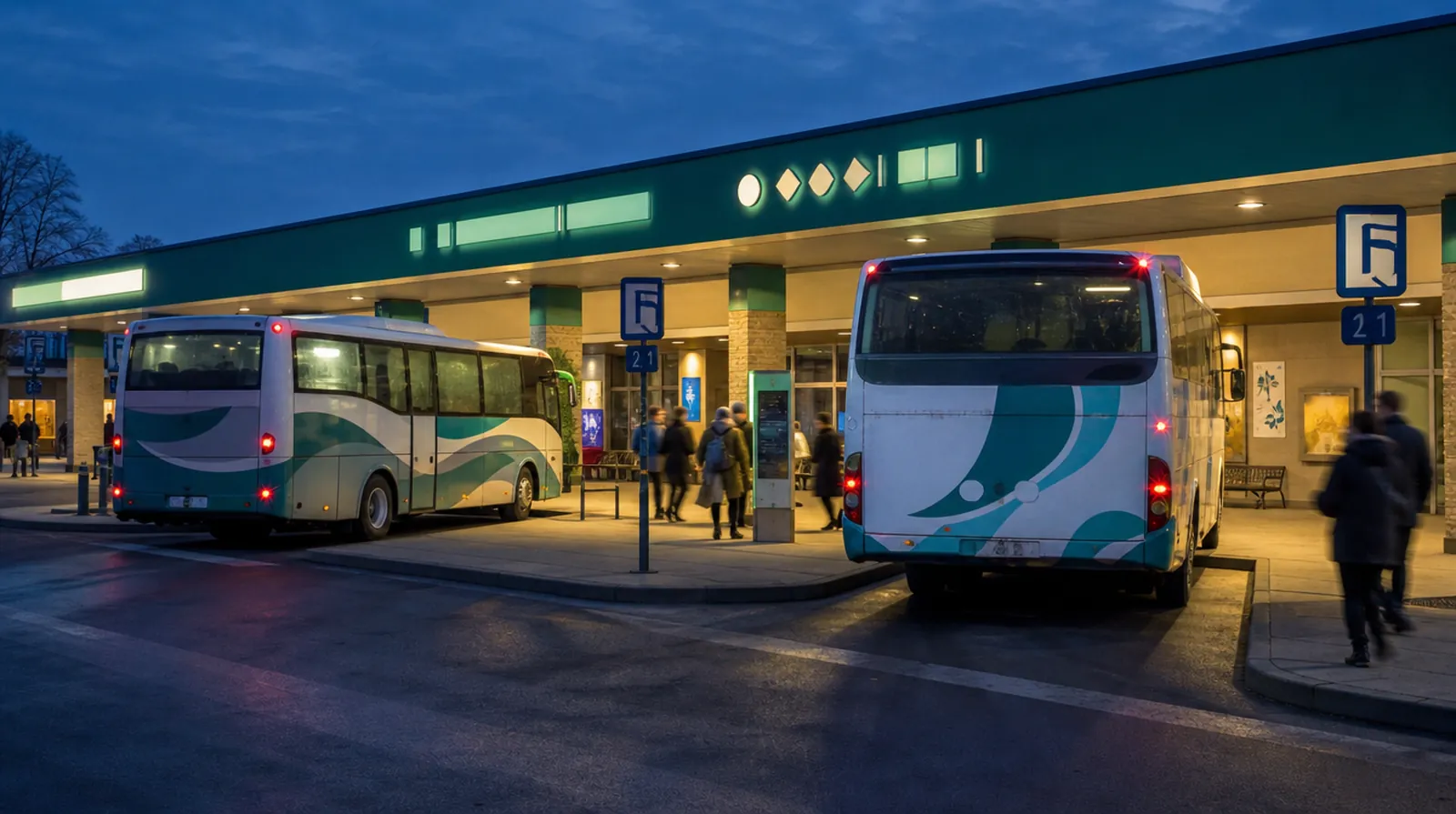 Illustrative visualisation
A bus is on the road for well over twelve hours a day, scrubbed by brushes and driven on salted roads. That is the toughest environment vehicle film ever faces, and the difference between cast vinyl and cheaper film shows after one winter. The second issue is time: a bus at the paint shop or the wrap shop is a service that doesn’t run. So we wrap on site at your depot, at night or at weekends, when the vehicle is standing anyway.
The bus station and stops are where a passenger in a hurry looks for the right bay. A bay number visible from the entrance, a timetable that can be changed without calling out a crew, a clearly marked ticket office: simple things, yet many stations still have A4 sheets on the wall. Vehicles and projects with grant funding also need stickers and signs that follow the agreement; send us its requirements and we will prepare the material to match.
1. Vehicles: operator livery
Buses bought in different years look as if they belong to different companies. One livery design, adapted to several body models, unifies the fleet and helps passengers spot ‘their’ operator at the stop. Over rivets and pressed panels we use only cast vinyl.
- Bus and minibus livery→Cast vinyl with UV print approx. €19–29 net per m² plus laminate approx. €8 net per m². The band under the windows on the side of a 12 m bus is about 18 m², approx. €520 net with laminate.
- One-way vision film on the rear window→Graphics on the outside, a clear view from the inside. Approx. €10–18 net per m²; a logo and the timetable website work well.
- Funding information stickers→For vehicles bought with EU or national funding. Design, size and position according to the agreement; printed on wash-resistant film.
2. Advertising on buses for local businesses
The sides and rear of a bus are space you can sell to local businesses: shops, driving schools, developers. The operator earns, and we handle the printing, the wrap and removing the film after the campaign.
- Side and rear advertising→Printed on laminated cast vinyl, or on one-way vision film on the windows. Priced by area; invoiced to the operator or directly to the advertiser, as you agree.
- Removing old adverts→After the campaign we remove the film and clean adhesive off the paintwork before the next wrap. Priced by area and the age of the film.
3. Vehicle interior
Inside the bus, passengers have a few minutes and nothing to do, so they read whatever is in front of them. A good place for conditions of carriage, fares, the helpline number and news about new routes.
- Interior stickers→Conditions of carriage, fares, prohibitions, seat numbers, emergency exit markings as required. Printed film approx. €6–12 net per m², contour cutting approx. €1.20 net per linear metre.
- Driver ID badges→Name, staff number, photo. 100 badges of 90 × 50 mm approx. €60 net; matching lanyards available too.
4. Bus station, bays and stops
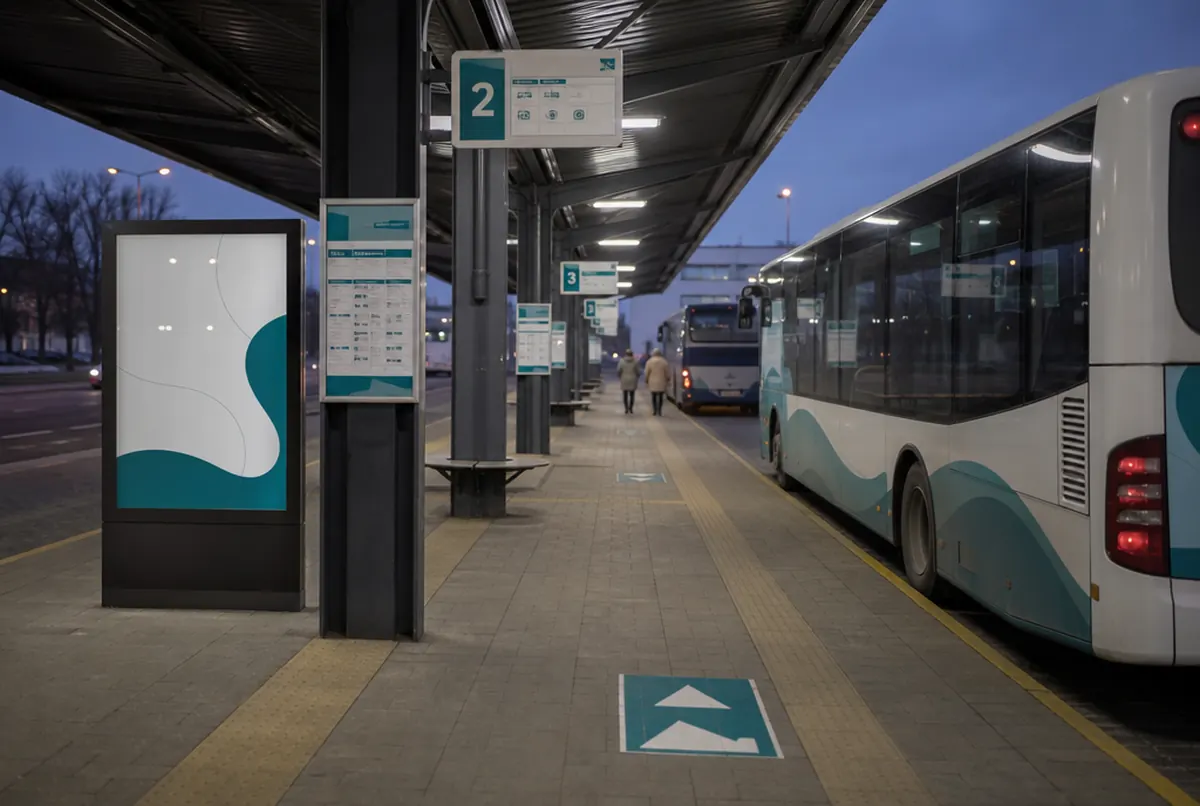
At the station a passenger looks for the bay number and the time; everything else is background. We design signage from a survey: where people come in, where buses stand, where signs can be seen from. Outdoor graphics are made from materials that stand up to sun and vandals.
- Bay and platform signage→Large bay numbers, destinations, a station plan. Survey from approx. €85 net, refunded when you order production.
- Timetable boards→Impact-resistant solid polycarbonate, approx. €55–75 net per m², or Dibond with UV print. The timetable itself is swapped as a cheap print.
- Floor arrows to the bays→Floor vinyl with R10 anti-slip laminate, approx. €19–30 net per m². Leads passengers from the hall to the bays without reading signs.
- Station name on the façade→Front-lit letters from approx. €46 net per character at 30 cm high, approx. €11 net for every extra 10 cm. Visible in the evening from the approach road.
- Citylight posters for shelters→Whiteback paper for illuminated cases, approx. €5–10 net per m². Your own messages, or space to sell to advertisers.
5. Tickets, timetables and information
Many passengers still prefer a paper timetable, especially older people and school commuters. A small leaflet with routes and times at the ticket office is the cheapest form of information, and for a new route the best advert.
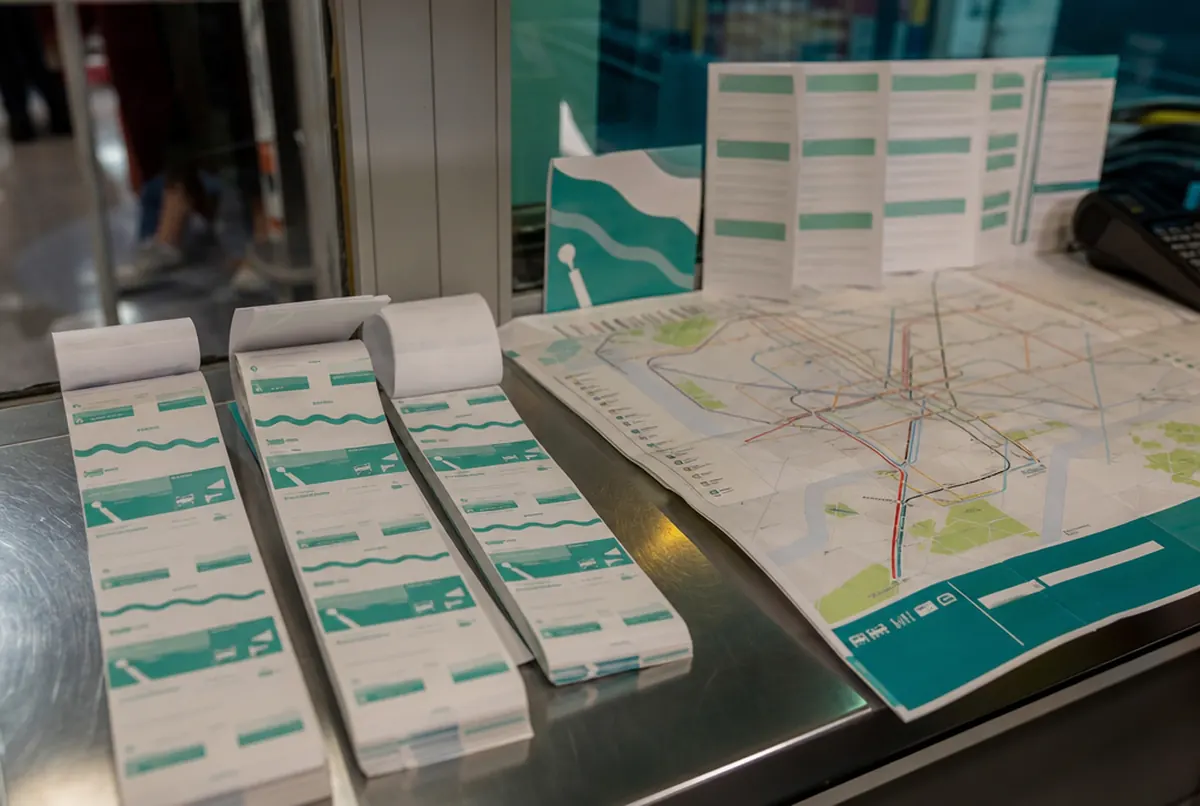
- Tickets in pads→55 × 170 mm tickets with perforation, glued into pads, 1,000 pcs approx. €75 net. Numbering makes it easier to cash up with the driver.
- Pocket timetable→DL leaflet, 6 panels, 1,000 pcs approx. €90 net. To hand out at schools before the new school year and when a new route starts.
- Network map→A folded route map with interchanges, for the ticket office and the website. Priced by format and number of folds.
- 01Brief
Description, sizes, site photos and deadline — a few sentences are enough.
- 02Design and quote
Our designers prepare artwork or a visualisation and you get a price.
- 03Approval
You approve the design; for brand colours we provide a proof.
- 04Production
35+ machines in our own plant in Poland: 3.2 m UV print, CNC, laser, 3D, sewing.
- 05Installation or delivery
Own crews and vehicles across Europe, partner network, couriers worldwide.
To start with — an indicative package
Example: unifying three buses and basic station signage. Based on our price list.
| Side band on 3 buses, 6 sides × 9 m² cast vinyl + laminate (54 m² × approx. €27) | approx. €1,460 net |
| One-way vision on rear windows, 3 × 2 m² (6 m² × approx. €14) | approx. €85 net |
| Interior stickers, 3 sets, about 1 m² (minimum order) | approx. €24 net |
| Station survey for signage | from approx. €85 net |
| Tickets in pads, 1,000 pcs | approx. €75 net |
| DL pocket timetable, 1,000 pcs | approx. €90 net |
Indicative net prices, excluding crew time (approx. €42 net per man-hour, approx. €65 net at night). Exact quote based on vehicle models and photos of the station.
From our experience — what to watch out for
- Before wrapping, the bus must be washed and dry, with no wax from the bus wash. Film on wax lifts within weeks.
- Design the livery with bands that can be adapted to different models. A rigid layout for one bus won’t fit the next ones.
- Change station timetables as inserts behind glass or in display cases. Printing the timetable directly on the board means a new board with every change.
- Make bay numbers big, at least readable from the hall entrance. A passenger with a suitcase won’t walk up to every post.
- Sell advertising to outside businesses for a fixed period, with the removal cost in the contract. It avoids arguments about who pays to take it off.