 Signs & Large Format Print
When you need a sign and when a poster is enough
The visibility rules for EU funds in 2021–2027 come from the EU Common Provisions Regulation and from national and regional documents (brand and visual identity manuals, beneficiary handbooks, the annex to the grant agreement). In simplified terms:
- Permanent plaque or billboard: ERDF and Cohesion Fund projects involving physical investment (construction, refurbishment, installation) or equipment purchase with a total cost above €500,000. In some programmes a similar obligation applies to ESF+ projects above €100,000.
- A poster of at least A3, or an equivalent electronic display: all other projects, below the thresholds. Details in our guide EU project information poster (A3): when it is enough.
- Stickers on purchased equipment and vehicles: regardless of the sign or poster, if the grant agreement requires them.
That is the general picture. Thresholds, deadlines and templates can differ between national and regional programmes and between member states, so before ordering anything, open your grant agreement and the current programme handbook. The binding answer is there, not in a printer's guide.
The most common sign sizes
| Size | Typical use | Area | Panel alone: calculation |
|---|---|---|---|
| 80 × 40 cm | purchase of equipment, furnishings, vehicles | 0.32 m² | approx. €18 net (minimum order approx. €24 net) |
| 120 × 60 cm | when there is no room for a larger sign | 0.72 m² | 0.72 × €55 = approx. €40 net |
| 80 × 120 cm | the minimum specified in some national programmes | 0.96 m² | approx. €53 net |
| 240 × 120 cm | construction works, infrastructure | 2.88 m² | 2.88 × €55 = approx. €160 net |
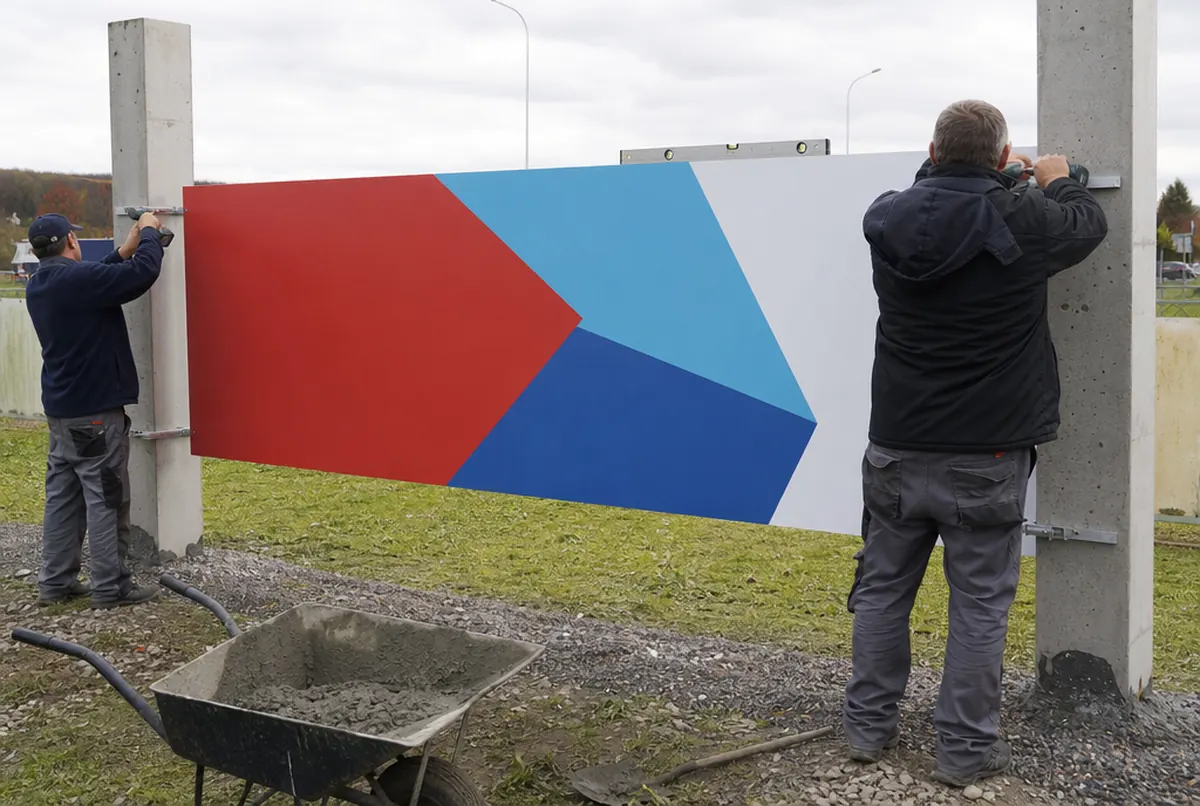
Then there is the fixing: on a facade, wall plugs and stand-offs are enough; on a building site you need a frame. A finished 200 × 100 cm sign on a galvanised frame costs from approx. €165 net with us (excluding setting in the ground). We quote a structure for the 240 × 120 cm format from a short description of the site: posts driven into a lawn are priced differently from fixing to a panel fence.
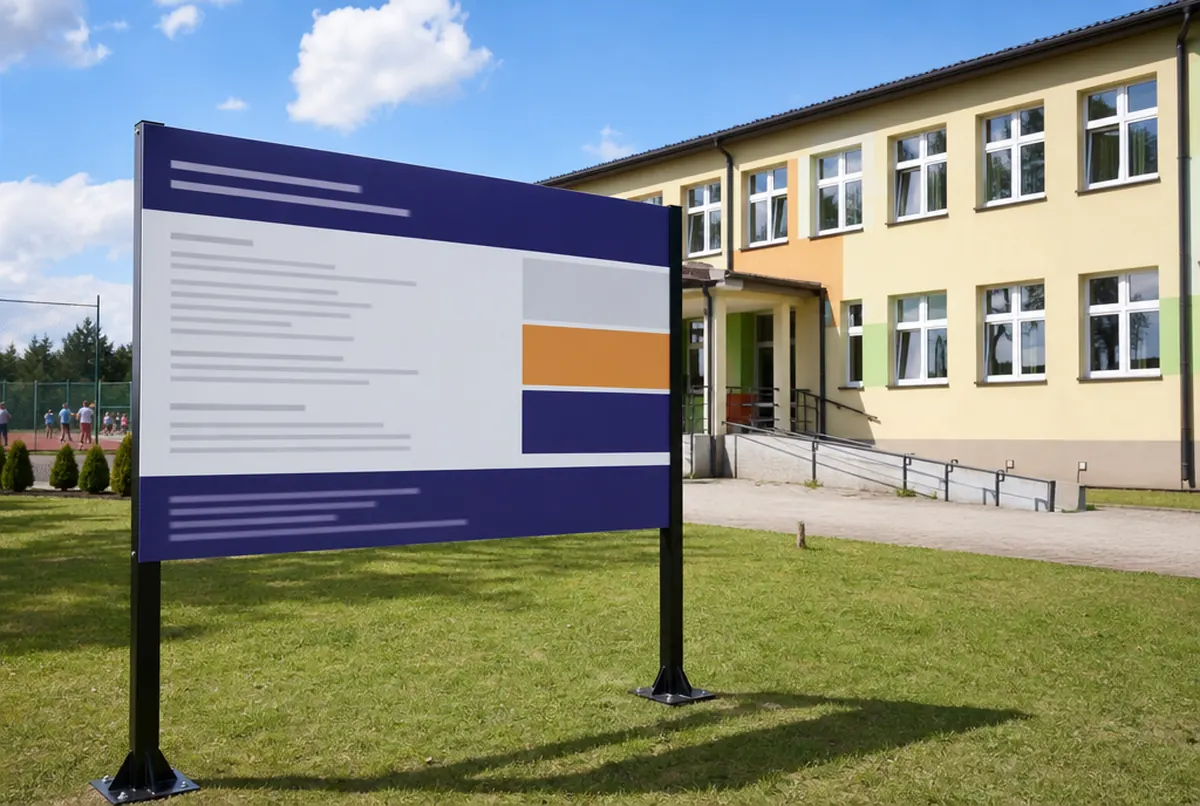
Choose the size by the programme template, not by what looks nice. If the template allows several variants, we go by the distance from which the sign must be legible. By a district road 120 × 60 cm gets lost; in a school corridor 240 × 120 cm overwhelms.
What must be on the sign: a checklist
Templates in the 2021–2027 programmes are similar. Before sending the file to print, check that you have:
- the logo sequence in the order set by the template: typically the EU emblem with the funding statement, plus national and programme marks (in Poland, for example, the European Funds mark with the programme name, the national colours and, in regional programmes, the region's logo);
- the beneficiary's name: in full, as in the agreement;
- the project title: many templates set a character limit (we have seen 150 characters), so long titles sometimes have to be shortened according to the programme rules, not by eye;
- the web address or other information specified in the template;
- any extra fields the template provides for, such as the project value or the amount of funding.
The template often also prescribes the typeface, proportions and the clear space around the logos. Do not adapt it to your taste. The most common problem we see in client files is logos pasted from a website at low resolution and stretched in one direction. On a 240 × 120 cm sign that shows from a distance.
What to make an EU-funded project sign from so it lasts the durability period
The sign has to stay up for the duration of the project and usually also for the durability period stated in the agreement, often several years. That is why we almost always make them from 3 mm Dibond (aluminium composite panel with two aluminium skins) with UV print directly on the panel. It does not swell with moisture or warp in the sun like thin PVC, and Dibond's outdoor life is measured in years, not seasons. We compare the options in more detail in outdoor signs: Dibond or PVC.
For large formats and windy locations, premium Dibond with thicker aluminium skins (approx. €45–65 net/m²) works well: it does not ripple on a large panel. Where the sign stands by a pavement next to a school or bus stop, we recommend anti-graffiti laminate (approx. €10 net/m²). Marker pen or spray paint then comes off much more easily.
We keep foam PVC for indoor signs, e.g. in a council office lobby. Outdoors it can warp after one summer.
- 24 hexpress printing (UV inks need no drying)
- approx. 3 daysstandard lead time
- up to 14 dayslarge and custom projects with installation
Plus courier delivery. Tell us your date — we plan production around it.
How to order an EU-funded project sign from us, step by step
- Send us the programme template (link or PDF), the project title, the beneficiary's name and where the sign will go: wall, fence, lawn.
- If you do not have a file, we lay out the design according to the template: a simple sign is approx. €42 net with two rounds of changes. For Polish programmes you can also use the designer at tablicedotacji.pl (in Polish).
- We send a proof for approval. It is worth forwarding it to your project officer at the managing authority: better to fix a comma before printing than after an inspection.
- We print and cut. As standard about 3 working days, 24-hour printing in urgent cases.
- We ship by courier across the EU or install with our own crew, or a partner team in your country.
The full range of signs is on the EU-funded project and grant signs page.