 Signs & Large Format Print
Comparison in one table
| Feature | Dibond 3 mm | Foam PVC 3–5 mm | Solid polycarbonate 3 mm |
|---|---|---|---|
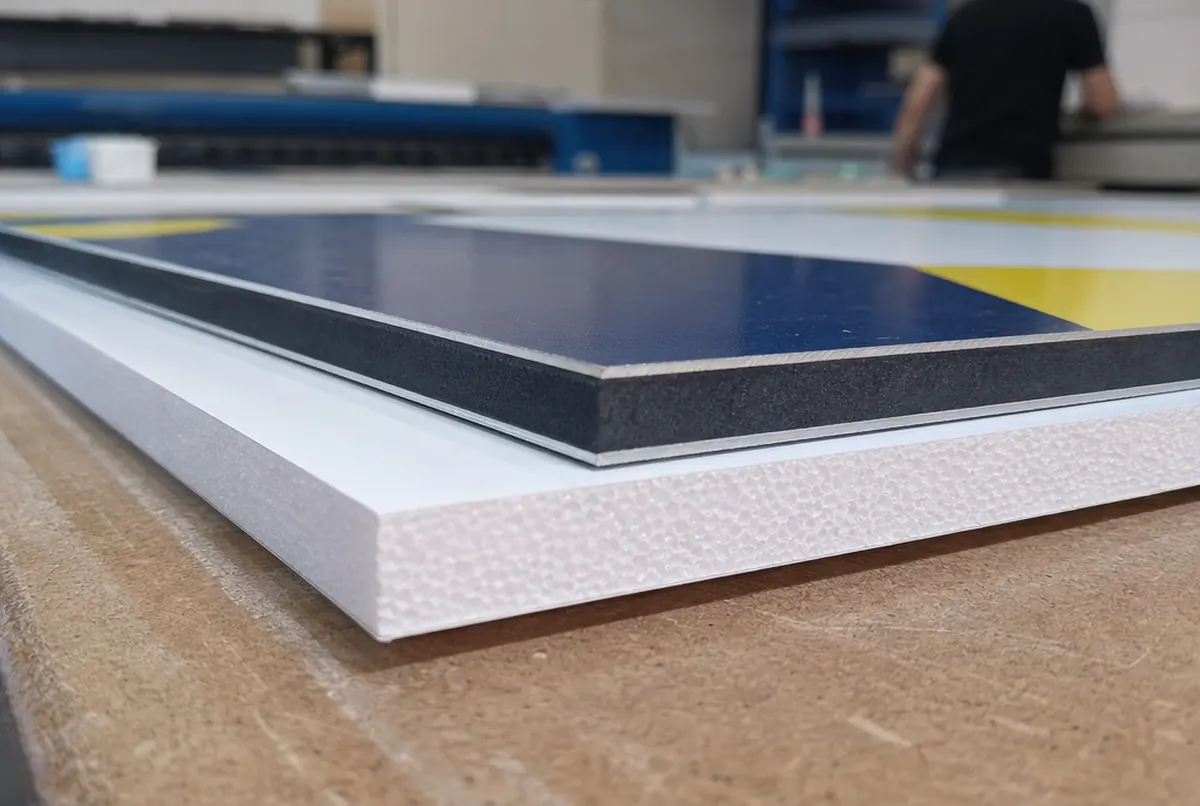
| Construction | two aluminium skins + core | foamed plastic core | solid plastic |
| Price with UV print | approx. €35–55/m² (premium approx. €45–65) | 3 mm: approx. €21–33/m²; 5 mm: approx. €26–39/m² | approx. €52–75/m² |
| In the sun | stable | softens and bows, especially in dark colours | stable |
| In winter | no change | becomes brittle, cracks on impact | resistant |
| Impact resistance | good, may dent | poor | very high |
| Typical outdoor life | many years | short term, a season | many years |
| When to choose | company, EU-funded, site and address signs | interiors, seasonal campaigns | places prone to vandalism |
In short: PVC is an indoor material that copes outdoors for a while. Dibond is an outdoor material that also looks good indoors.
Why PVC bows outdoors
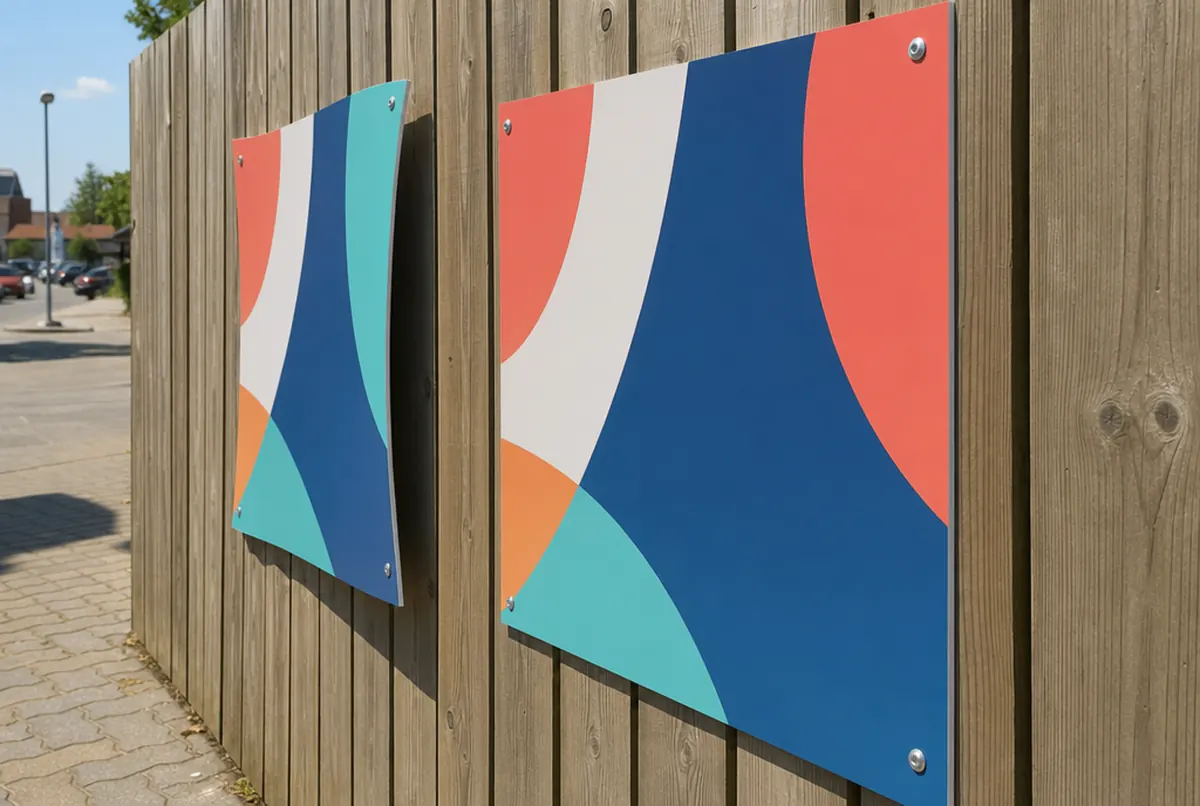
The most common call we get on this subject goes roughly like this: "the sign went up in spring, and by August it had turned into a boat". That is not a fault in a particular sheet but the nature of the material. Foam PVC:
- expands with heat much more than aluminium, and a sign heated by the sun can be noticeably hotter than the air;
- softens at high temperatures, so a sign screwed at four corners bulges between the screws;
- dark backgrounds heat up most: a navy or black sign on a south-facing wall is the worst case;
- becomes brittle in winter: a ball, a branch or a snow shovel can crack it.
Dibond has aluminium sheet on both sides, which keeps the panel in shape. That is why it is the standard for signs meant to stay up for years, such as EU-funded project signs, which must last through implementation and the project's durability period.
When PVC makes sense outdoors too
We do not rule out PVC entirely. We choose it deliberately when:
- the sign is up only briefly, a few weeks or a season: elections, a fete, a sale, a roadworks notice;
- the spot is sheltered: under a canopy, in a shelter, on a north-facing wall without direct sun;
- the sign is small and bonded over its whole surface to a rigid backing, not hung at the corners;
- the budget is really tight and the client accepts replacing the sign within a year.
Then we go for 5 mm rather than 3 mm and a light background rather than a dark one. Indoors (lobbies, corridors, halls), PVC is a very good, inexpensive choice, and there we recommend it without reservation.
Standard or premium Dibond
"Dibond" is the name commonly used for aluminium composite panels. We have two versions:
- Standard 3 mm Dibond (approx. €35–55 net/m²): with thinner aluminium skins. The standard for signs, quite sufficient for signs up to about 2 m² fixed to a wall or frame.
- Premium 3 mm Dibond (approx. €45–65 net/m²): with thicker aluminium skins, stiffer. We recommend it for large panels, light box faces and facades, where a standard panel might ripple slightly in raking light.
For a 240 × 120 cm EU-funded project sign on a frame the price difference is noticeable, but in a windy location the effect really shows.
- 24 hexpress printing (UV inks need no drying)
- approx. 3 daysstandard lead time
- up to 14 dayslarge and custom projects with installation
Plus courier delivery. Tell us your date — we plan production around it.
What it costs: the maths for a 100 × 70 cm sign
A 100 × 70 cm sign is 0.7 m². We use the rate for 1–4 m² orders:
- Foam PVC 3 mm: 0.7 × approx. €33 = approx. €23 net.
- Foam PVC 5 mm: 0.7 × approx. €39 = approx. €27 net.
- Dibond 3 mm: 0.7 × approx. €55 = approx. €39 net.
- Premium Dibond 3 mm: 0.7 × approx. €65 = approx. €46 net.
- Solid polycarbonate 3 mm: 0.7 × approx. €75 = approx. €53 net.
The difference between PVC and Dibond is about €15 net. If a PVC sign has to be replaced even once (new print, another visit with a drill), the saving is gone. That is why for long-term signs we always recommend Dibond.
The price includes the panel, UV print and rectangular cutting. Fixing holes are approx. €0.50 net each, rounded corners approx. €0.50 net per corner. Ready-made signs are in the printing on rigid boards and panels and shop signs and company plaques categories.
Fitting that extends a sign's life
Even a good panel badly fitted will cause trouble. A few rules from our practice:
- Make the holes in the panel slightly larger than the screw and use washers: the panel needs a little play for thermal movement. This applies especially to PVC.
- On larger signs, fix not only at the corners but also along the sides at regular intervals.
- On a mesh fence, screw the sign to a rigid frame or posts, not to the mesh itself: mesh moves in the wind and eventually tears the fixings out.
- A sign on stand-offs from the wall sheds heat better than a panel bonded to a hot wall.
We can drill the panels to your spacing before shipping, or install the signs with our own crew.