 Signs & Large Format Print
Three types of board municipalities ask about
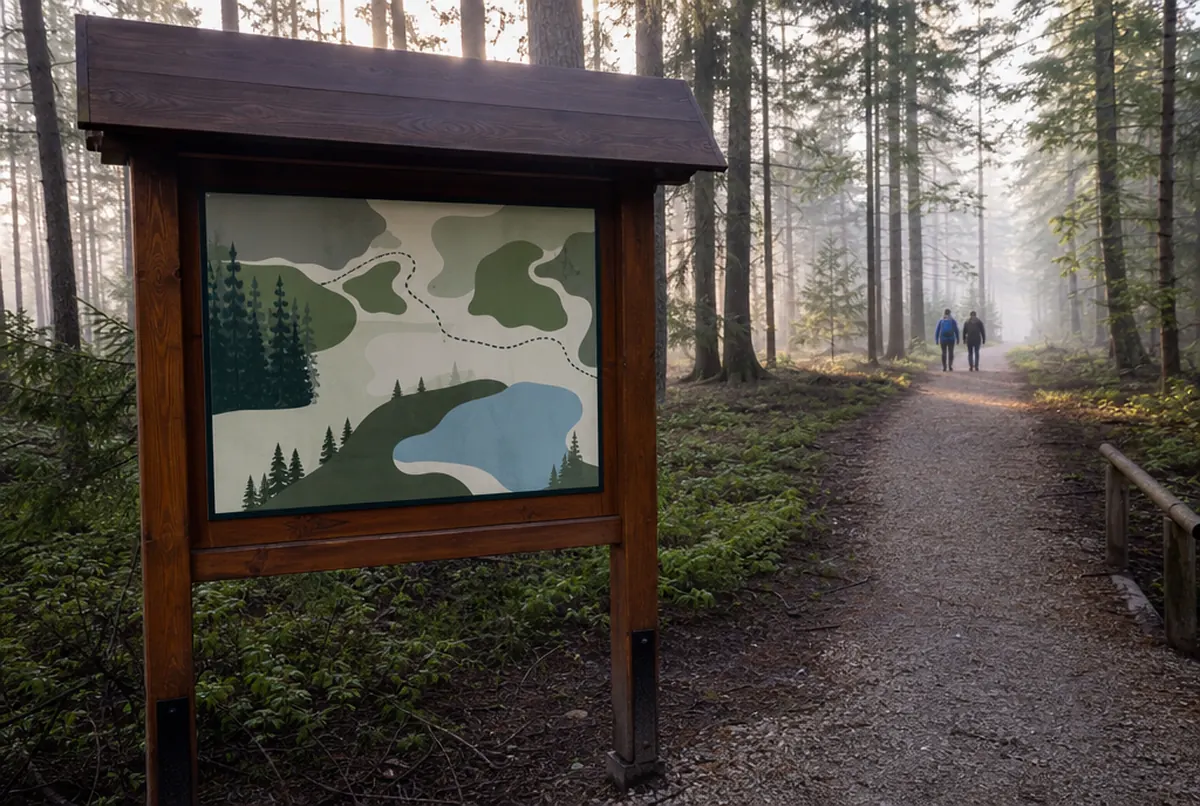
Map board: by the market square, a car park, a station, the entrance to a park or an estate. It shows "you are here", key points and routes. Usually one or a few large boards, often 200 × 100 cm on a frame.
Educational trail: nature, history or cycling. A series of several to a dozen panels in one style, set along a route. Smaller formats, lots of text and photos, read up close.
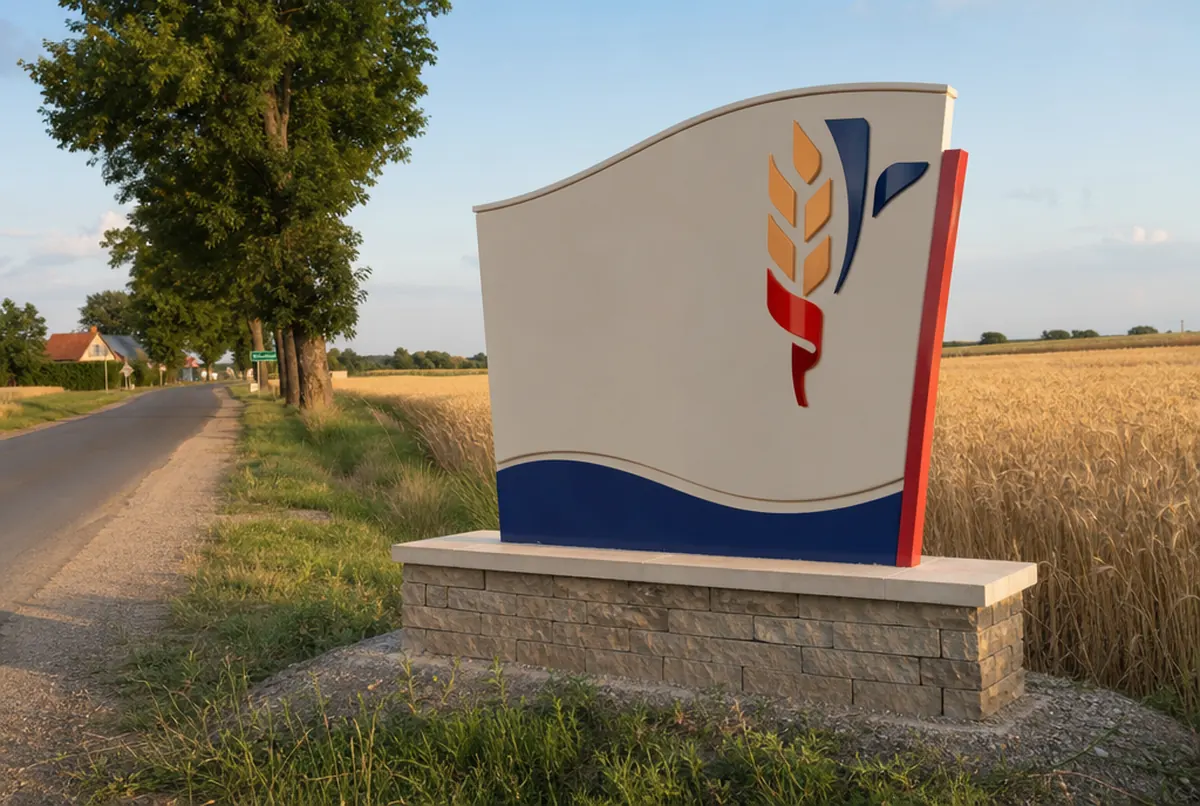
Welcome sign: "Welcome to…" at the entrance to a town or district. An image medium read from a moving car, so little text, a large coat of arms, large letters. It may be a board on posts, a totem or a built-up letter form.
Each needs a slightly different approach to content and structure, but the face material is usually the same.
Materials: what lasts for years outdoors
| Material | Price | Resistance | When to choose it |
|---|---|---|---|
| Dibond 3 mm | approx. €35–55/m² | weather, sun, moisture | the standard for most boards |
| Dibond 3 mm premium | approx. €45–65/m² | as above, stiffer | large map boards, no rippling |
| Solid polycarbonate 3 mm | approx. €52–75/m² | high impact resistance | places prone to vandalism, bus stops, parks |
| Anti-graffiti laminate (add-on) | approx. €10/m² | paint and marker come off more easily | town centres, near schools |
| Foam PVC 5 mm | approx. €26–39/m² | limited outdoors | seasonal boards, short displays |
In woodland and by water the enemy is different from in town: damp, moss, birds, sometimes beavers gnawing wooden posts. A Dibond face does not care, but the structure does. In towns the threats are stickers, markers and kicks, hence polycarbonate or laminate. We cover the differences between boards in more detail in Dibond or PVC outdoors.
An educational trail, step by step
- Set the route and stops. How many stops, what at each one, where the boards stand. Photos of the locations help us choose the format and structure.
- Write the content. A board read standing up realistically fits 600–900 characters of text and 2–3 photos. Move longer descriptions online and add a QR code.
- Gather the images: photos at full resolution, with publication rights. Photos taken from the internet "because they look nice" are the most common cause of delays.
- Design a template and repeat it. One layout for all panels: a band with the trail name, the stop number, a mini route map. Studio time is approx. €35 net per hour: for a series we design the template once, and the following panels go faster.
- Approval and printing. About 3 working days from approval as standard; for a larger series we set the date to suit the opening.
- Installation. On ready structures, posts or frames, by our crew, a partner team or your own staff.
A panel cost example: 8 panels of 100 × 70 cm = 5.6 m². Dibond in the 5–15 m² band: 5.6 × approx. €44 = approx. €245 net. With anti-graffiti laminate, add 5.6 × approx. €10 = approx. €56 net.
The map on the board: where to get it
The map is the most common problem with boards like these. A few rules:
- Do not copy maps from popular online services: their licences usually do not allow printing on signs.
- Maps based on OpenStreetMap can be used, provided attribution is given in line with the project's licence.
- A map from the official survey or from a cartographer is the safest when the board must be accurate.
- An illustrated map drawn by a designer is the friendliest for tourists and children, but takes more work.
On a map board always mark "you are here" and orient the map the way a person standing in front of the board is facing. A map fixed rigidly north-up when the reader faces south confuses many people: they turn left when they should turn right.
This is a general description: if in doubt about a particular map's licence, check its terms at source.
- 24 hexpress printing (UV inks need no drying)
- approx. 3 daysstandard lead time
- up to 14 dayslarge and custom projects with installation
Plus courier delivery. Tell us your date — we plan production around it.
Welcome signs: structure and paperwork
A welcome sign usually stands by a public road, and that brings extra formalities. Placing an object within the highway requires the highway authority's consent; outside it, you must keep the required distances and check whether the municipality has local design rules. Larger structures also raise building control questions. We do not give a ready route here: it depends on the road category and the site. Start with the highway authority and the planning department.
On the production side, a welcome sign is most often:
- a Dibond board on a steel frame: a 200 × 100 cm board on a galvanised frame from approx. €165 net, excluding setting in the ground;
- a non-illuminated Dibond totem on a steel frame, 2.5 m high: from approx. €750 net (pylons and totems);
- built-up letters or a coat of arms routed from boards on a structure.
Keep the content of a welcome sign to a minimum: coat of arms, town name, perhaps a slogan. A driver has 2–3 seconds to read it. Solutions for local authorities are on the municipalities and public offices page.