 Signs & Large Format Print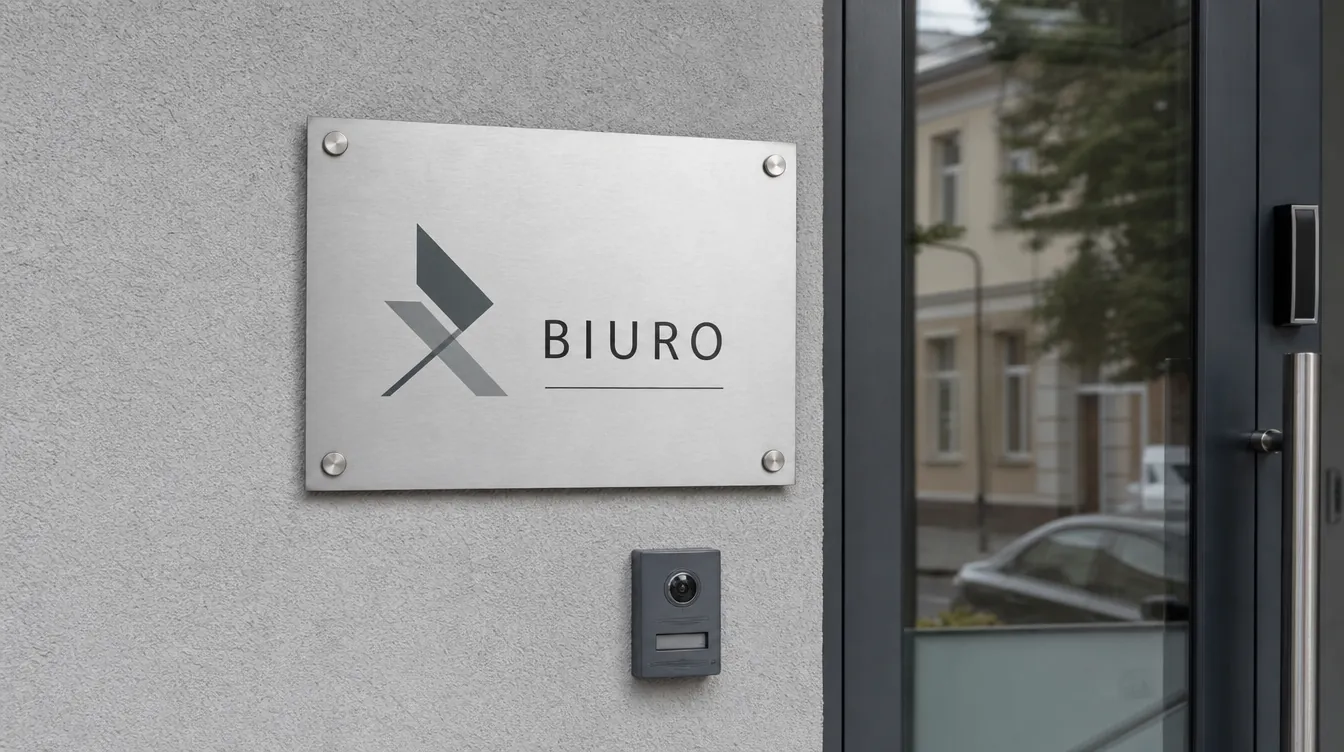
Three materials in a sentence each
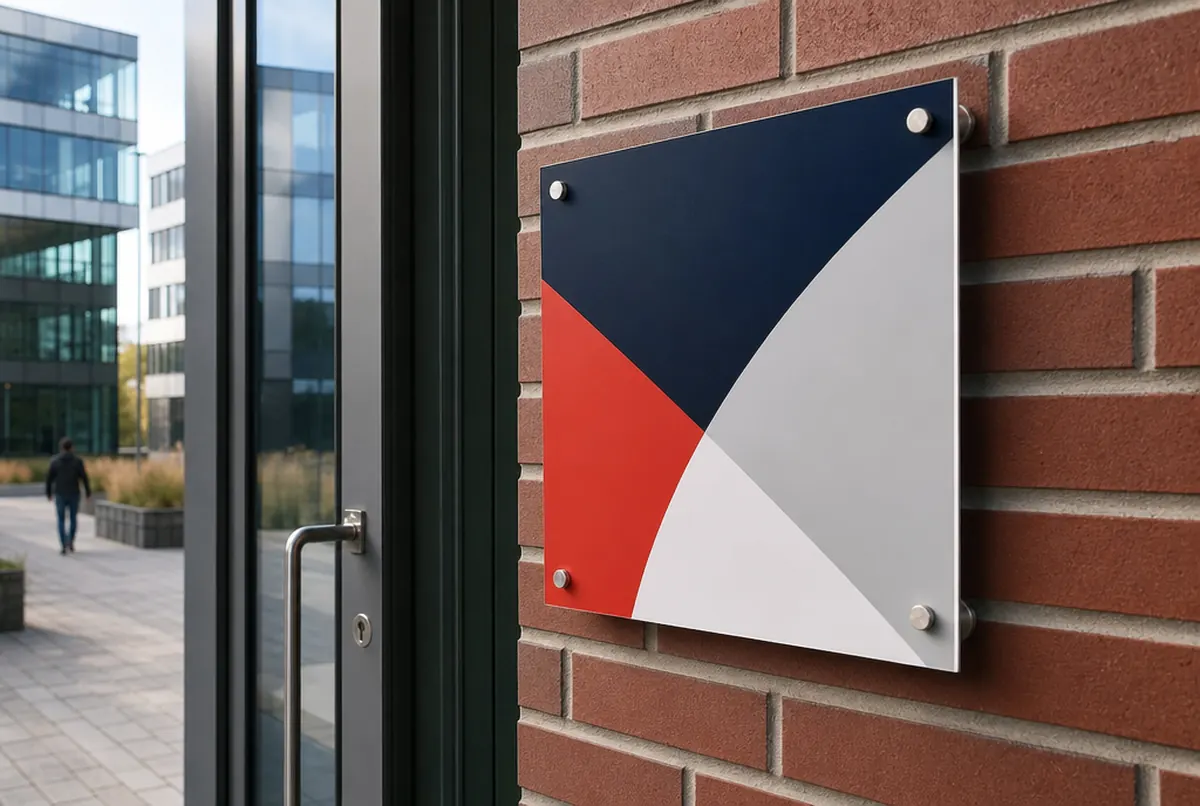
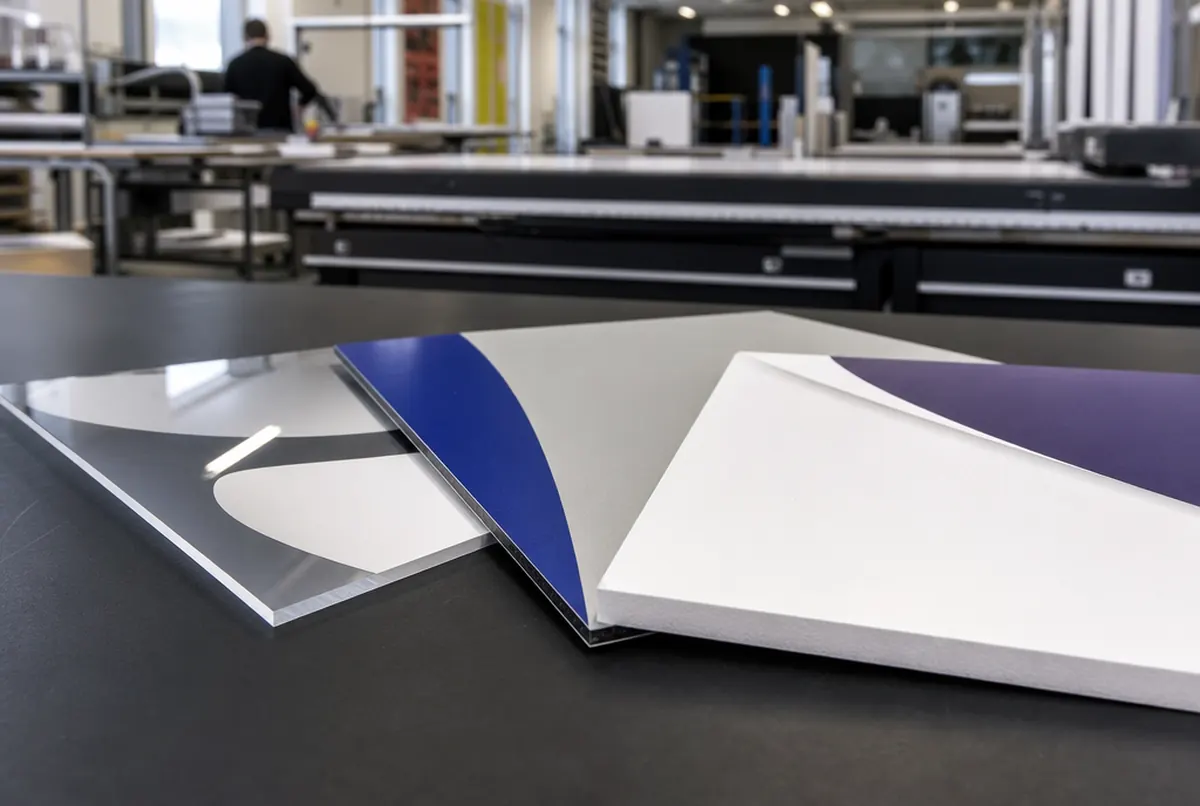
Dibond is an aluminium composite panel: two thin aluminium skins and a plastic core. It looks like sheet metal, but it is light, flat and does not rust. The standard for signs on facades.
Acrylic (PMMA, often called Perspex or plexiglass) is a clear or opal sheet that looks like glass but is lighter and less brittle. We print on the reverse or the front, with a white underlay so the colours stay saturated.
Foam PVC is a light, white plastic board. It cuts and routes easily and is cheap, but it is less rigid and can warp in the sun over time.
We print all three directly with UV inks, no vinyl needed, and cut them to size, including unusual shapes on our CNC router.
Sign materials compared
| Material | Price | Outdoors | Look | Typical use |
|---|---|---|---|---|
| Foam PVC 3 mm | approx. €21–33 | Short term | Matt, light board | Small plaques, interior signage |
| Foam PVC 5 mm | approx. €26–39 | Short term | More rigid | Interior boards, larger formats |
| Dibond 3 mm | approx. €35–55 | Yes, 10+ years | Flat, metallic | Facade signs, boards |
| Dibond 3 mm premium | approx. €45–65 | Yes | No rippling on large panels | Large signs, light box faces |
| Clear acrylic 3 mm | approx. €43–60 | Yes | Glass effect, depth | Signs on stand-offs, receptions |
| Opal acrylic 3 mm | approx. €48–70 | Yes | Milky, diffuses light | Faces of light boxes and illuminated signs |
| Solid polycarbonate 3 mm | approx. €55–75 | Yes | Clear, very tough | Places exposed to vandalism |
Details and full prices: shop signs and company plaques and printing on rigid boards and panels.
What a sample 100 × 60 cm sign costs
A 100 × 60 cm sign is 0.6 m². For such a small area we use the top band rate (1–4 m²):
- PVC 3 mm: 0.6 × €33 = approx. €20, but our minimum order value is approx. €24 net, so a small PVC sign costs the minimum,
- Dibond 3 mm: 0.6 × €55 = approx. €33 net,
- clear acrylic 3 mm with white underlay: 0.6 × €60 = approx. €36 net,
- four stainless steel stand-offs for acrylic or Dibond: 4 × approx. €2.35 = approx. €9.40 net.
The difference between a "cheap" and a "proper" sign of this size is a matter of a few euros. For a sign that will hang on a facade for several years, saving on the material is not worth it.
Dibond: pros and cons
Pros: rigid, flat, resistant to damp, frost and sun. It does not rust. UV print on Dibond stands up well to outdoor conditions. It can be routed, folded after V-grooving and made into built-up letters. On a facade it lasts for years.
Cons: on very large panels standard Dibond can ripple slightly in the sun, so we use the premium version with thicker aluminium skins. The edge shows as a thin strip of core, which on premium signs we sometimes hide with an edge trim or by mounting on stand-offs.
This is our default choice when a client simply asks for "a sign for the building".
- 24 hexpress printing (UV inks need no drying)
- approx. 3 daysstandard lead time
- up to 14 dayslarge and custom projects with installation
Plus courier delivery. Tell us your date — we plan production around it.
Acrylic: pros and cons
Pros: a glass-like depth that Dibond cannot give. A clear acrylic sign on stand-offs by the entrance to a law firm or clinic looks refined. Opal acrylic is the basic material for light box faces and illuminated letters, because it diffuses LED light evenly.
Cons: it scratches more easily than Dibond, and you must not clean it with solvents or alcohol, as it goes cloudy and cracks. Where it may be kicked, hit by stones or vandalised, polycarbonate works better.
Acrylic is also excellent for interior signage: door signs, reception boards, directional signs; more on the door and directional signs page.
How we mount panel signs
The material is half the job; the other half is fixing. We most often use:
- stainless steel stand-offs: a sign set a few centimetres off the wall looks lighter and copes better with uneven masonry. Stand-offs, fitted, cost approx. €2.35 net each,
- fixing holes and plugs: the simplest wall fixing; drilling a hole in the panel costs approx. €0.45 net each,
- high-strength double-sided tape: for light signs on smooth surfaces such as glass or metal, approx. €1.85 net per linear metre,
- hooks and hanging systems: for boards changed from time to time, approx. €1.70 net each.
Plus a small detail that makes a difference: rounded corners (approx. €0.55 net per corner). A sign with sharp corners at head height, e.g. by an entrance, is easily damaged, and even more easily someone gets cut on it.
PVC: when it is enough and when it is not
We choose foam PVC when price matters and the sign is indoors: office signage, information boards in a school or warehouse, exhibition panels. Outdoors it works for short periods, e.g. a season, a promotion or the duration of building works.
We do not recommend PVC for a long-term sign on a south-facing wall. A dark board heats up in the sun, and thin PVC can bend. Thicker 10 mm PVC, on the other hand, is a good material for routed letters and 3D elements indoors.
A wider comparison of materials for outdoor boards is in the guide Dibond or PVC outdoors, and if the sign needs to light up, see light box or 3D letters.