 Signs & Large Format Print
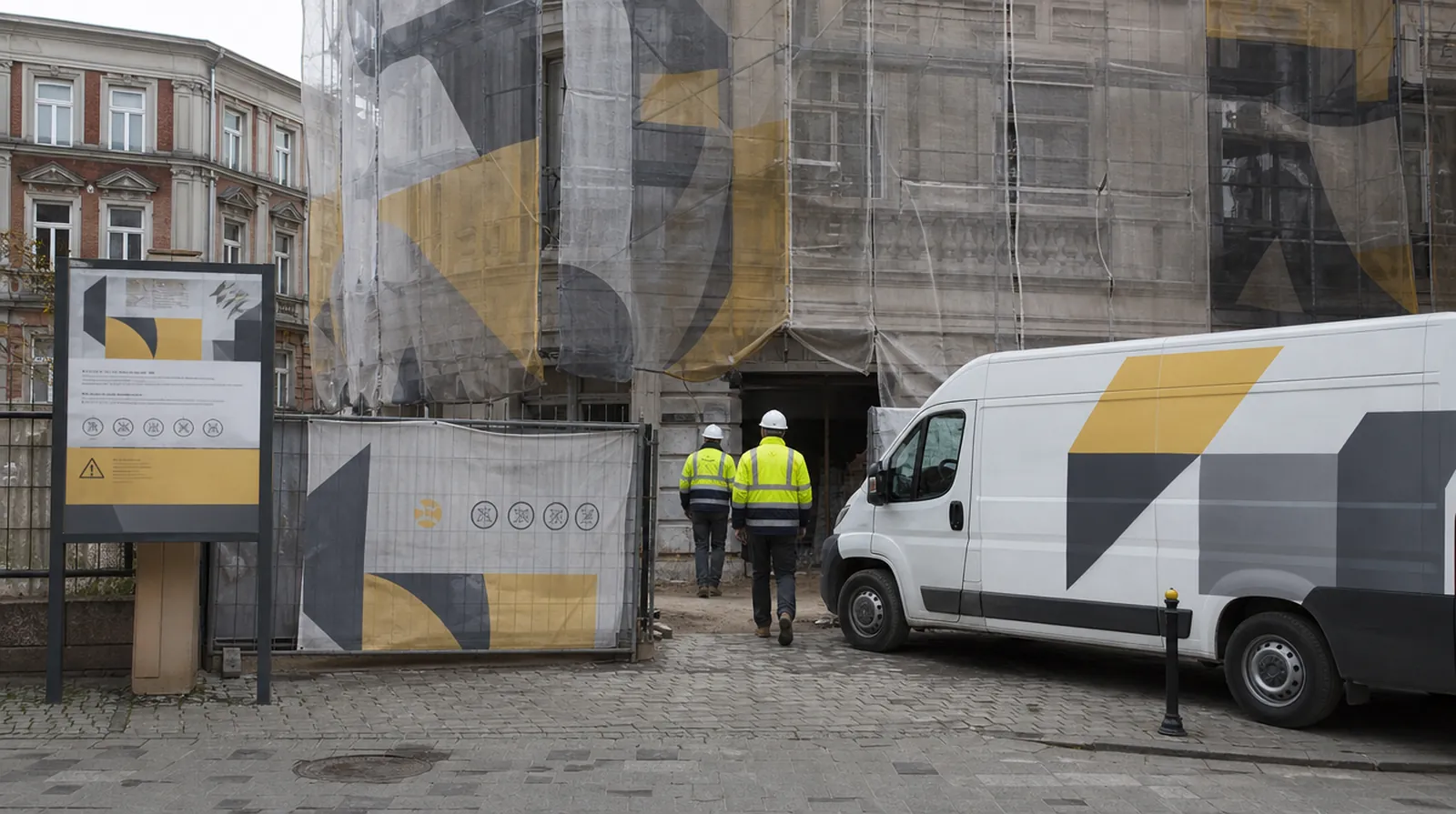 Illustrative visualisation
A construction company advertises mainly through what it builds. Every site stands by a road for months, and everyone driving past sees who's running it – as long as there's a contractor banner on the fence. Add vans that drive round the whole area and people in branded T-shirts. That's three media working every day at no cost beyond a one-off print.
On site, some signage is required: a site information board, and on public contracts often a funded-project plaque too. We don't guess here – the content is set by the site manager or the client, in line with regulations and programme guidelines, and we're responsible for durable production and installation. Site materials have to withstand dust, rain and being moved from place to place, so we choose them differently from office materials. Companies bidding for tenders also ask about proper folders and bid materials – more below.
1. Building site and fencing
We make the site board from dibond with UV print – it doesn't rust, doesn't bend like thin sheet metal, and after the project can be stored or reprinted. The contractor banner is hung on the fence with eyelets every 50 cm, and on construction mesh fencing with reinforcing tape. On scaffolding we use mesh, which lets the wind through.
- Site information board→Usually required on site. We make it on dibond, with legs or to bolt to the fence, in the size and wording agreed with the site manager.
- Funded-project plaque on public schemes→Sometimes the council or school passes this on to the contractor. We make it to the programme guidelines, with installation on site.
- Contractor fence banner→Logo, phone, services. In coated material it moves from site to site for several seasons.
- Scaffold mesh with the company name→During facade renovations scaffolding stands for weeks in the town centre. Mesh with the contractor's logo is then the biggest advert on the street.
- On-site information signs→Delivery hours, site manager contact, direction to the site office, no unauthorised entry. PVC or dibond, to bolt to a cabin or fence.
2. Vehicles and equipment
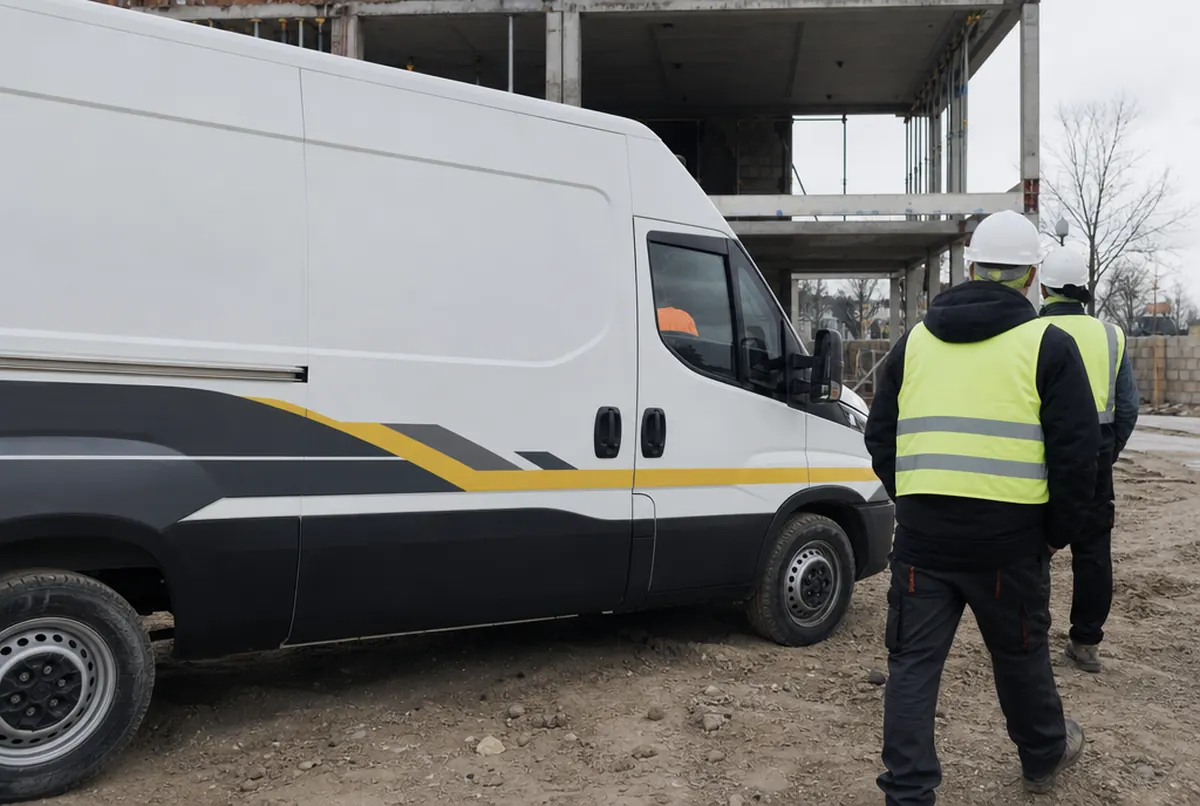
A branded van parked outside a client's house for three weeks does more than a leaflet through the door. On company vehicles we use cast vinyl with laminate – it holds well on contours and usually comes off when the vehicle is sold. If the vehicle is private or on a short lease, magnets are enough.
- Van and company vehicle livery→Logo, services and phone on the sides, and that's it. UV-printed cast vinyl costs approx. €19–29 net/m², laminate approx. €8 net/m².
- Car door magnets→For subcontractors, private cars and short leases. Off at the weekend and the car is private again.
- Logo stickers for helmets, machinery and cabins→Contour cut, in film resistant to rain and sun. They also make it easier to find company equipment on a shared site.
3. People on site
A crew in matching T-shirts and sweatshirts looks more professional in front of the client and in site photos. Transfer print holds well, but for heavy-duty work we're straightforward: workwear wears out, so printing is ordered once a season, not once and for all.
- Branded T-shirts and sweatshirts for the crew→An A4 print on T-shirts at 50–99 pieces costs approx. €2.35 net per item, on a sweatshirt from approx. €4 net.
- Branded baseball caps→In summer everyone on site wears a cap anyway, so make it a company one. Transfer print on a cap costs approx. €2.60 net per item, from 25 pieces.
4. Office, bids and tenders
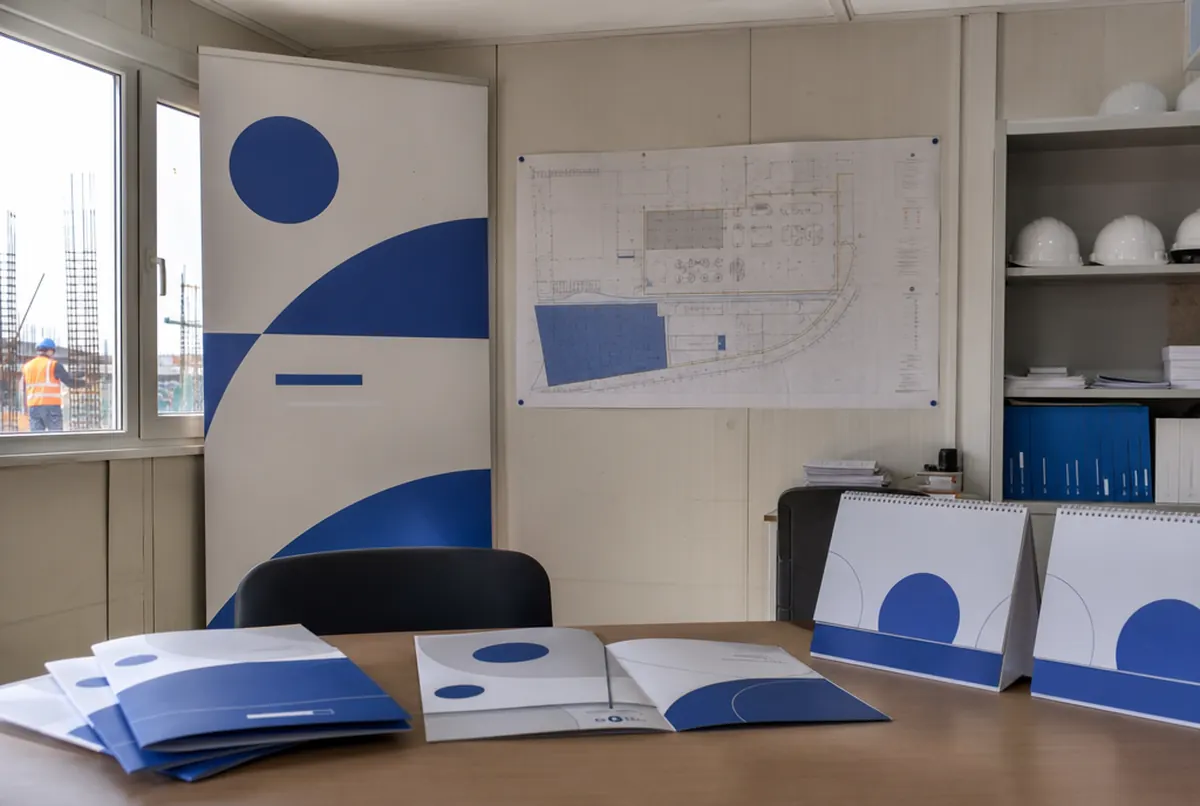
In tenders and meetings with clients, the first impression from the documents matters. A branded folder holding the bid and references, site managers' business cards and a sign on the office are the basic set. For firms doing a lot of project work we also print technical drawings and scan large-format plans.
- Presentation folders for tenders and clients→An A4 folder with a pocket and matt lamination. 100 pieces cost approx. €135 net, 500 pieces approx. €270 net.
- Business cards for site managers and sales staff→500 double-sided business cards on 350 g silk cost approx. €15 net.
- Sign for the head office and plant yard→Clients and suppliers need to find the yard. UV-printed dibond lasts for years.
- Three-month calendars for clients and partners→In construction they still hang on the walls of offices and merchants all year. They're ordered in autumn.
- Roll-up for construction fairs and client meetings→Project photos, services, accreditations and references. Stand it up at a presentation at the council or on a trade fair stand.
- 01Brief
Description, sizes, site photos and deadline — a few sentences are enough.
- 02Design and quote
Our designers prepare artwork or a visualisation and you get a price.
- 03Approval
You approve the design; for brand colours we provide a proof.
- 04Production
35+ machines in our own plant in Poland: 3.2 m UV print, CNC, laser, 3D, sewing.
- 05Installation or delivery
Own crews and vehicles across Europe, partner network, couriers worldwide.
To start with — an indicative package
A sample set for a firm that wants to brand its sites and vehicles properly. Prices from our price list, installation not included.
| Dibond board 200 × 100 cm on a galvanised frame | from approx. €165 net |
| Contractor banner 6 × 1 m, coated 510 g (6 m² × approx. €9) | approx. €54 net |
| 370 g mesh for scaffolding | approx. €10–17 net / m² |
| Printed cast vinyl for vehicles + polymeric laminate | approx. €19–29 + approx. €8 net / m² |
| A4 print on T-shirts, 50–99 pcs | approx. €2.35 net / pc |
| Double-sided business cards, 500 pcs | approx. €15 net |
Indicative net prices; an exact quote follows a short description and photos of the vehicles or site. Installation on site: crew approx. €42 net per hour plus approx. €1 net/km travel both ways.
From our experience — what to watch out for
- Order the contractor banner in coated material, not economy. It will move from site to site, so it has to survive several seasons and several rollings-up.
- A construction company banner needs three things: the name, what you do, the phone number. A list of ten services in small print can't be read from the road.
- On construction mesh fencing always add reinforcing tape round the edge and fix with cable ties. A banner tied with string starts tearing at the eyelets within a week.
- Don't make the site board from thin, hand-painted sheet metal. UV-printed dibond is simple, readable and doesn't rust at the edges.
- When branding a van, leave room for the phone number on the rear doors. That's what the driver stuck behind you in traffic reads.