 Signs & Large Format Print
Why fence banners tear
A banner on a fence acts like a sail. In gusty wind the whole surface pushes on the fixings, and all that force goes into a few points. If the banner hangs only by its four corners, those four eyelets take the entire load and after a few storms they rip out of the material.
When we look at torn banners, we usually see one of three mistakes: the banner was hung by the corners only, by every other eyelet, or pulled so tight it had no give at all. The material itself is rarely to blame. A well-fixed 510 g coated banner lasts 2–3 years on a fence.
What you need for fitting
- Bungee cords (ball bungees or hook bungees): best where it is windy, because they absorb jolts.
- Cable ties: black, UV-resistant ones. White and clear ties go brittle in the sun after one summer.
- Scissors or side cutters to trim the tie ends.
- A second person. You will not hang a banner longer than 3 m straight on your own.
- For panel and mesh fencing, a few spare ties come in handy: one always snaps when tightening.
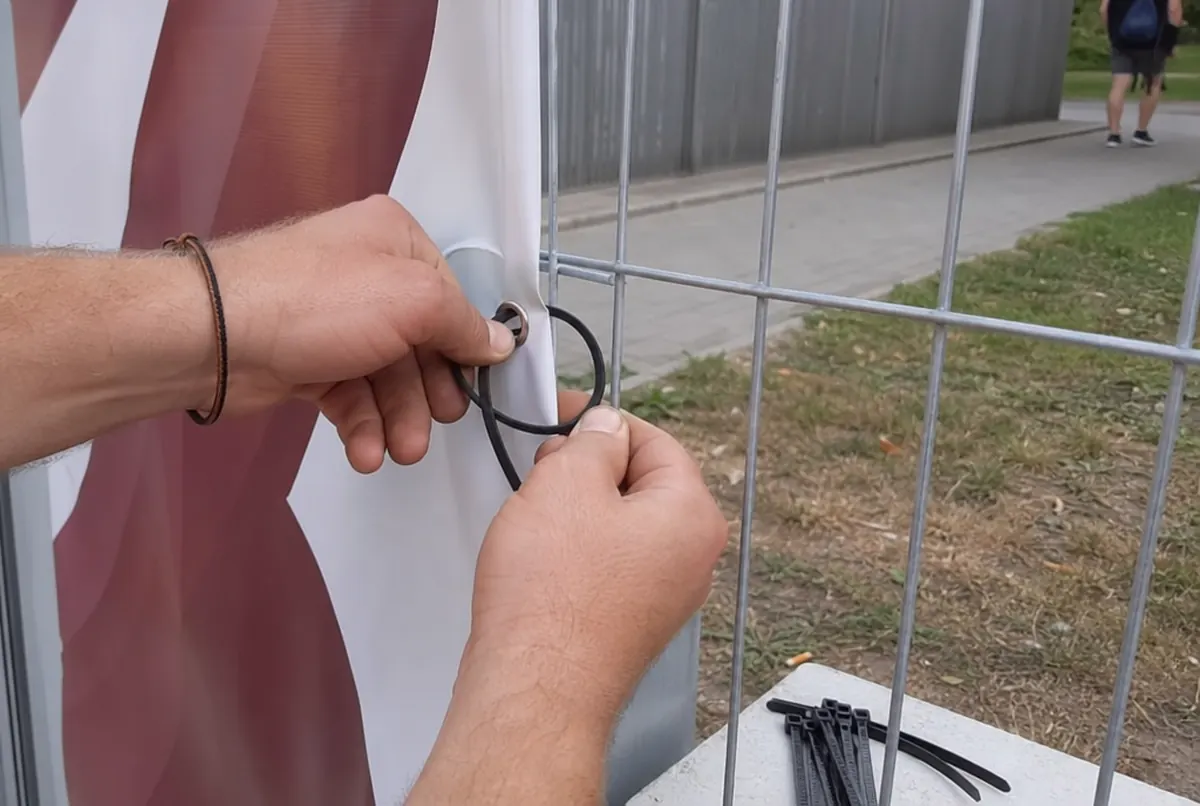
Fitting step by step
- Lay the banner on the ground face down on a clean surface and check which edge is the top. It sounds obvious, but banners do get hung upside down.
- Start with the top corners. Fix the top left and top right corners at the final height, loosely for now.
- Hang the whole top edge, working from the centre outwards. Every eyelet to a wire, rail or panel. The banner should hang straight, without waves.
- Fix the sides, then the bottom edge. The bottom also needs fixing at every eyelet, because wind lifts the banner from below.
- Adjust the tension. The banner should be smooth but not as tight as a drum. A few millimetres of slack at each fixing lets the material move.
- Trim the tie ends and check that no eyelet rests against sharp wire or the edge of a panel.
- Check after the first storm. If a fixing has failed, replace it straight away, before the neighbouring eyelets take its load.
Common mistakes and their consequences
| Mistake | What happens | How to do it right |
|---|---|---|
| Fixed at the corners only | The banner flaps, eyelets rip out within days | Fix at every eyelet |
| Banner pulled very tight | Tears at the eyelets in the first strong gust | A little slack; bungees in windy spots |
| One banner along the whole fence | Huge wind load, awkward to fit | Several banners, e.g. one per fence panel |
| White cable ties | They crumble in the sun and the banner sags | Black UV-resistant ties |
| Banner resting on sharp wire | Abrasion and holes in the material | Move the fixing, wrap the sharp spot |
| Cutting "wind slits" in the banner | The slits tear further and the artwork looks bad | In very windy spots order mesh |
- 24 hexpress printing (UV inks need no drying)
- approx. 3 daysstandard lead time
- up to 14 dayslarge and custom projects with installation
Plus courier delivery. Tell us your date — we plan production around it.
Which banner to order for a fence and what it costs
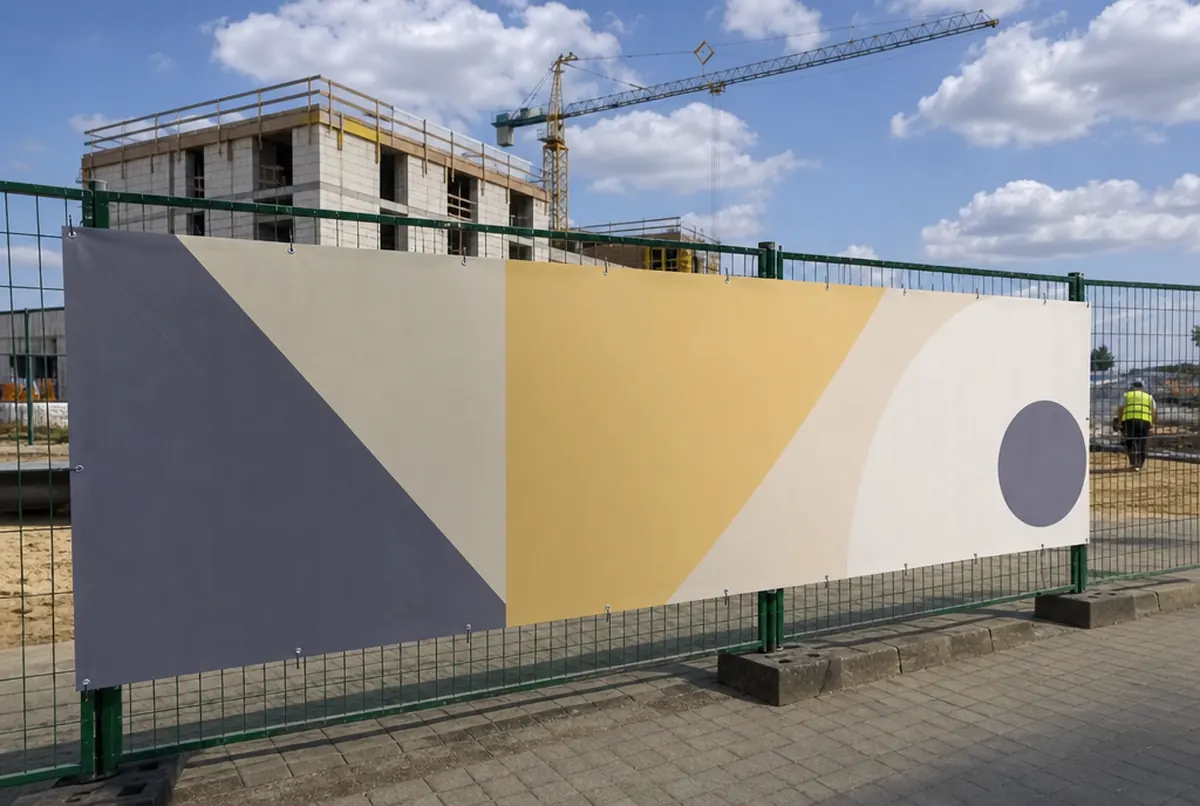
For a solid fence (wall, boards, sheet metal) we use a standard 510 g coated banner. For mesh fencing, panels and palings, a 550 g black-back banner works better: it blocks light, so the shadow of the structure does not show against the sun. For a short campaign a laminated banner is enough.
Example: a 10 m fence, banner 1.5 m high. That is 15 m², band 5–15 m².
- coated banner 510 g: 15 × approx. €9 = approx. €135 net,
- black-back banner 550 g: 15 × approx. €12 = approx. €180 net,
- eyelets every 25 cm around the whole edge (23 lm) for a very windy spot: 23 × approx. €0.80 = approx. €18 net.
The same 15 m² is worth splitting into three banners of 5 × 1.5 m: the area and price stay much the same, but hanging and any replacement are far easier. A ready overview of materials is on the fence banners page, and the full price list in how much does a PVC banner cost.
When to use eyelets every 25 cm and when mesh
Eyelets every 25 cm spread the load over twice as many points. We order them for banners by open fields, next to fast roads, at stadiums and sports pitches: anywhere nothing shelters the fence from the wind.
We choose mesh when the banner is large and high up, e.g. on a tall construction site hoarding, or when the wind has already destroyed an ordinary banner in that spot. Mesh cuts wind load by about 40%, but the artwork looks slightly lighter. Details in mesh or standard banner. For pitch fencing and stands, see also our guide to banners for stands and pitch fencing.