 Signs & Large Format Print
Which material for which position
| Position | Material | Finishing | Net price/m² |
|---|---|---|---|
| Mesh fence up to 1.5 m high | black-back banner 550 g | eyelets every 25–50 cm | approx. €9–16 |
| High fence, ball-stop netting | mesh 270 g | eyelets every 25 cm, reinforcing webbing | approx. €7–13 |
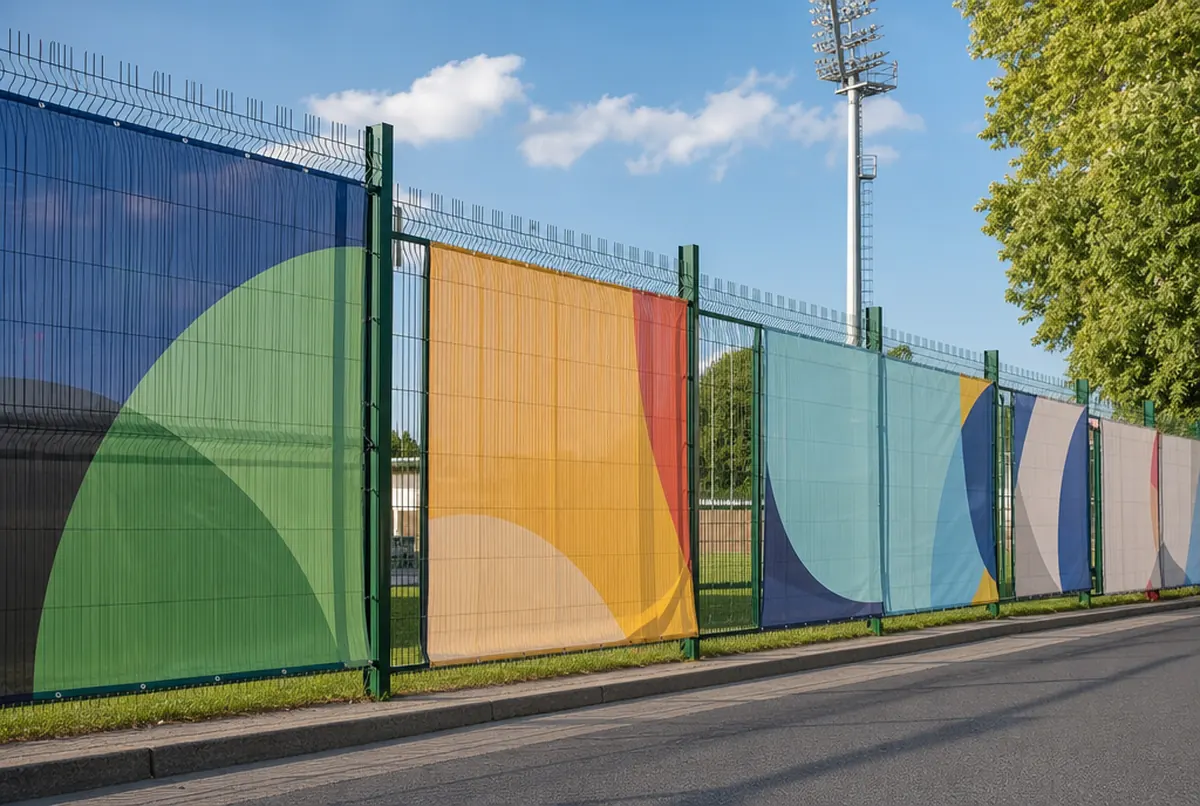
| Roadside fence, large formats | reinforced mesh 370 g | top/bottom pole pockets included | approx. €10–17 |
| Stand balustrade | coated banner 510 g | eyelets every 50 cm | approx. €7–13 |
| Event barriers (short term) | banner or mesh as a barrier cover | pockets or hook-and-loop | approx. €7–13 |
| Visible from both sides | double-sided blockout banner 650 g | eyelets every 50 cm | approx. €13–24 |
The lower price in each range applies to large orders (100 m² and more), the higher one to 1–4 m². Trimming, welded hems and eyelets every 50 cm are included in the print price. We print up to 3.2 m high in one piece, without welds.
Why banners at sports grounds tear – and how to prevent it
A banner on a pitch fence has a harder life than one on a building wall. It stands in open ground, the wind hits it from both sides, and on top of that come footballs and supporters leaning on it. When a damaged pitch banner comes back to us for replacement, the cause is almost always one of four things:
- Too few fixing points – the banner tied only at the corners or at every other eyelet. The wind tugs the middle and the eyelets rip out of the material.
- Solid banner on a high fence – several square metres of solid PVC on a 3–4 m fence is a sail. This calls for mesh, which reduces wind load by approx. 40%.
- One long strip – 20–30 m of banner in one piece is hard to tension evenly, and one tear means replacing the lot.
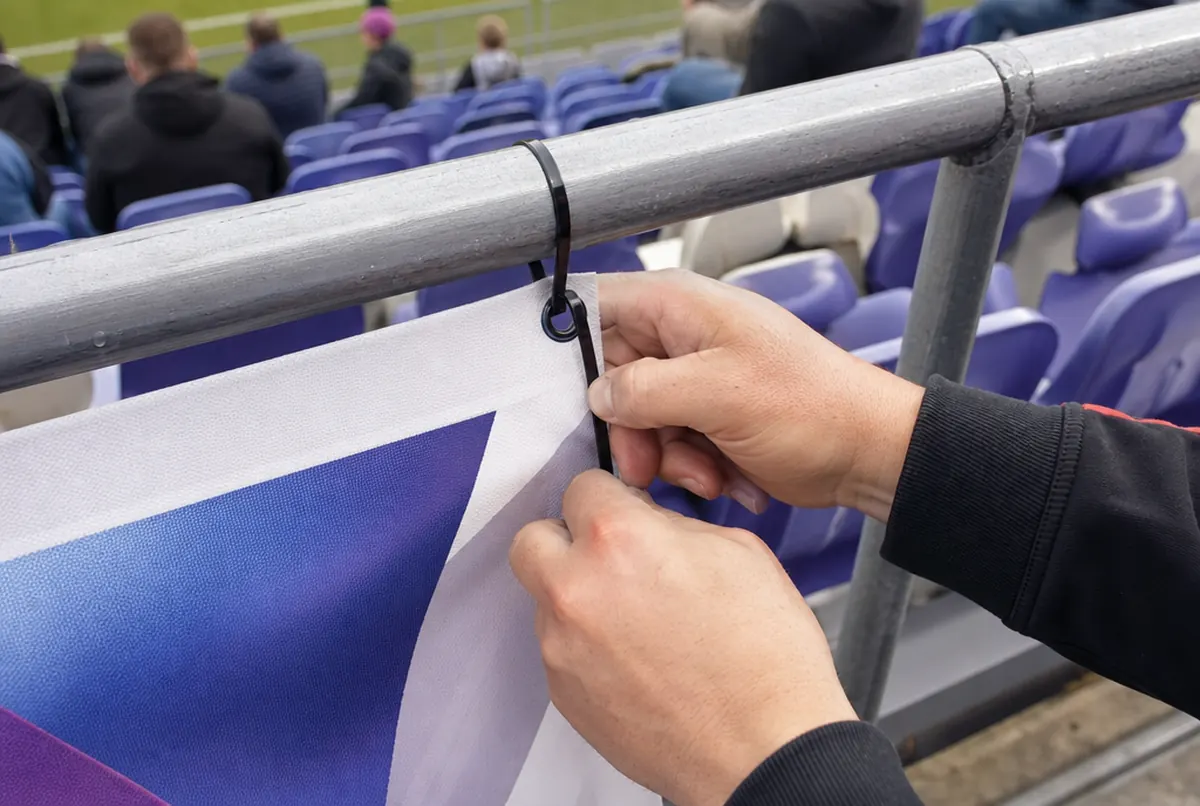
- Wire instead of cable ties – wire cuts through the material at the eyelet within a few weeks.
So for pitches we recommend eyelets at 25 cm spacing (approx. €0.80 net per metre) or reinforced eyeleting with a backing strip (approx. €1.45 net per metre), and for formats over 20 m², reinforcing webbing around the edge (approx. €3.05 net per metre).
Fixing, step by step
- Measure the bays, not the whole fence. The banner should end a few centimetres short of the post so it can be tensioned towards it.
- Split a long fence into 3–6 m sections. Easier to install, and easier to replace one damaged section.
- Start with the top edge – fix the corners, then the middle, then the remaining eyelets, keeping a light horizontal tension all the time.
- Fix the bottom edge last, pulling downwards. The banner should be taut but without diagonal folds – diagonal folds mean uneven tension.
- One tie per eyelet, or a length of bungee cord. Bungee absorbs gusts better; cable ties are quicker and cheaper.
- After the first storm, check the fixings and tighten any slack spots.
Hanging banners on fences in general (not just at pitches) is covered in our guide how to hang a banner on a fence.
Example: a roadside pitch fence
A club wants to screen and brand the fence facing the road: 25 m long, 2 m high, with the club logo and several sponsors. A tall panel fence in open ground, so 270 g mesh.
- Area: 25 × 2 = 50 m², rate in the 50–99 m² band approx. €7 → approx. €350 net.
- Split into 5 sections of 5 m (10 m² each) – each with eyelets all round; reinforcing webbing is not needed at these sizes.
- Eyelets every 25 cm on the top and bottom edges: 5 × 10 m = 50 m × approx. €0.80 = approx. €50 net.
Total approx. €400 net for printing. Installation, if our crew does it: a 2-person team at approx. €42 net per crew-hour plus travel at approx. €1 net per km both ways from Wieluń. A fence like this usually takes a few hours.
Doing the same as a single 25 m strip of solid banner would save little on material, but the risk of tearing in the first storm would be high.
- 24 hexpress printing (UV inks need no drying)
- approx. 3 daysstandard lead time
- up to 14 dayslarge and custom projects with installation
Plus courier delivery. Tell us your date — we plan production around it.
Stands and large public events
On a stand, the banner usually hangs on the balustrade – coated banner with eyelets every 50 cm is enough there, because a sheltered stand does not catch as much wind. It is important that the banner does not block the view from lower rows or obstruct gangways.
At matches and events with larger crowds, the organiser or venue operator may have their own requirements for materials and fixing points (for example the fire rating of the material, or escape routes). These are agreed with the venue operator and in the event documentation – ask what is required before you order, and we will choose the material accordingly.
For crowd-control and safety barriers used at events we make printed barrier covers – they go on in seconds and come off after the event. How to arrange sponsor boards around the pitch and what it costs is covered in our guide pitchside advertising boards for clubs.