 Signs & Large Format Print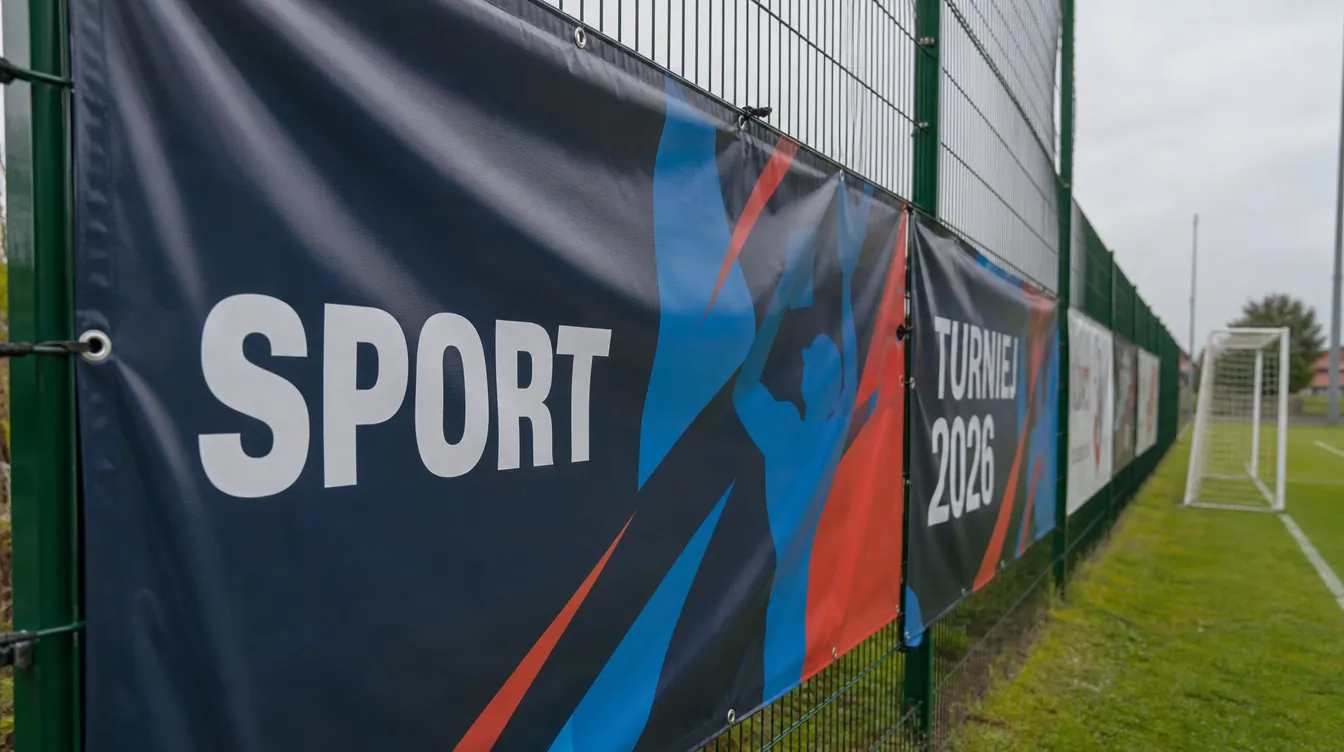
What pitchside and sports hall boards are made from
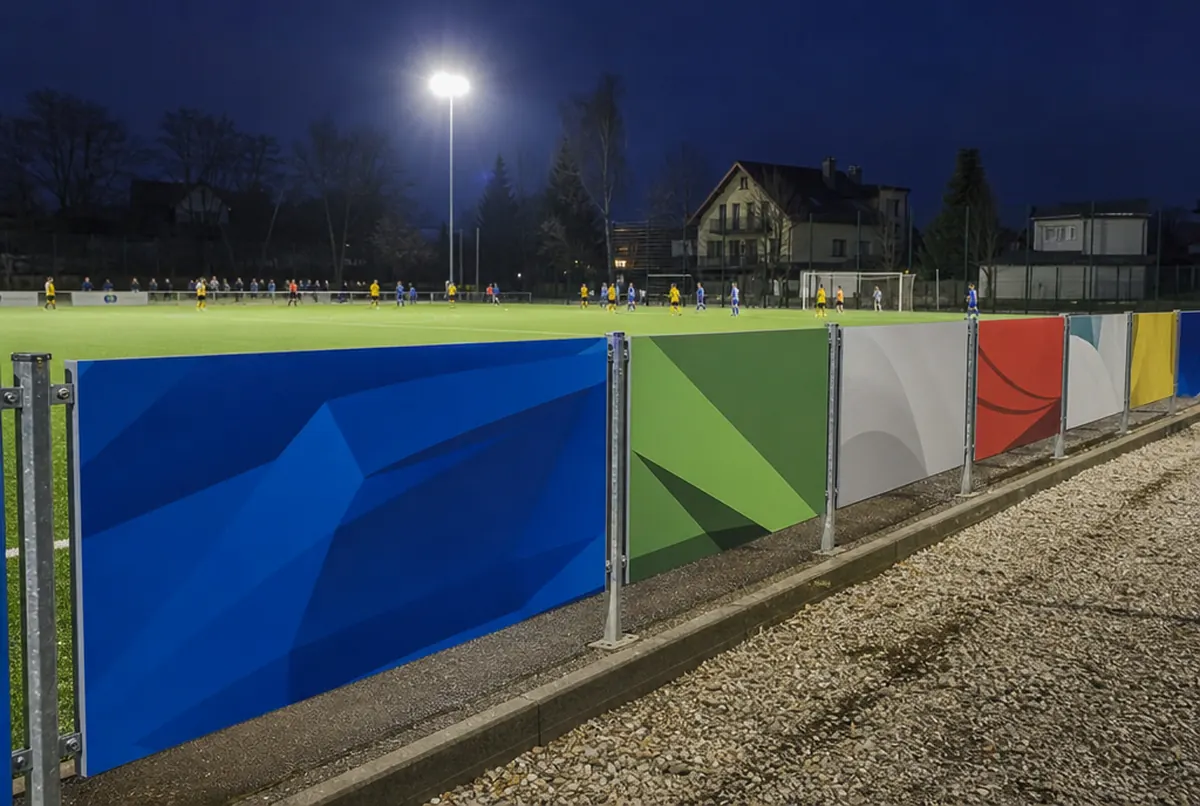
At a club, 'advertising board' usually means one thing: a strip with a sponsor's logo along the touchline, on the fence, a barrier or the wall of a sports hall. Technically there are four sensible options, and each has its place.
- Coated banner 510 g – the basic choice. Matt, so it does not reflect floodlights or hall lighting, and it lasts 2–3 years outdoors. We print it up to 3.2 m wide without welds, so even a long board is one piece.
- Black-back banner 550 g – for boards hung on mesh fencing that lets light through. Ordinary banner shows through against the sun and the logo looks washed out; the black reverse stops that.
- Mesh 270 g – for high fences and ball-stop netting where wind is a problem. The perforation reduces wind load by approx. 40%, but colours are slightly lighter than on solid banner.
- Foam PVC or dibond with UV print – a rigid board screwed to a frame. More expensive, but it does not ripple and looks good on camera. A common choice in sports halls and on courts.
LED perimeter boards (screens) are a separate technology that we price individually – our day-to-day work is everything printed on banner, mesh and boards. For tennis courts and court fencing, see our separate page on tennis windscreens and court boards.
What an advertising board costs – rates per m²
| Material | 1–4 m² | 5–15 m² | 16–49 m² | 50–99 m² | Where it works |
|---|---|---|---|---|---|
| Laminated banner 510 g | approx. €11 | approx. €8 | approx. €7 | approx. €6 | a tournament, one season (up to 12 months) |
| Coated banner 510 g | approx. €13 | approx. €9 | approx. €8 | approx. €7 | standard for 2–3 seasons |
| Black-back banner 550 g | approx. €16 | approx. €12 | approx. €10 | approx. €10 | see-through fencing |
| Mesh 270 g | approx. €13 | approx. €9 | approx. €8 | approx. €7 | high fences, wind |
| Foam PVC 5 mm | approx. €39 | approx. €33 | approx. €30 | approx. €27 | rigid boards indoors |
| Dibond 3 mm | approx. €55 | approx. €44 | approx. €40 | approx. €37 | rigid boards for years |
A real-life example: a club orders ten 6 × 1 m sponsor boards in coated banner. That is 60 m², so the 50–99 m² rate applies: 60 × €7 = approx. €420 net. The same quantity in black-back banner: 60 × €10 = approx. €600 net. A single board ordered on its own (6 m²) is 6 × €9 = approx. €54 net.
That is why we advise grouping boards into one order before the season rather than adding them one at a time when a new sponsor signs. The difference in rate is noticeable, and all the boards share exactly the same background shade.
Sizes and design: what the stand and the camera see
The most common format is 1 m high and 3 to 6 m long – dictated by the height of fences and barriers. Before you order, measure the actual bays. Fence posts every 2.5 m mean a different board length from posts every 3 m, and a board that overlaps a post never tensions properly.
A board design is not a flyer. Supporters look from 30–60 metres away, and the camera catches a board for a second. A few rules that work in practice:
- The logo and at most one line of text (a web address or phone number). No lists of services.
- Strong contrast: a dark logo on a light background or the other way round. A pastel background with light grey lettering disappears in the first sunshine.
- The sponsor's logo as a vector. A small JPG pulled off a website looks like a mosaic at 6 metres.
- All the club's boards in one layout (same background, same logo height) – the ground looks tidy and sponsors do not argue about who has the bigger logo.
If a sponsor has no print-ready file, our studio designs it: a simple banner is approx. €43 net, and adapting an existing design to another size approx. €13 net. More on file preparation: how to prepare a banner file for print.
Fixing boards – what to watch out for
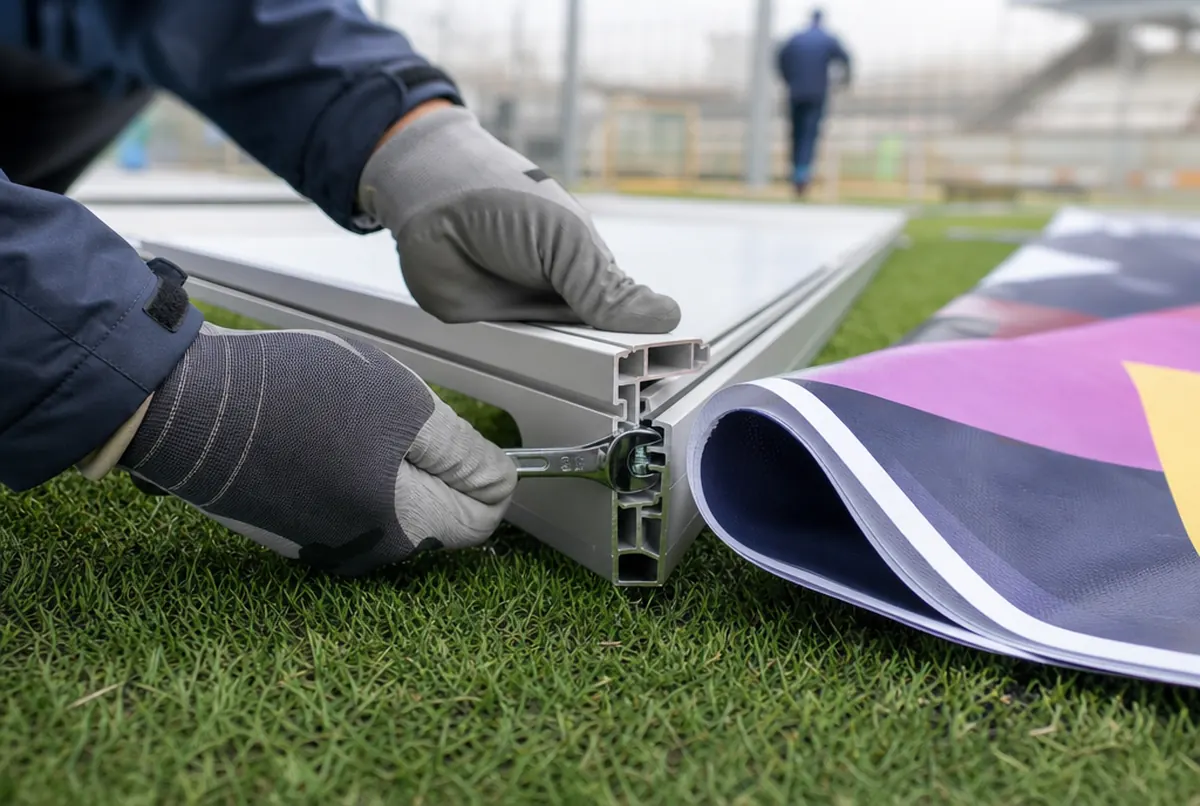
As standard we put eyelets every 50 cm around the edge, and that is enough on an indoor barrier. On an open pitch, where the board hangs on mesh fencing and catches the wind, we recommend eyelets every 25 cm (approx. €0.80 net per metre) or mesh. Boards are fixed with cable ties or bungee cord – bungee copes better with wind gusts, cable ties are cheaper and quicker.
The most common mistake is a board hung loosely 'on two eyelets'. After a few weeks of flapping it tears at an eyelet and has to be reprinted. Fixing on fences and stands is covered in a separate guide: banners for stands and pitch fencing.
Our own crew can install the boards for you: a 2-person team costs approx. €42 net per crew-hour (minimum 4 hours per visit) plus travel at approx. €1 net per km both ways from our plant in Wieluń; across the EU we also work with partner installers. Otherwise we deliver by courier or our own vans – boards are packed on a roll, never folded.
- 24 hexpress printing (UV inks need no drying)
- approx. 3 daysstandard lead time
- up to 14 dayslarge and custom projects with installation
Plus courier delivery. Tell us your date — we plan production around it.
Boards and sponsors – how to plan a season
A board is the simplest 'product' a club can sell to a sponsor. The material cost is small compared with what the sponsor pays for the exposure, so treat it as part of a package rather than a separate expense.
What works for clubs:
- Set fixed formats (e.g. 3 × 1 m and 6 × 1 m) and number the positions on the fence – the sponsor buys a specific spot, e.g. opposite the main stand.
- Order all boards in one go before the season starts.
- Keep 1–2 spare boards in the budget for sponsors who join mid-season.
- After the season, take the boards down, roll them up and store them somewhere dry – coated banner will easily do a second season.
More ideas on combining boards with other materials into a sponsorship offer are in our guide how a club can earn from sponsors. The full range of what we make for clubs is on our sports clubs page.