 Signs & Large Format Print
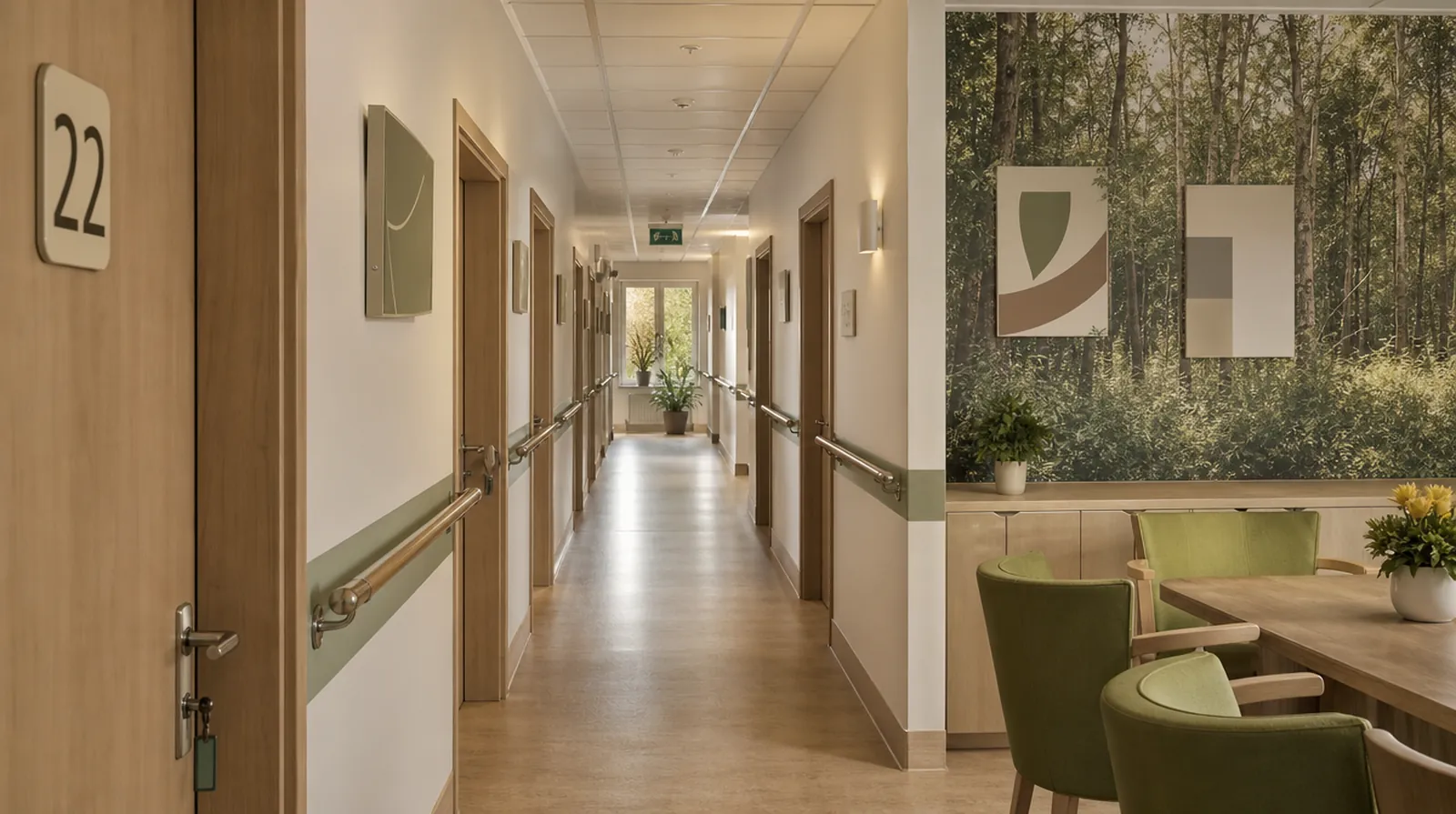 Illustrative visualisation
In a care home, signage has a different audience from an office or clinic. Some residents have poor eyesight, some have memory and orientation difficulties. 'Room 12' in a grey font means nothing to them. What helps is a large, high-contrast number, a corridor colour, a picture next to the word and something personal by the door. Staff know this but rarely have the time and budget to do it properly across the whole building at once.
The second group is families. They come at weekends looking for reception, visiting hours, parking. A private home also needs factual materials for those still choosing a place for a loved one. Homes run by local authorities usually order through public procurement, so to begin with we prepare a costing for the estimate and an item list. We install around the residents, calmly and quietly.
1. Entrance, approach and garden
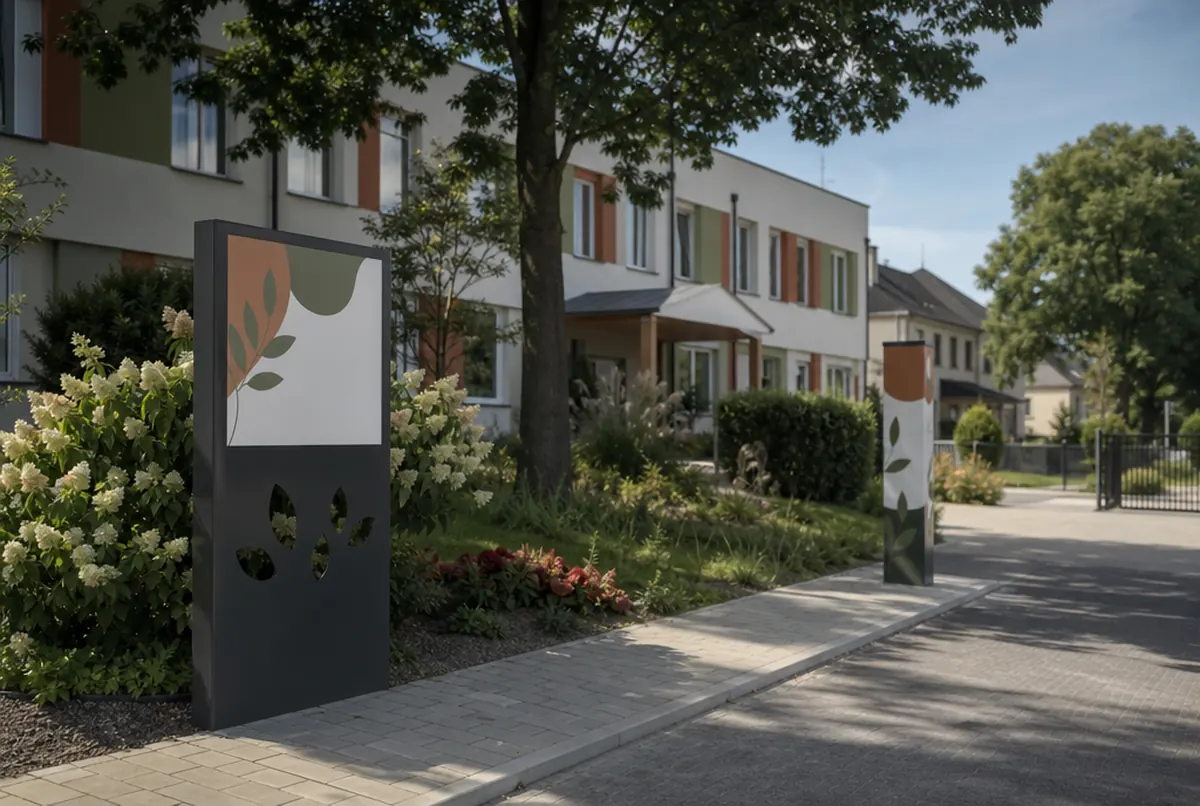
Outside you need the full name of the home, the building number, the visitors' entrance and visiting hours. In the garden a few signs along the paths help – for residents they're a destination for a walk, for families a way to get their bearings.
- Name board at the entrance→UV-printed dibond, approx. €35–55 net per m², built to last. With several buildings we sign each entrance separately.
- Totem at the entrance→When the home stands on a road or set back on its plot. A non-illuminated 2.5 m totem from approx. €750 net.
- Building number and address plate→Helps couriers, families and ambulances find the way. Dimensional digits 30 cm high from approx. €16 net per character.
2. Rooms and corridors
Simple things do the most here: each floor or wing in a different colour, a large high-contrast room number, a pictogram next to the word at the bathroom and dining room. By the room door, space for the resident's name and photo – with their consent, of course. The content changes often, so the name strip must be replaceable without calling a crew.
- Room signs with a changeable strip→Dibond or acrylic, a large permanent number, the name on a slide-in strip. Reception prints a new strip itself on an ordinary printer.
- Coloured bands and floor identification on walls→Monomeric vinyl wall graphics, approx. €6–12 net per m². Colour at eye level and a large floor number by the lift.
- Pictograms: bathroom, dining room, lounge→A picture plus a word, at the eye level of a wheelchair user. It helps when the same symbol is on the door and on the directional sign.
- Film for glass doors and partitions→A band of frosted film at eye level so the glass is visible. Approx. €12–21 net per m².
3. Communal areas
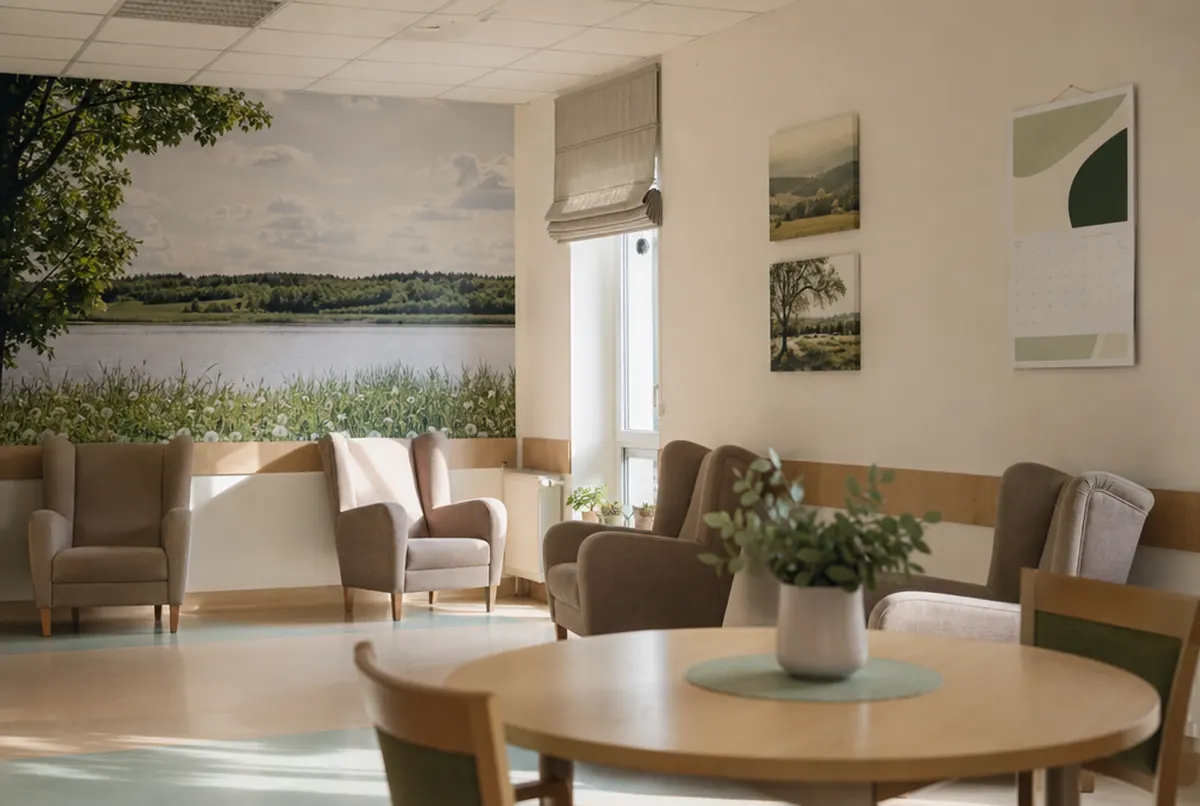
The dining room, lounge and corridor by the nurses' station are where residents spend most time. A calm wall with a view of a forest or your town's old market square can start a conversation better than the television.
- Landscape wall mural→Non-woven wallpaper with fire reaction class B-s1,d0, odour-free after hanging – we put it up with residents present. Approx. €15–25 net per m².
- Canvas prints of local photos→Old photos of the town, the church, the square. Canvas print approx. €15–24 net per m² plus stretcher frame approx. €27 net per m². We scan photos from prints.
- Large wall calendar→Clear day, month and season. Helps with orientation in time, and a version with photos from home life is also a gift for families.
4. Families and staff
Families want to know when they can visit, whom to call and what their loved one's day looks like. A short leaflet with this information saves reception many phone calls.
- Family information leaflet→Visiting hours, contacts, daily routine, admission rules. An A5 folder in a run of 1,000 costs approx. €90 net.
- Badges with a large first name→Residents may have poor eyesight, so the carer's name must be readable from a metre. 100 badges 90 × 50 mm cost approx. €60 net.
- Roll-up for an open day or summer fair→Stands at the entrance during the event, then goes back in its bag. An 85 × 200 cm roll-up from approx. €55 net.
5. Funded modernisation
Care homes often renovate with national and EU funding. A project plaque or poster then has to be displayed – the template, size and display period are set by the agreement.
- EU or grant-funded project plaque→Dibond 200 × 100 cm on a frame from approx. €165 net. The template from the agreement is all we need for the design.
- Fence banner during works→Information about a temporarily closed entrance and the way round. Coated 510 g banner approx. €7–13 net per m².
- 01Brief
Description, sizes, site photos and deadline — a few sentences are enough.
- 02Design and quote
Our designers prepare artwork or a visualisation and you get a price.
- 03Approval
You approve the design; for brand colours we provide a proof.
- 04Production
35+ machines in our own plant in Poland: 3.2 m UV print, CNC, laser, 3D, sewing.
- 05Installation or delivery
Own crews and vehicles across Europe, partner network, couriers worldwide.
To start with — an indicative package
A sample set for a home with about 40 rooms on two floors. Calculated from our price list, installation not included.
| 40 dibond signs 30 × 20 cm with a slot for a strip (2.4 m² × approx. €55) | approx. €132 net |
| Coloured bands and floor numbers, wall vinyl 6 m² (6 × approx. €8) | approx. €48 net |
| Frosted film for glazing, 6 m² (6 × approx. €16) | approx. €96 net |
| Dining room wall mural, 10 m² (10 × approx. €20) | approx. €200 net |
| 10 canvas prints 60 × 40 cm with frames (2.4 m² × approx. €50) | approx. €120 net |
| Entrance name board, dibond 150 × 50 cm (0.75 m² × approx. €55) | approx. €41 net |
Indicative net prices; an exact quote follows a short description and photos of the site. Installation: crew from approx. €42 net per hour plus travel at approx. €1 net per km.
From our experience — what to watch out for
- Test signage with residents, not just staff. If the lady in room three finds her way back without help, the system works.
- Avoid dark patches and strong patterns on the floor. To a person with impaired vision a black rectangle can look like a hole or a step.
- Matt surfaces rather than gloss. A lamp's reflection on a sign makes the lettering disappear.
- Make changing content (names, menus, activity plans) changeable. Only numbers and directions are permanent.
- Choose a calm wall mural. A landscape, a garden, familiar places – yes. Abstracts and harsh colours in a corridor tend to unsettle.