 Signs & Large Format Print
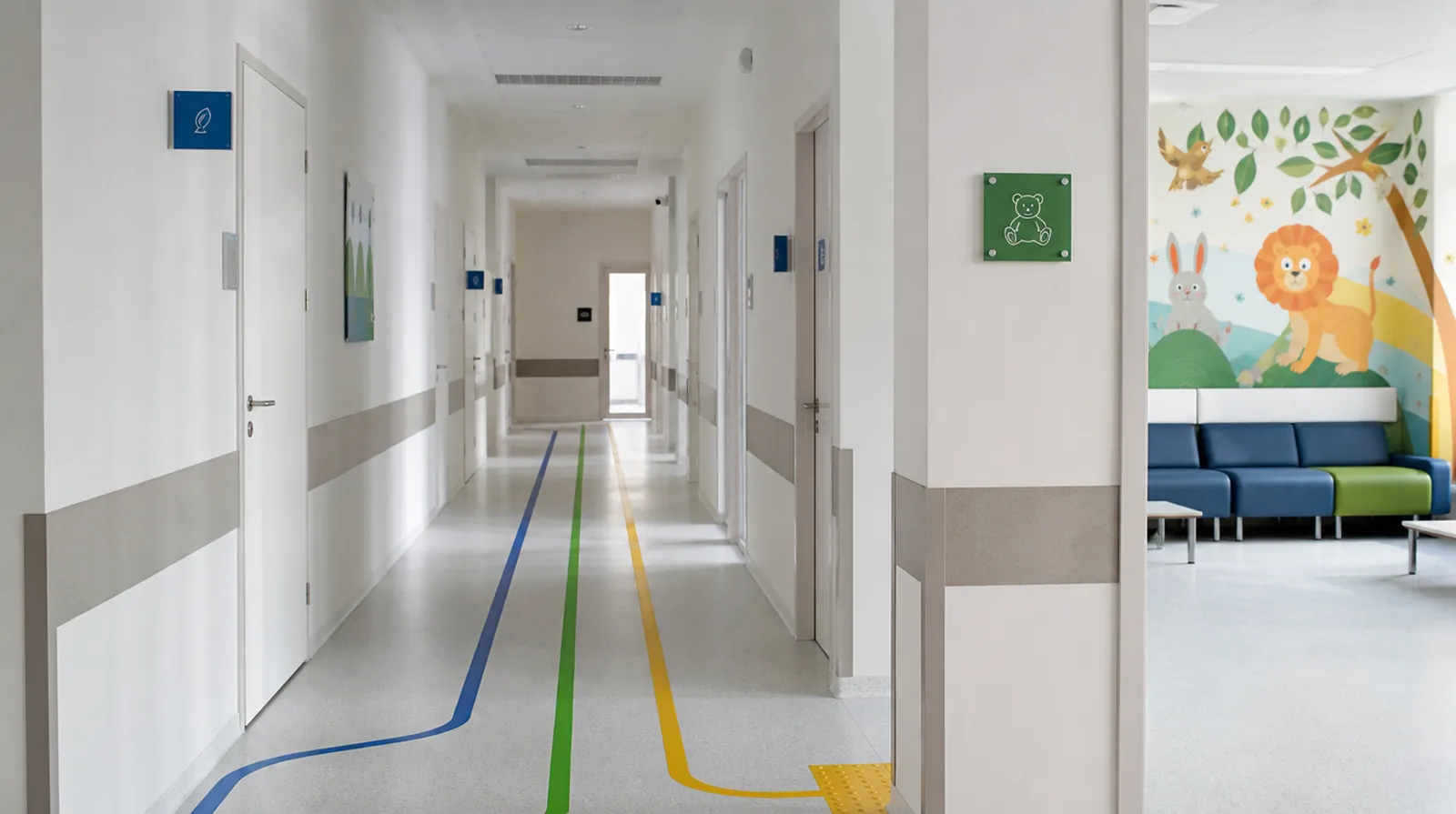 Illustrative visualisation
In a clinic, signage isn't decoration – it's how reception avoids answering 'where's room 12?' a hundred times a day. Patients may be elderly, anxious, carrying a child. They need to find the entrance, reception, the blood test room and the right door quickly. So with clinics we think first about the patient's route from the car park to the consulting room, and only then about colours.
Advertising of medical services is restricted in many countries by healthcare regulations and professional ethics. A clinic may give information about the services offered, opening hours and availability, but without the character of advertising. On top of that there are notices a clinic must display because of its contract with the public health insurer or patients' rights rules – the wording comes from the payer or your lawyer. We don't assess content legally; we turn it into durable, readable boards that withstand years of daily cleaning.
1. Approach and car park
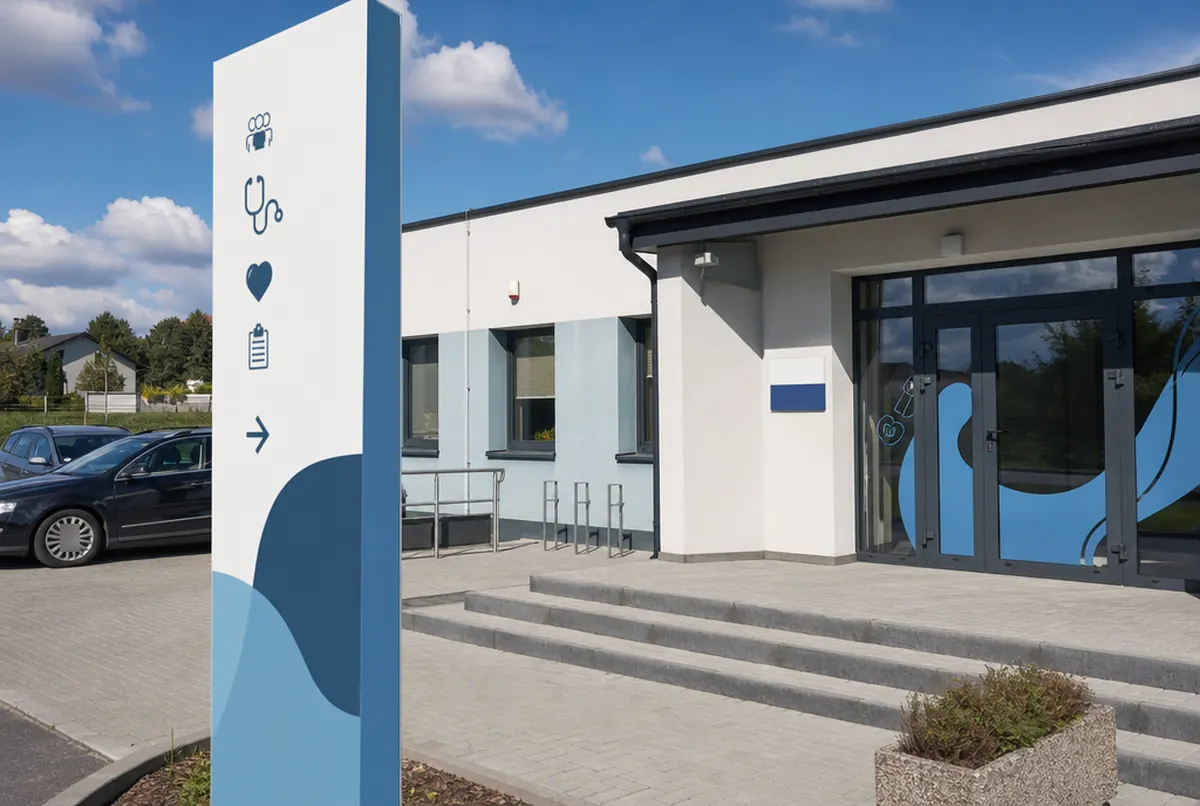
If the clinic is on a road or has its own car park, the first information must be visible from a car. Where several providers share one building, a totem listing all departments works well.
- Totem at the entrance→Dibond on a steel frame, 2.5 m high, from approx. €750 net. Holds the clinic name and a list of departments that can be changed later.
- Board or light box over the entrance→The clinic name visible from the street after dark too. In buildings with several entrances, we mark each one separately.
2. Entrance and reception
At the door a patient looks for three things: is this the place, is it open, and which way to reception. The answers must be at eye level, in a large font.
- Directory board with departments and hours→Dibond with UV print, or a panel with changeable strips if doctors' rotas change often. Outdoors it lasts for many years.
- Floor lines and arrows→A coloured line to reception, the blood test room or X-ray. Vinyl with R10 anti-slip laminate, approx. €19–30 net per m².
- Patient information boards→Patients' rights, notices required by the payer, house rules. Printed on PVC or dibond instead of an A4 sheet in a plastic sleeve.
3. Corridors and consulting rooms
In a larger clinic we do this as a [wayfinding system](/produkty/systemy-informacji-wizualnej): one font, one set of zone colours, numbering that matches the building plan. We start with a survey and a list of rooms, then the design, then production of the whole set.
- Wayfinding design and survey→On-site inventory from approx. €85 net, refunded with the production order. That way nothing hangs crooked and no signs are missing.
- Consulting room door signs→Printed acrylic on stand-offs, or dibond. The number is permanent; the doctor's name goes on a changeable strip.
- Floor directories→By the lift and stairs: what's on which floor. These take the most load off reception.
- Frosted film on glazing→Consulting room doors, treatment room windows, partitions at reception. Screens but lets light through; the room number can be cut into it.
4. Children's area and paediatrics
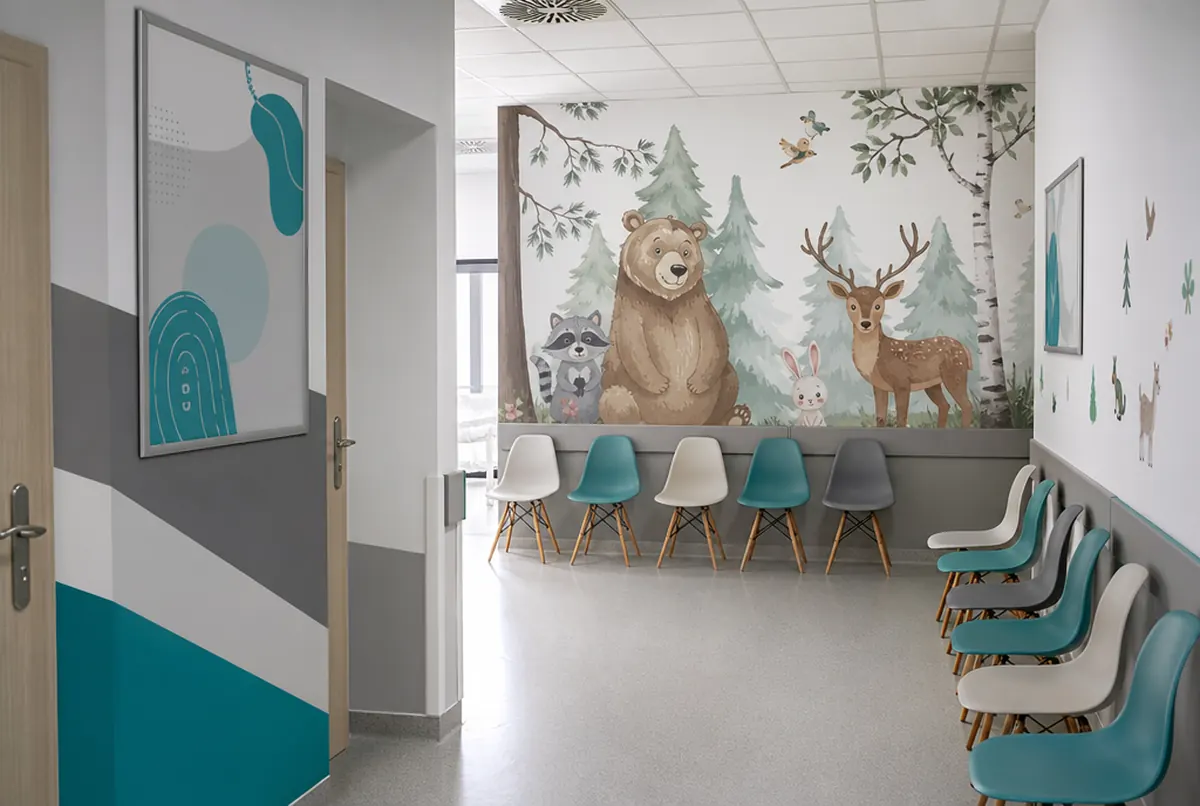
A child who isn't bored cries less in the waiting room. A cheerful wall costs little but makes a huge difference to parents and staff.
- Paediatric waiting room wall mural→B-s1,d0 rated non-woven wallpaper, odour-free after hanging, so we put it up in a working clinic. Animal motifs, forest, counting rhymes.
- Wall stickers and characters→Contour-cut animals, a height chart on the wall by the consulting room. Easy to add more without redecorating.
5. Information and print
Patient materials should inform, not persuade. Most often they're about prevention, vaccinations, screening programmes and booking rules.
- Framed posters in the corridor→Ten A2 posters cost approx. €28 net. You change the content each season; the frame stays.
- Roll-up for a vaccination or screening campaign→Stands in the waiting room for a few weeks, then goes back in its bag. An 85 × 200 cm roll-up from approx. €55 net.
- Booking information leaflets→Hours, phone numbers, online booking, what to bring to an appointment. An A5 folder in a run of 1,000 costs approx. €90 net.
6. Refurbishment and funded projects
Clinics are increasingly modernised with EU and national funding. Information plaques or posters are then mandatory – their design and size are set by the agreement and programme guidelines.
- EU or grant-funded project plaque→Dibond on a 200 × 100 cm frame from approx. €165 net, or an A3 poster inside the building. We'll prepare the design to the template in your agreement.
- 01Brief
Description, sizes, site photos and deadline — a few sentences are enough.
- 02Design and quote
Our designers prepare artwork or a visualisation and you get a price.
- 03Approval
You approve the design; for brand colours we provide a proof.
- 04Production
35+ machines in our own plant in Poland: 3.2 m UV print, CNC, laser, 3D, sewing.
- 05Installation or delivery
Own crews and vehicles across Europe, partner network, couriers worldwide.
To start with — an indicative package
Sample items for a clinic with about 12 consulting rooms on one level. Calculated from our price list, installation not included.
| Department directory board, dibond 100 × 150 cm (1.5 m² × approx. €55) | approx. €83 net |
| 12 acrylic signs 30 × 10 cm on stand-offs (0.36 m² × approx. €60 + 48 stand-offs × approx. €2.35) | approx. €135 net |
| R10 floor lines and arrows, 3 m² (3 × approx. €30) | approx. €90 net |
| Frosted film for glazing, 4 m² (4 × approx. €21) | approx. €84 net |
| Non-woven wall mural in the children's area, 8 m² (8 × approx. €20) | approx. €160 net |
| Entrance totem, 2.5 m high | from approx. €750 net |
Indicative net prices; an exact quote follows a short description and photos of the site. On-site survey from approx. €85 net, refunded with the production order.
From our experience — what to watch out for
- First walk the patient's route: car park, entrance, reception, consulting room, exit. Every point where someone stops and looks around needs a sign.
- Don't tape up A4 sheets. After a month they curl and the clinic looks neglected; a PVC board costs little more.
- Make the room number permanent and put names and specialisms on changeable strips. You'll save on every rota change.
- Use a plain font and strong contrast. Dark grey on light grey looks elegant, but an elderly patient won't read it.
- Before ordering boards, check which notices you must display under your contract with the public payer and patients' rights rules, and send us the final wording.