 Signs & Large Format Print
In short: who may have a say
We are not a law firm and do not give legal advice, but after years of fitting signs we know what clients ask the authorities and where problems usually arise. For a sign on a building, consent or an opinion may be needed from several parties at once:
- the building owner, landlord or managing agent: practically always, unless you own the wall,
- the municipality: if there are local design rules or a local plan with requirements for signs,
- the planning or building control department: where planning or building regulations require an application or notification (in the UK, for example, many illuminated signs need advertisement consent),
- the heritage or conservation officer: for listed buildings and in conservation areas,
- the highway authority: when the sign hangs over the pavement or carriageway or stands close to a road.
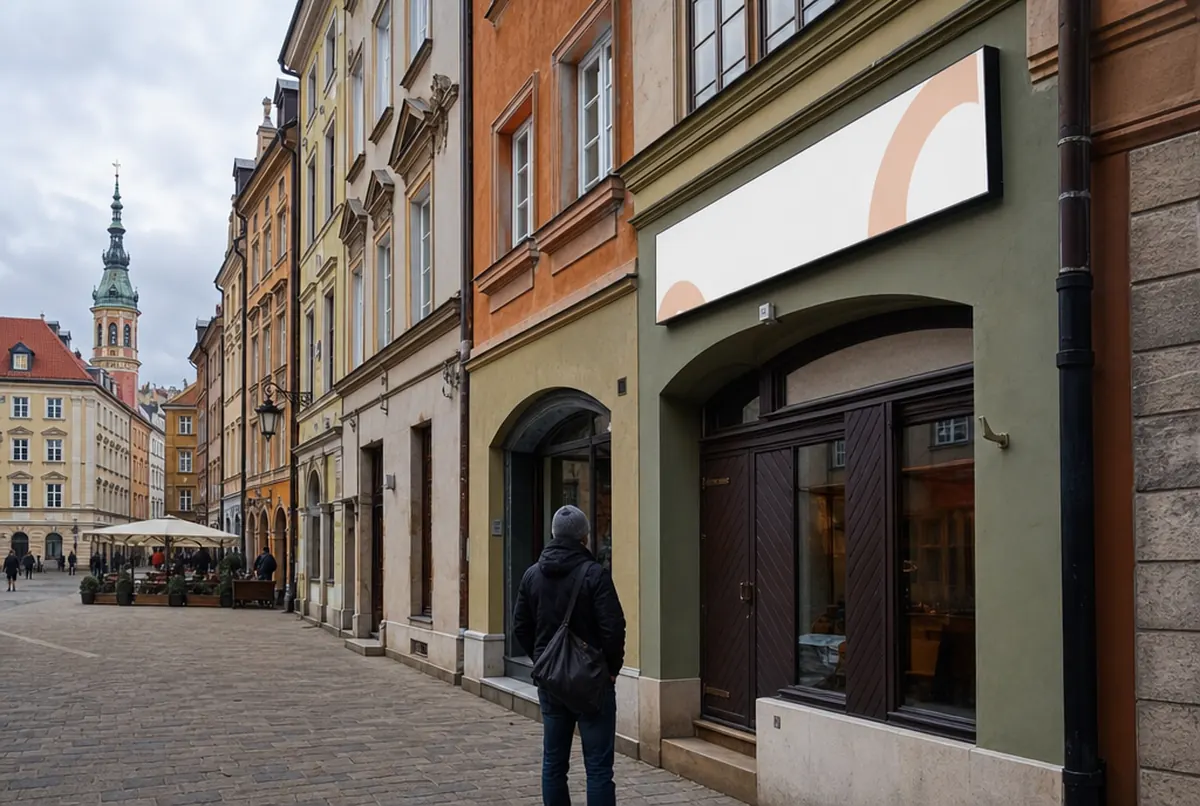
Every case is different. The same light box on a retail unit in a side street and on a period building in a historic town centre are two completely different routes through the paperwork.
Checklist before you order a sign
Before you order a light box or letters, go through these points. It takes a few phone calls and can save you a removal job.
- Lease or landlord's consent. Check whether your lease allows signs on the facade and whether it specifies their position or size. In shared or residential buildings you often need a formal decision by the owners or the managing agent.
- Local design rules. Ask the municipality whether any apply. Such rules can set the maximum sign size, the number of signs per business, and even whether a sign may be illuminated. Some towns also charge an advertising fee.
- Local plan. The local development plan sometimes has its own provisions on signs.
- Listed building or conservation area. If the building is listed or in a conservation area, do not fit anything without agreement from the heritage authority.
- Planning and building regulations. The planning department will tell you whether your sign needs an application or not. This depends on the type and size of the sign, whether it is illuminated and how it is fixed.
- Public highway. A projecting sign over a public pavement or a pylon next to a road usually needs agreement or a licence from the highway authority.
Regulations change and every municipality has its own rules. Treat this list as a set of questions for the authority, not a ready answer.
Common situations and where to ask
| Situation | What to watch out for | Where to ask |
|---|---|---|
| Light box above a shop entrance in a residential block | Owners' or landlord's consent, local design rules | Managing agent, municipality |
| Letters on your own company building | Local design rules, local plan, possible planning application | Municipality, planning department |
| Sign on a period building in a historic centre | Heritage approval, local design rules | Heritage or conservation officer, municipality |
| Projecting sign over the pavement | Highway licence, clearance height above the pavement | Highway authority, building owner |
| Freestanding pylon by a car park | Structure and foundation, distance from the road | Planning department, highway authority |
| Light box in a shopping centre | Centre rules, tenant fit-out guidelines | Centre management |
Shop sign vs advertising board: why the distinction matters
Local rules usually treat a shop sign (information about a business placed where that business operates) differently from an advertising board or advertising structure that can promote anything, including something located elsewhere. Shop signs tend to be treated more leniently, but they are often still restricted.
In the local rules we have come across on different projects, similar provisions keep coming up:
- maximum sign area or height,
- number of signs per business or per facade,
- position, e.g. only within the ground-floor band or within the shop window,
- preferred form, e.g. letters rather than panels, restrictions on light boxes,
- lighting rules, e.g. no flashing or changing light.
Every municipality writes its rules differently, so treat these points as examples, not rules. If the authority sends you an extract from its guidelines, forward it to us with a photo of the facade and we will adapt the design to it.
- 24 hexpress printing (UV inks need no drying)
- approx. 3 daysstandard lead time
- up to 14 dayslarge and custom projects with installation
Plus courier delivery. Tell us your date — we plan production around it.
How we help with the paperwork
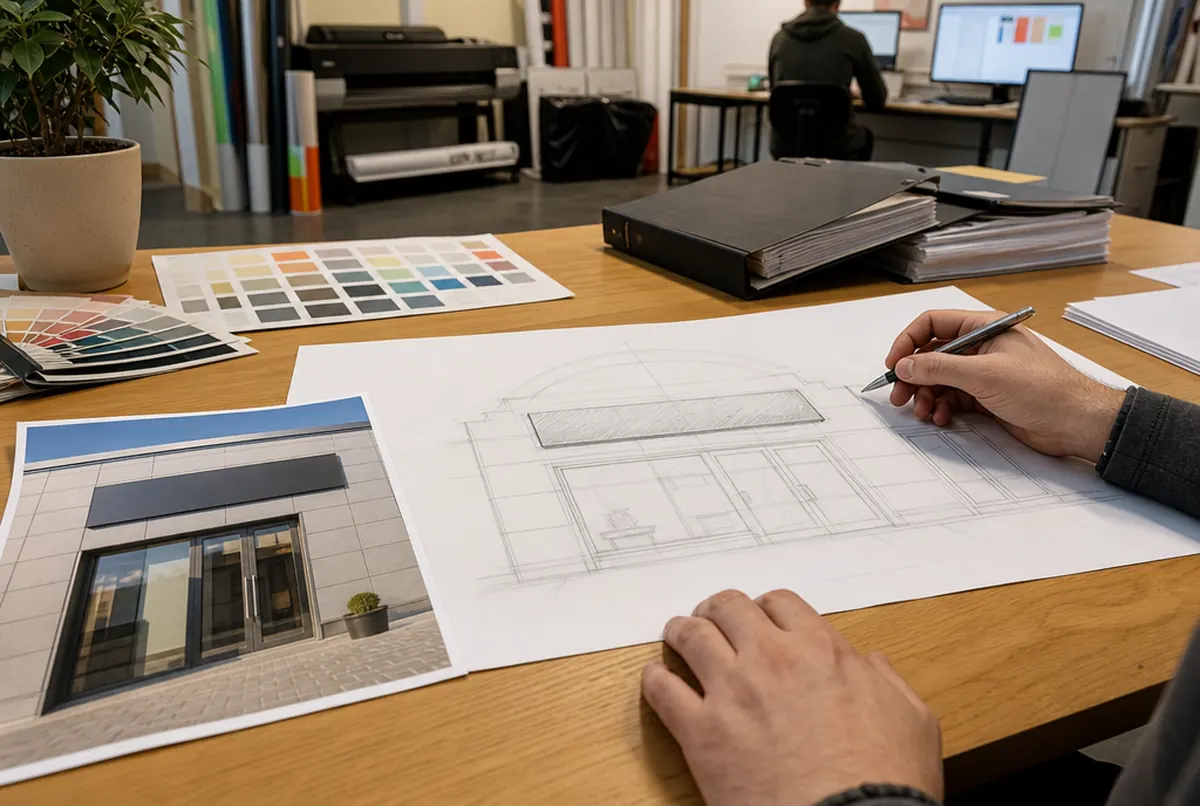
A planning officer, landlord or heritage officer will rarely accept a description such as "3 m light box on the wall". They want to see what it will look like and how it will be fixed. So we prepare:
- a visual on a photo of the facade and a technical drawing with dimensions and fixing method, from approx. €85 net,
- a site survey, from approx. €85 net, refunded when you place the production order,
- support with heritage approval or the application documents in conservation areas and where local design rules apply, from approx. €210 net. Abroad we prepare the drawings and visuals; the application itself is usually filed by you or a local contact, as procedures differ from country to country.
The design can often be adjusted to fit the rules: a smaller light box, letters instead of a panel, halo lighting instead of a fully lit face. How these options differ visually is explained in the guide light box or 3D letters.
What not to do
Do not order production until you have the building owner's consent in writing. It is the most common reason a finished sign sits in storage for months.
Do not rely on "the neighbour has the same one". The neighbouring sign may have gone up before the current rules came in, and new rules usually give existing signs a transition period, while new ones have to comply straight away.
Do not assume that a small sign needs nothing. In a conservation area even a small panel on stand-offs may need approval.
If you are planning advertising across a whole facade, with a banner, mesh and letters, also read advertising on a building facade. Sign designs and pricing are on the shop signs and company plaques and LED light boxes pages.