 Signs & Large Format Print
Why a projecting sign when you already have one on the wall
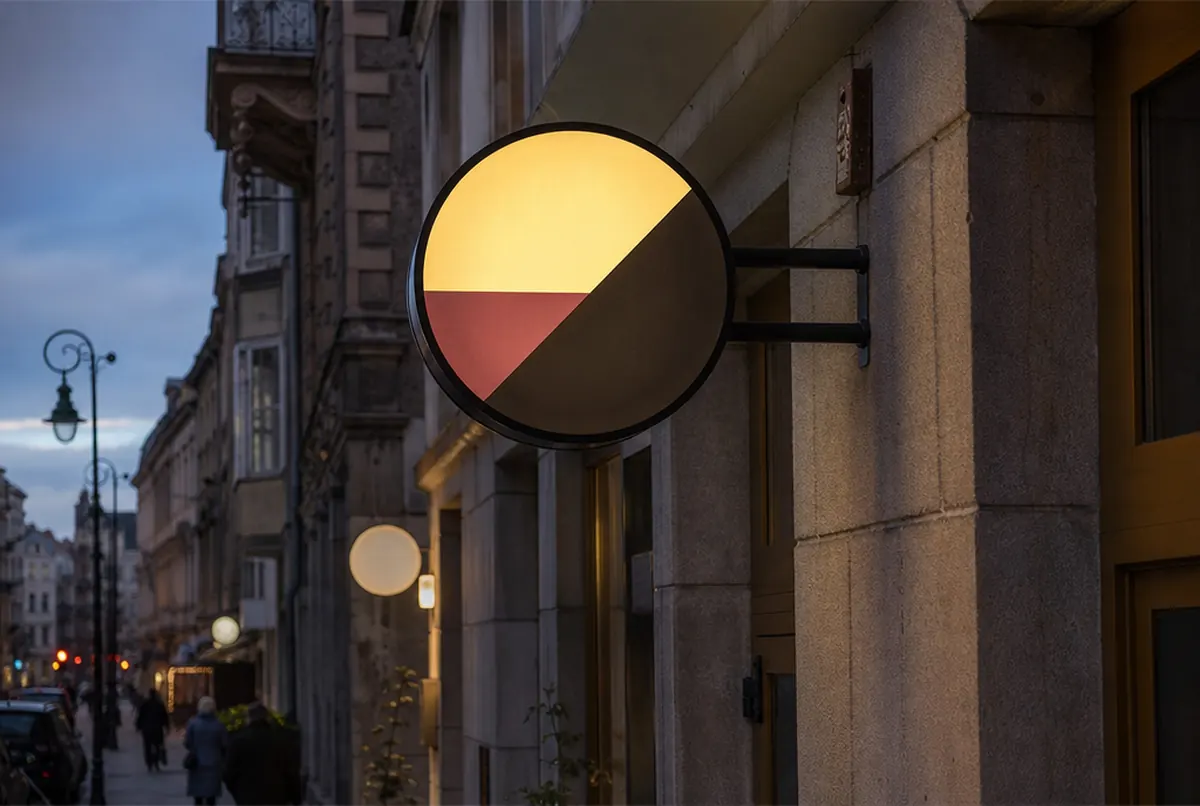
A flat sign is easy to see from across the street. The trouble is that in a narrow street, an arcade or a pedestrian zone nobody looks at the building from opposite: people walk along the pavement, parallel to the wall. From that angle a fascia light box is seen so obliquely that the name cannot be read.
A projecting sign sticks out at right angles towards the passer-by. It shows the logo to both directions of foot traffic: those coming from the left and those coming from the right. It works like a railway signal, visible from a distance along the line you are moving on.
That is why you see so many of them outside pharmacies, bureaux de change, hairdressers, cafes and shops in town centres.
When it pays off and when it does not
| Situation | Does a projecting sign make sense | Why |
|---|---|---|
| Narrow street, pedestrian zone, arcade | Yes, definitely | Passers-by walk along the facade |
| Unit in the middle of a terrace of period buildings | Yes | Picks the entrance out from neighbouring signs |
| Retail unit by a wide road with a car park | Probably not | A flat sign or pylon is easier to see from a car |
| Pharmacy, bureau de change, service point | Yes | Customers look for the sign from afar, often in a hurry |
| Detached building on its own plot | Rarely | A pylon or totem will work better |
| Conservation area | Possibly, after approval | Often accepted instead of large flat light boxes |
The combination works best: a flat sign or letters above the entrance and a projecting sign at the corner of the facade. The first says "it's here", the second "this way".
What a projecting sign costs
- Illuminated double-sided projecting sign with bracket: from approx. €300 net for the set. This is a typical small projecting sign, round or rectangular, by the entrance to a shop.
- Larger double-sided light boxes with an acrylic and vinyl face: from approx. €410 net per m². Example: a 100 × 100 cm projecting sign is 1 m² × €410 = approx. €410 net for the light box, plus a bracket matched to its weight and size.
- New face (backlit film, fitted) when the logo changes: from approx. €80 net per m², without replacing the structure.
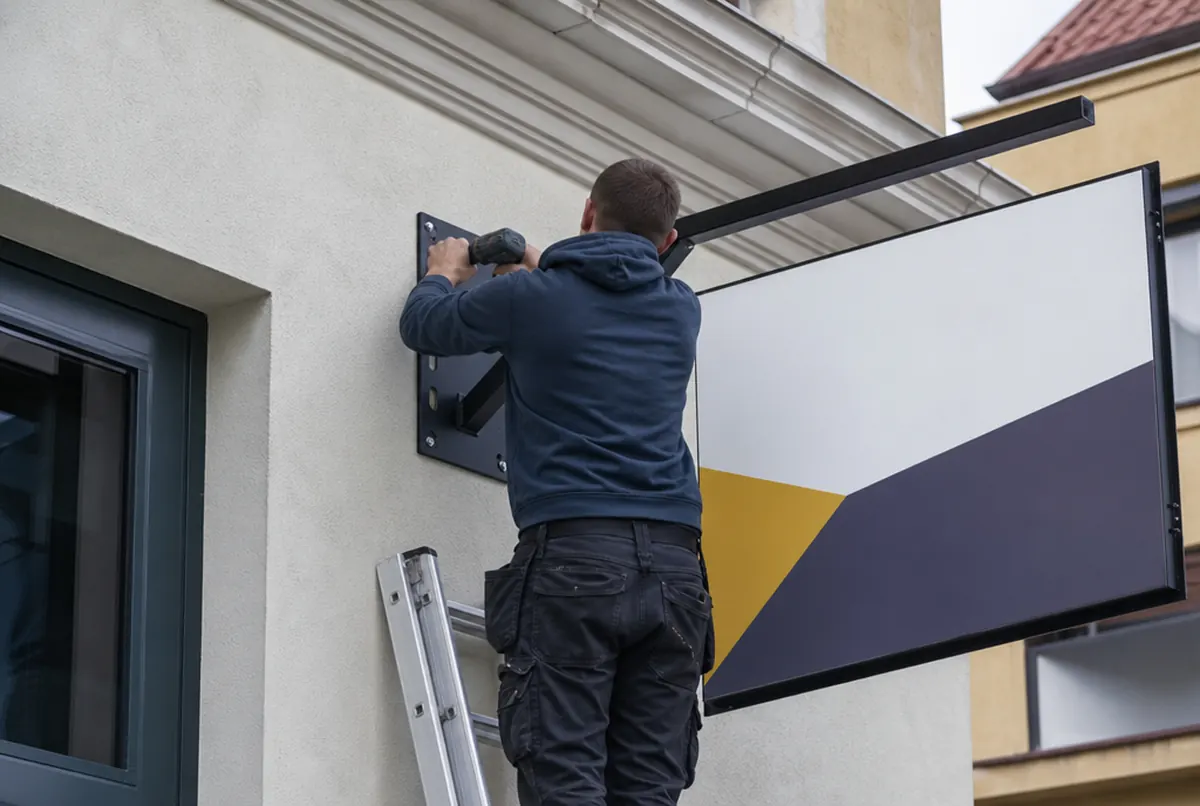
Then installation: a two-person crew at approx. €42 net per hour (minimum 4 hours) and travel at approx. €1 net per km both ways from Wieluń. A projecting sign at first-floor level is usually fitted from a ladder or scaffold; higher up, from a cherry picker (from approx. €230 net per day).
Configurations and guide prices are on the double-sided projecting signs page.
Which shape and size to choose
Rectangular and round projecting signs are the most popular. A rectangle fits a longer name better; a circle looks good with just a logo or a trade symbol, such as a pharmacy cross. A shape following the logo outline is possible, but that means routing and bending the profile, so it costs more.
We size the sign to the street and the building. In a narrow old-town lane a small projecting sign is perfectly legible, because passers-by walk right past it. On a wider street, where the sign should also be visible from the road, a larger format is better. A projecting sign that is too big overwhelms a low period building and can be hard to get approved by the landlord or the heritage officer.
Keep only the essentials on the face: the logo, the name, or one word such as "Pharmacy", "Exchange", "Pizza". A phone number or opening hours on a sign several metres overhead are practically unreadable.
- 24 hexpress printing (UV inks need no drying)
- approx. 3 daysstandard lead time
- up to 14 dayslarge and custom projects with installation
Plus courier delivery. Tell us your date — we plan production around it.
What to watch out for
Wind and fixing. The bracket acts as a lever: every gust tugs at the fixing in the wall. That is why we anchor projecting signs into the masonry, not just the insulation, and size the bracket to the light box. On an insulated facade the anchors must reach the load-bearing layer.
Height above the pavement. The sign must not hang so low that someone could hit their head on it, and over a public pavement the clearance and projection may be set by the highway authority or local rules.
Paperwork. A sign projecting over the public highway usually needs agreement or a licence from the highway authority, which may come with a fee. You also need consent from the building owner or landlord. More in does a shop sign need permission.
Both sides. A projecting sign has two faces. They can be identical or different, e.g. the logo on one side and opening hours on the other. Just keep the design legible at the size it hangs, several metres overhead: little text, a big logo.
How to order a projecting sign, step by step
- Take a photo of the facade straight on and one from the pavement, from a passer-by's viewpoint.
- Measure the height from the pavement to the mounting point and check what the wall is made of; tips are in how to measure the space for a shop sign.
- Send your logo, preferably as a vector file, and tell us whether both sides should be the same.
- You receive a quote and a visual. With a visual it is easier to get consent from the landlord or highway authority.
- Once approved, we produce the sign and arrange installation. The electrical connection is made by your electrician or our qualified crew.