 Signs & Large Format Print
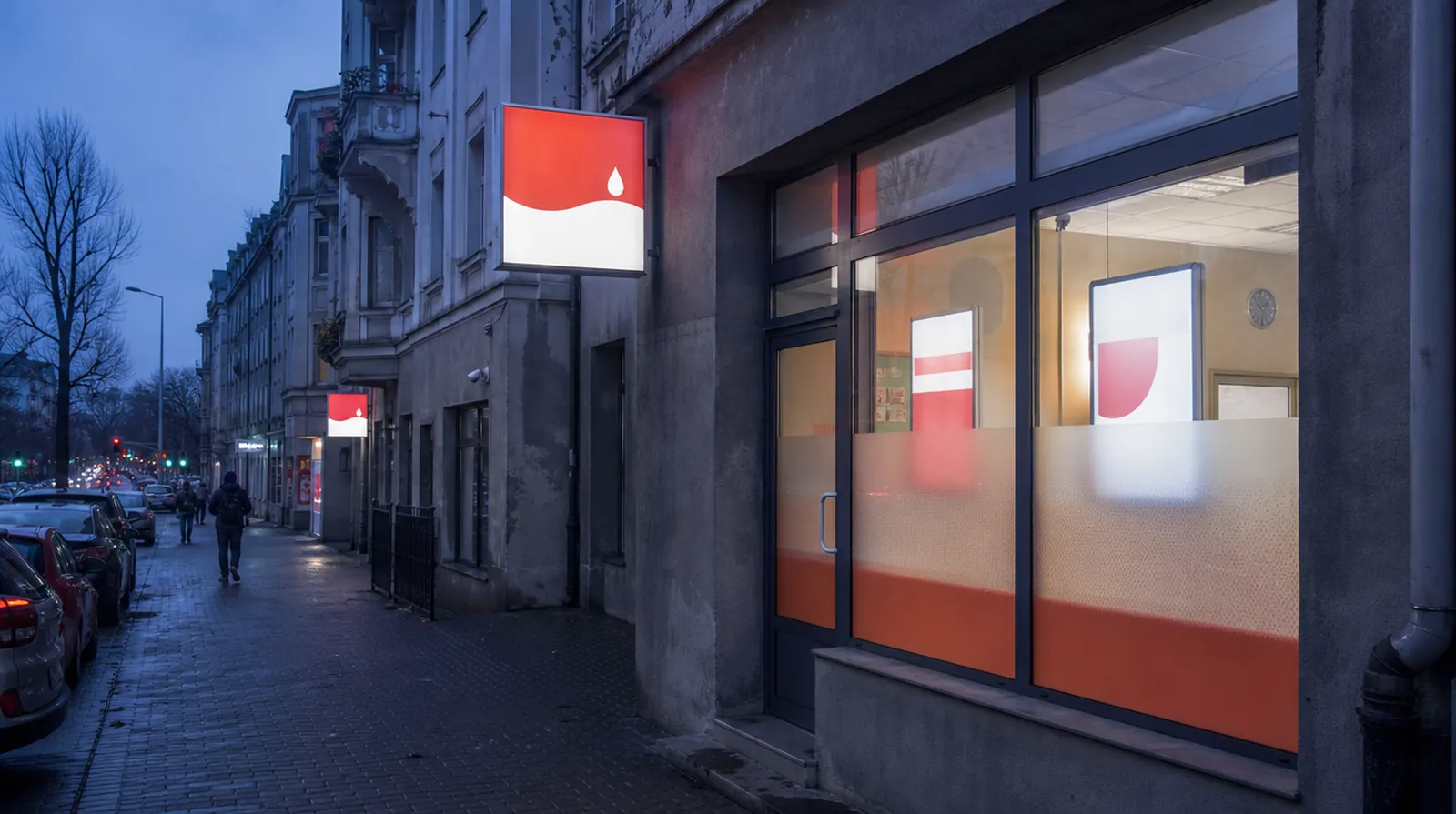 Illustrative visualisation
A blood collection point works differently from a shop. Most people come in the morning, fasting, in a hurry before work. They look for the entrance, check the hours and whether they need a ticket. In the afternoon the point is often already closed, so collection hours must be visible from the pavement, not only on the door. The second issue is privacy: the blood draw chair mustn't be visible from the street.
A laboratory is a healthcare provider, so materials should inform (tests offered, hours, preparation, prices) without the character of advertising. The clinical content is prepared by the lab, and any legal questions by its lawyer. Much of the market consists of networks with dozens of sites. Then consistent colour in every town matters, along with kits packed separately for each site and installation after collections have finished for the day.
1. Facade and window
A collection point is often in a terraced building, a retail unit or next to a clinic, squeezed between other signs. A [projecting sign](/poradnik/semafor-reklamowy-co-to) at right angles to the wall can be seen from the pavement in both directions; a flat fascia only from across the street.
- Double-sided projecting sign→An illuminated light box on a bracket, from approx. €300 net. On winter mornings it's still dark, and people come for blood tests before 7 am.
- Light box over the entrance→Single-sided light box from approx. €320 net per m². For a network we make them all to one colour specification.
- Window with collection hours→Collection hours separate from opening hours, phone, online results information. Printed vinyl approx. €6–12 net per m².
- Film by the blood draw station→Frosted film on the lower part of the window or on the room's glazing. A patient with a rolled-up sleeve isn't on display. Approx. €12–21 net per m².
2. Inside the collection point
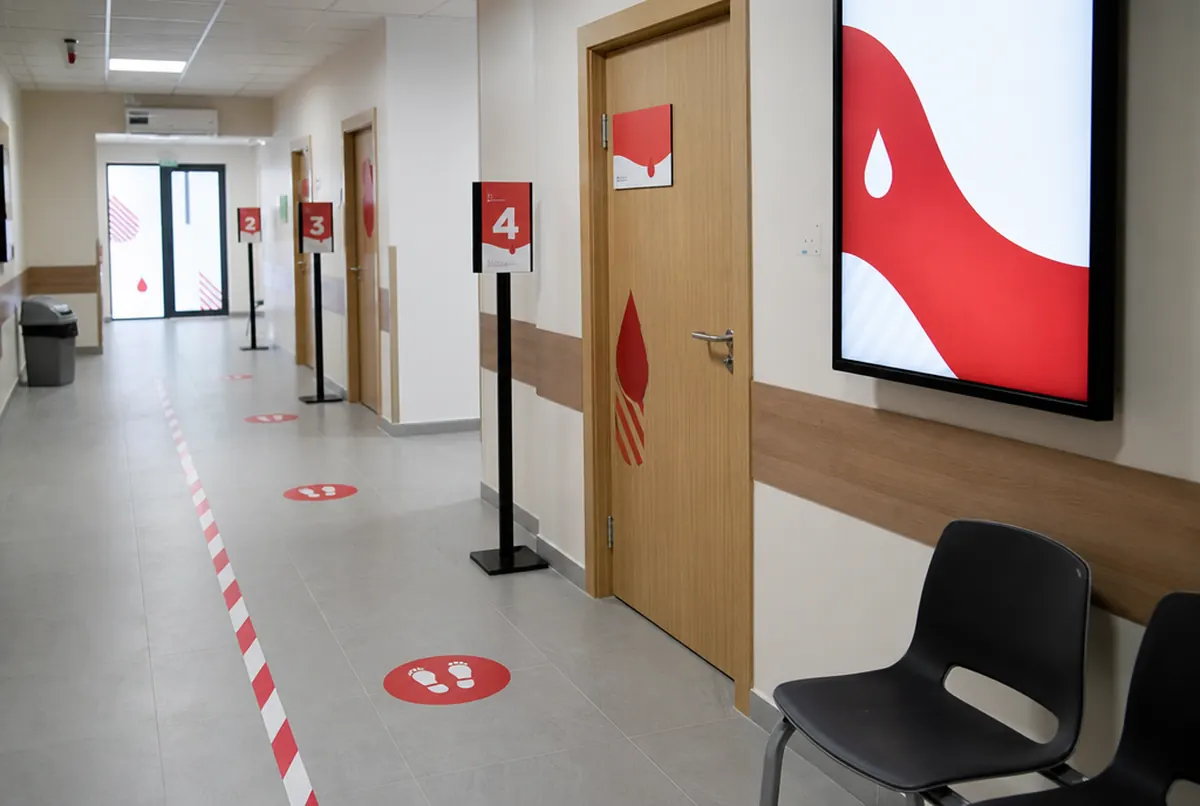
Inside, patients need to find out where to sit, when to go in and how to hand in a sample brought from home. The fewer questions at the desk, the faster the queue moves.
- LED frame with changeable graphics→An ultra-slim light box with graphics for seasonal test packages and information. A1 from approx. €165 net; the graphic changes in a minute.
- Queue and station floor markings→A 'please wait here' line, station numbers, the way to the draw room. Vinyl with R10 laminate approx. €19–30 net per m².
- Signs: blood draw, sample drop-off, toilets→Acrylic or dibond, readable from the waiting area. For sample drop-off a pictogram helps, because people don't like asking.
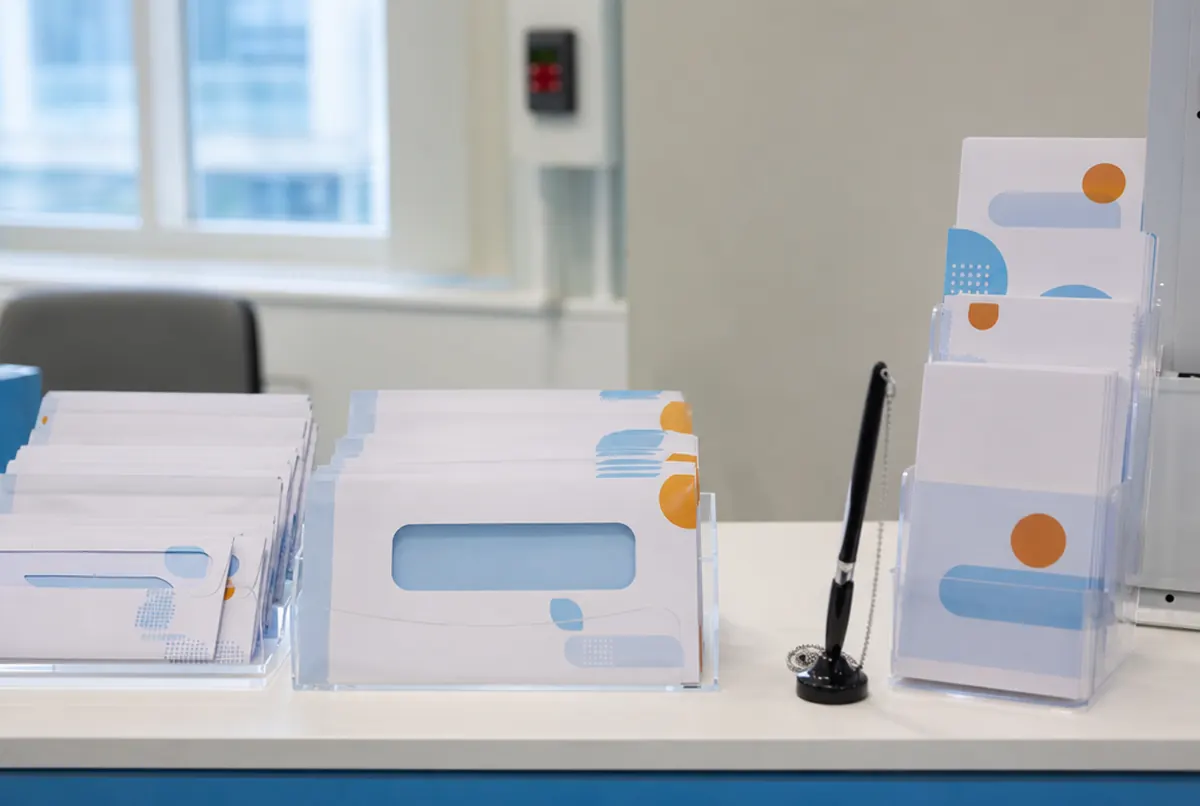
- Counter leaflet holder→Clear acrylic, laser cut and bent, with space for test preparation leaflets. Quoted by size.
3. Print for patients
The most common question at a lab is how to prepare. A well-written leaflet, with content from the lab, saves repeat tests and stress.
- Test preparation leaflets→Fasting or not, how to collect a sample at home, when results are ready. A DL folder in a run of 1,000 costs approx. €90 net.
- Results envelopes→With logo and contact details, sized for printed results. Quoted by quantity and format.
4. Network of sites
With a network, most time is lost on logistics: which site has which window, how many frames, who applies the film. So on the first order we make a list of sites with dimensions, and after that we just ship ready packs (just as for [pharmacies](/branze/apteka)) or install with a crew.
- Campaign kits for every site→Posters, film, frame graphics, leaflets – packed separately for each address. Kitting approx. €3.30 net, shipping approx. €2.80 net per site.
- Rollout with photo report→Site survey approx. €85 net, then production and installation with photo documentation of every location. We usually install after collections finish, without closing the site.
- Light box face replacement in a rebrand→New backlit film on the existing structure from approx. €80 net per m², cheaper than a new light box. We keep the colour consistent across the network.
5. Mobile campaigns
Testing at workplaces, community fairs, in local authorities – then the collection point has to be signed in an unfamiliar place, often for a single day.
- Roll-up at a mobile collection point→Lab name, scope of the campaign, order of registration. A 100 × 200 cm roll-up from approx. €65 net.
- Car or van livery→A courier car or mobile collection unit, recognisable in the car park. Cast vinyl approx. €19–29 net per m² plus laminate approx. €8 net per m².
- 01Brief
Description, sizes, site photos and deadline — a few sentences are enough.
- 02Design and quote
Our designers prepare artwork or a visualisation and you get a price.
- 03Approval
You approve the design; for brand colours we provide a proof.
- 04Production
35+ machines in our own plant in Poland: 3.2 m UV print, CNC, laser, 3D, sewing.
- 05Installation or delivery
Own crews and vehicles across Europe, partner network, couriers worldwide.
To start with — an indicative package
An example for one collection point in a unit with a window, plus logistics costs for a network of 30 sites. Calculated from our price list, installation not included.
| Double-sided projecting sign with bracket | from approx. €300 net |
| Window graphics with hours, 4 m² (4 × approx. €12) | approx. €48 net |
| Frosted film by the draw station, 3 m² (3 × approx. €21) | approx. €63 net |
| Ultra-slim A1 LED frame with graphic | from approx. €165 net |
| Test preparation leaflets, DL folder, 1,000 pcs | approx. €90 net |
| Network of 30 sites: kitting and shipping of kits (30 × approx. €7) | approx. €210 net |
Indicative net prices; an exact quote follows a short description and photos of the site. For a network we quote from the list of sites and window dimensions.
From our experience — what to watch out for
- Make collection hours bigger than opening hours. A patient arriving at 11 am sees 'open until 6 pm' and is annoyed that collections have already finished.
- Stand on the pavement by the draw station and look in through the window. If you can see the chair, you need film.
- In a network, keep one master file and one colour proof. Each site printed separately at different printers means several shades of logo in one town.
- Make a card for each site: window dimensions, number of frames, type of sign, a photo. The next campaign then takes a day of preparation instead of a week.
- Put test preparation leaflets where patients book their test, not just where they have it done.