 Signs & Large Format Print
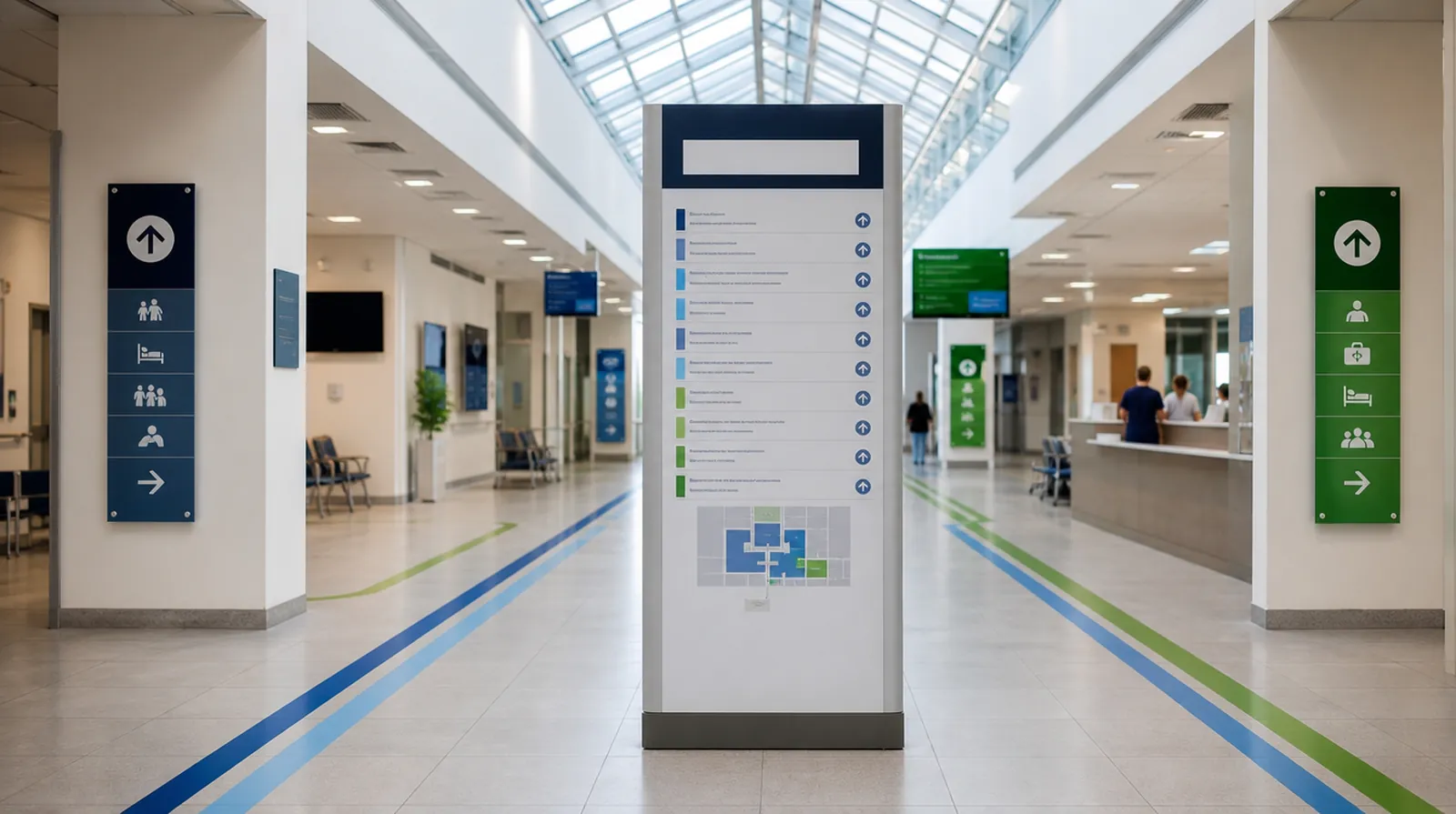 Illustrative visualisation
A hospital is several buildings, a dozen entrances, hundreds of doors and people arriving for the first time, usually under stress. Add ambulances, deliveries, visitors and staff who know the site by heart and for that very reason can't see where others go wrong. Good signage starts at the gate: which way to A&E, where to park, which building houses the outpatient clinic. Only then the corridors and doors.
There's no advertising of services here, nor should there be – it's about information and wayfinding. Content required by regulations (patients' rights, zone markings, payer notices) is supplied by the hospital or its lawyer; we make sure it's readable and durable. Most hospitals buy signage through public procurement. We help as early as the cost estimate: survey, item list, materials, visualisations. The bid itself follows the tender documents, so we produce exactly to the specification.
1. Site, gates and car parks
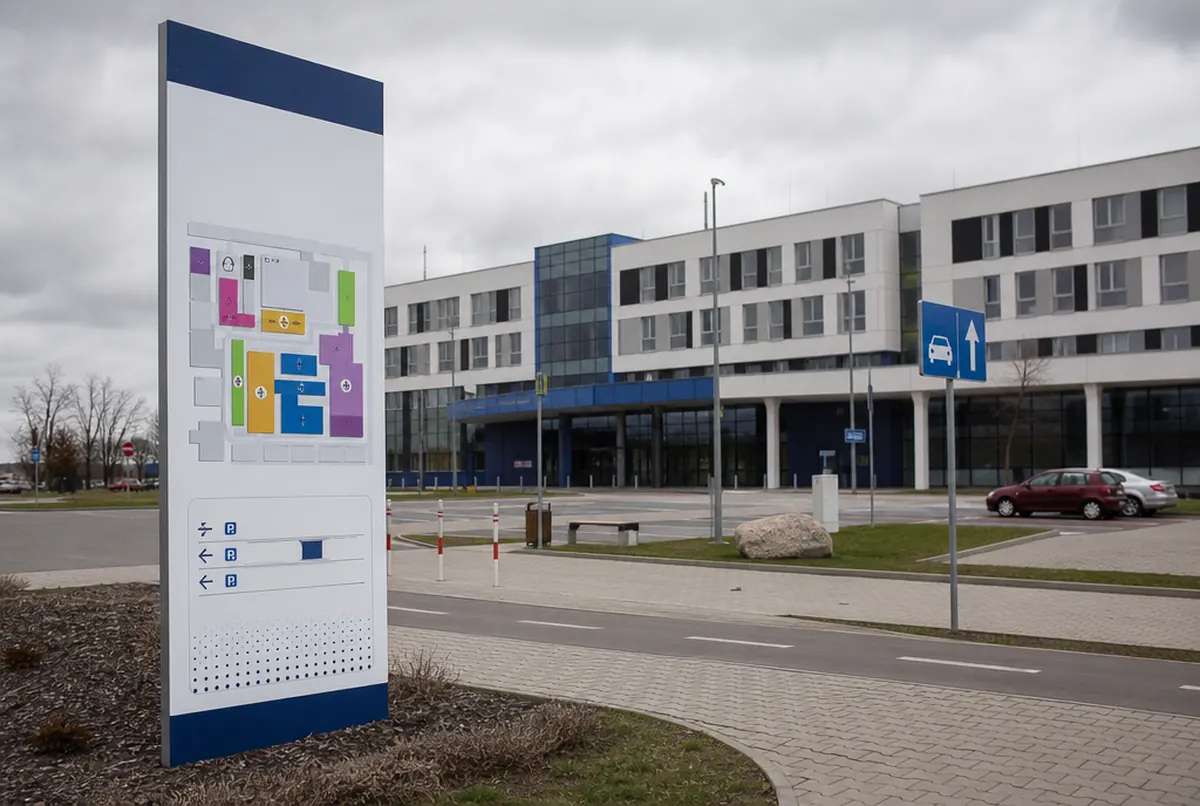
The ambulance driver knows the way; the patient's family doesn't. At the entrances you need to answer three questions: where's A&E, where's parking, where's the main entrance. External signs must be readable from a car and weatherproof, and building numbering must match what the hospital gives on its website and in referral letters.
- Hospital site map totem at the gate→A site plan with building numbers and a list of wards. A non-illuminated 2.5 m totem from approx. €750 net; we replace the dibond face when a ward moves building.
- Approach and car park directional signs→Signs on posts at junctions of internal roads: A&E, admissions, visitor parking, deliveries. We design them together with the rest of the system so colours and abbreviations match.
- Building numbers and identification→Large digits or letters on the facade, visible from afar. Dimensional digits in dibond or acrylic, 30 cm high, from approx. €16 net per character.
- Illuminated A&E and admissions signage→Must be visible at night and in the rain. Single-sided light box from approx. €320 net per m². The design and wording are supplied by the hospital in line with the regulations that apply to it.
2. Entrances, halls and reception
In the main hall patients stop and look for a board. If there isn't one, they ask the first person in a uniform. A large directory listing wards and floors by the lifts takes more load off staff than you'd think.
- Ward directory board→Dibond or acrylic on stand-offs, with changeable strips, because wards and clinics move from time to time. UV-printed dibond approx. €35–55 net per m².
- Coloured floor lines→A line to X-ray, to the lab, to outpatients. Vinyl with R10 anti-slip laminate, approx. €19–30 net per m². Most effective where corridors cross several times.
- Patient information boards→Patients' rights, rules, visiting hours. The hospital supplies the content, and we print it on board that withstands wiping with disinfectants.
3. Wards, corridors and rooms
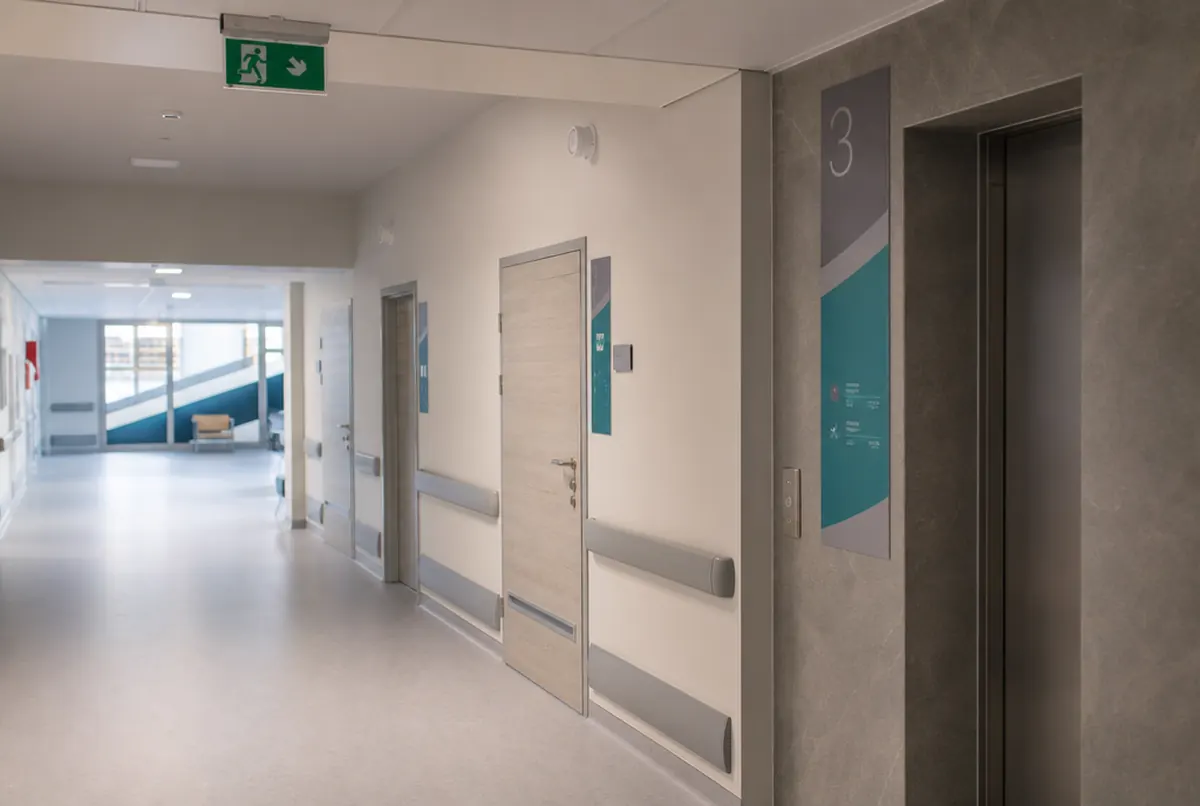
On the wards we do it as one [wayfinding system](/produkty/systemy-informacji-wizualnej): the same typeface, building and floor colours, numbering matching the site documentation. In phased refurbishments we add signs to the new section so they don't look out of place next to the old.
- Room and office door signs→Printed acrylic on stand-offs or dibond. Permanent room number; department name or staff name on a changeable strip.
- Floor identification at lifts and stairs→A large floor number and the list of wards on that level. People step out of the lift and know at once which way to go.
- Frosted film on glazing→Treatment room doors, glazed nurses' station partitions, courtyard windows. Screens while letting light through; approx. €12–21 net per m².
- Wall murals on the children's ward→Non-woven wallpaper with fire reaction class B-s1,d0, odour-free after hanging, so we put it up on a working ward. Approx. €15–25 net per m².
4. Information and print
Posters and leaflets in a hospital should explain how to prepare, where to report and what to bring. No slogans. Best when there's one template for the whole hospital and wards just swap the content.
- Framed corridor posters→Prevention, visiting rules, screening programmes. Ten A2 posters cost approx. €28 net.
- Patient leaflets and instructions→Preparing for a procedure, advice after discharge – content prepared by clinical staff. An A5 booklet, 16 pages, 500 copies costs approx. €240 net.
- Staff ID badges→Name, role, photo, colour by staff group. 100 personalised 90 × 50 mm badges cost approx. €60 net.
5. Investments, refurbishments and installation
Hospitals are always building or modernising, often with EU and national funds. That brings project information plaques and site hoardings. The plaque template and display period are set by the funding agreement and programme guidelines.
- EU or grant-funded project plaque→Dibond 200 × 100 cm on a frame from approx. €165 net; inside, a poster is often enough. We design to the template in the agreement.
- Construction hoarding banners→They screen the site and show which entrance is temporarily closed and the way round. Coated 510 g banner approx. €7–13 net per m².
- Phased installation, outside peak hours→A 2-person crew from approx. €42 net per hour plus travel at approx. €1 net per km; a cherry picker up to 18 m from approx. €230 net per day. We work zone by zone, without blocking wards.
- 01Brief
Description, sizes, site photos and deadline — a few sentences are enough.
- 02Design and quote
Our designers prepare artwork or a visualisation and you get a price.
- 03Approval
You approve the design; for brand colours we provide a proof.
- 04Production
35+ machines in our own plant in Poland: 3.2 m UV print, CNC, laser, 3D, sewing.
- 05Installation or delivery
Own crews and vehicles across Europe, partner network, couriers worldwide.
To start with — an indicative package
An example first phase for one building with about 30 rooms – a starting point for discussion or for estimating the contract value. Calculated from our price list, installation not included.
| On-site survey and inventory | from approx. €85 net (refunded with the order) |
| Site map totem, 2.5 m high | from approx. €750 net |
| 30 acrylic signs 30 × 10 cm on stand-offs (0.9 m² × approx. €60 + 120 stand-offs × approx. €2.35) | approx. €340 net |
| R10 floor lines, 10 m² (10 × approx. €25) | approx. €250 net |
| Frosted film for glazing, 10 m² (10 × approx. €16) | approx. €160 net |
| Non-woven wall mural for the children's ward, 15 m² (15 × approx. €20) | approx. €300 net |
Indicative net prices; an exact quote follows a short description and photos of the site. In a tender we price according to the specification.
From our experience — what to watch out for
- Walk the route from the gate to the bed with someone who's in the hospital for the first time. Staff can't see the gaps because they know the way.
- Building and floor numbering must be the same on signs, referral letters, the website and evacuation plans. A mismatch here causes the most stress.
- Make changing content (clinic names and staff names) on changeable strips. When wards move, you don't replace whole boards.
- Choose contrast and letter size for an older person with glasses looking from several metres. Light grey on white looks elegant, but nobody can read it.
- A4 sheets taped to walls show where a sign is missing. Collect them for a month – you'll have a ready list of signage gaps.