 Signs & Large Format Print
Why the same colour comes out differently
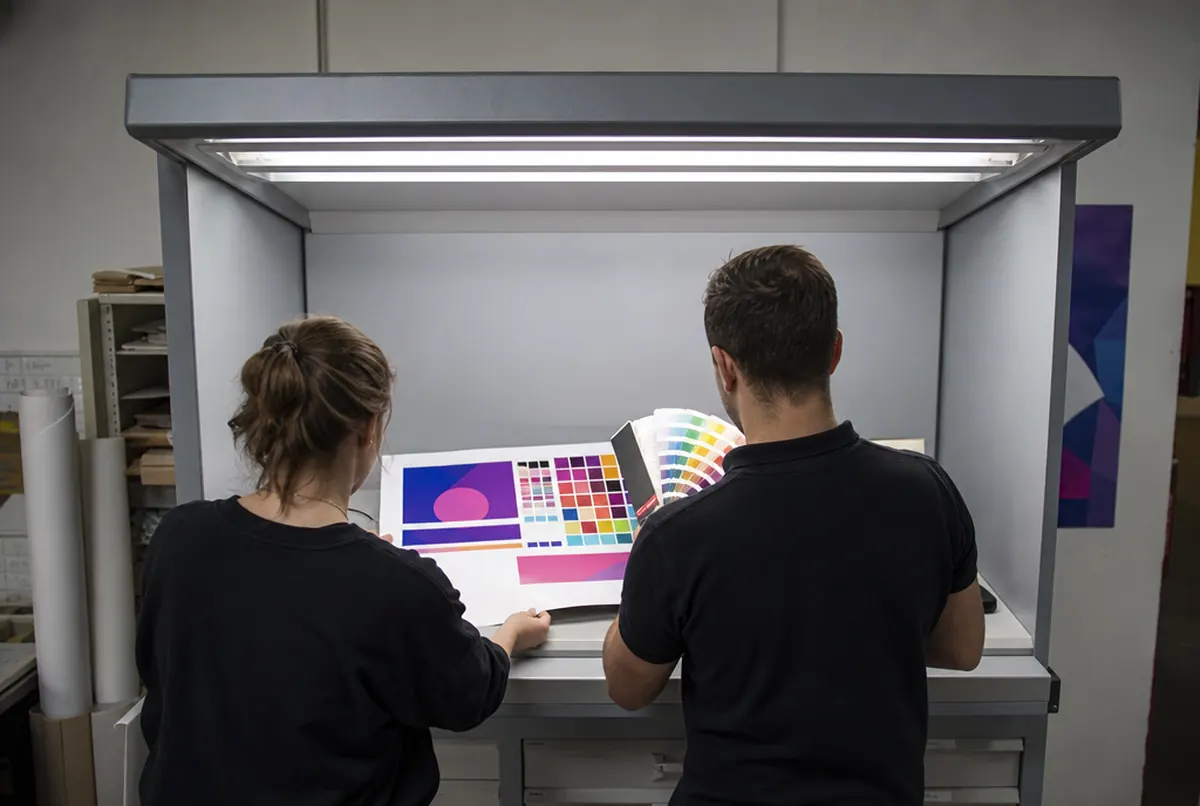
A client brings a flyer where the logo is 'right' and a banner where it is 'too dark'. Both prints may be technically correct. Several things affect colour at once:
- Screen vs print. A monitor creates colour from light (RGB), a printer from ink on a substrate (CMYK). Some vivid screen colours simply do not exist in print; more in our guide CMYK or RGB.
- Material. The same file on matt banner, glossy vinyl and coated paper gives three shades. Texture and the whiteness of the base change how colour is perceived.
- Light. Backlit film in a light box is seen with LED light behind it, so we print it with a correction for backlighting. The same light box looks different by day and by night.
- Technology. UV print on fabric and dye-sublimation give different colour depth; sublimation goes into the fibre and gives more saturated colours on flags and display walls.
- Colours outside the CMYK gamut. Intense oranges, vivid greens, some blues, and above all gold, silver and fluorescents. These Pantones can only be approximated in CMYK.
Pantone, CMYK, RAL – what to give your printer
| Reference | Where it is useful | What to watch |
|---|---|---|
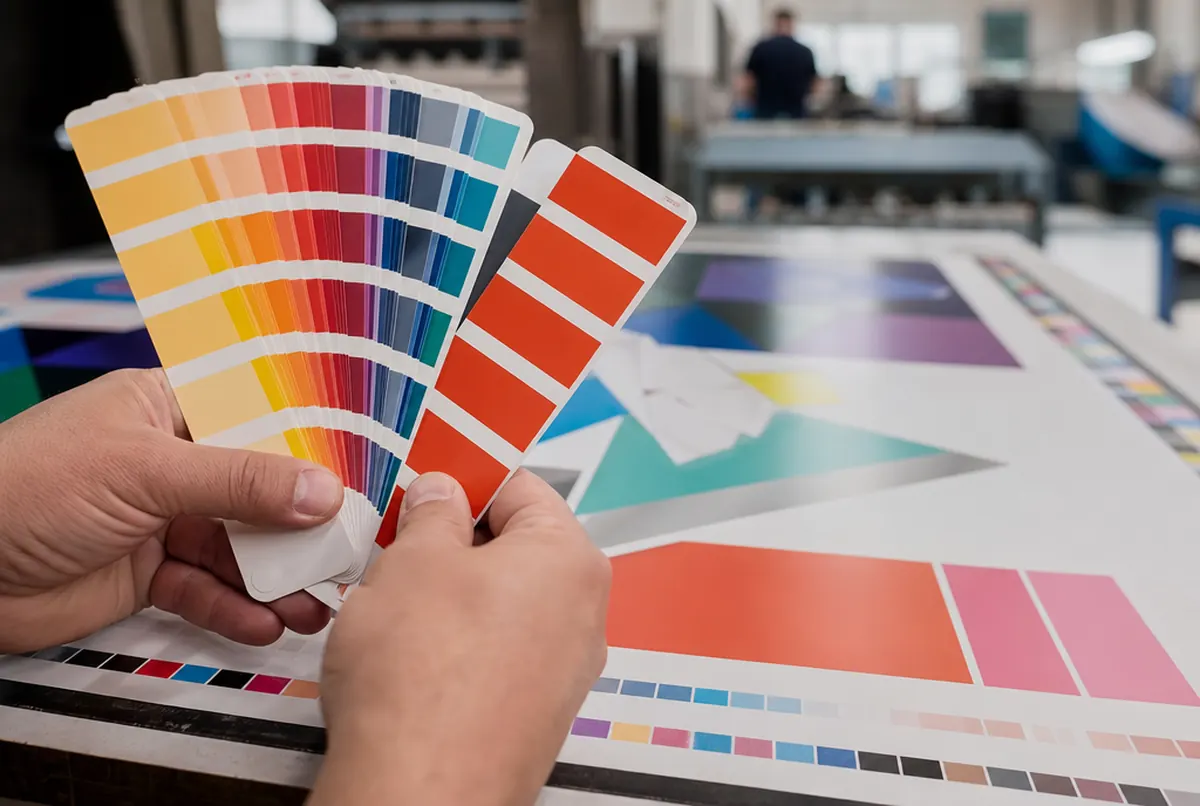
| Pantone (C – coated paper, U – uncoated) | logos on banners, vinyl, textiles, print | Pantone C and U with the same number look different; say which swatch book you use |
| CMYK (percentage values) | digital and large format print | values from brand guidelines are the most reliable; ones auto-converted from RGB can be random |
| RAL | painted structures, returns of 3D letters, spray-painted foam | RAL is for paint, not print – useful for light boxes and letters |
| HEX / RGB | website, social media | for print it is only a starting point, not a reference |
| Physical reference | any product | the best reference, if it is printed on a similar material |
If your company has brand guidelines, send us the colour page. If not, send the best print you are happy with and tell us it is the reference. We will match to that, not to your monitor.
Test print or contract proof?
They are two different things, used for different purposes.
Test print on the final material – we print a section of the design (A3) on exactly what production will use: banner, vinyl, dibond, fabric, glass. It costs approx. €13 net, refunded on orders over 20 m².
- Pros: you see the real result – colour, texture, sheen, opacity.
- Pros: you can hold the sample up where it will be installed, e.g. against the window or facade.
- Cons: it adds the time needed to print and deliver the sample.
Certified contract proof – printed on certified paper under controlled conditions, with a colour deviation of up to dE 2. It costs approx. €38 net.
- Pros: it is a reference 'on paper' against which the run is compared; useful when several companies print the materials and a common standard has to be kept.
- Cons: it shows the colour on paper, not on banner or fabric.
For large format signage we recommend a test print in most cases. Both types are described on the samples, prototypes and proofs page. A contract proof makes sense for paper print, agency campaigns and when colour is part of the contract.
- 01Brief
Description, sizes, site photos and deadline — a few sentences are enough.
- 02Design and quote
Our designers prepare artwork or a visualisation and you get a price.
- 03Approval
You approve the design; for brand colours we provide a proof.
- 04Production
35+ machines in our own plant in Poland: 3.2 m UV print, CNC, laser, 3D, sewing.
- 05Installation or delivery
Own crews and vehicles across Europe, partner network, couriers worldwide.
How to judge a sample
- Look at it in daylight, ideally by a window, not under a warm office bulb.
- Compare with the reference, not the monitor. A phone and a laptop will show something different from paper.
- Look from the distance customers will. A fence banner is seen from several metres, not 30 cm.
- Judge a light box with the lights on. Backlit film without light behind it looks faded – it is meant to.
- Approve in writing. An email saying 'I approve the colour from the sample' is enough. Keep the sample – it will be the reference for future orders.
- 24 hexpress printing (UV inks need no drying)
- approx. 3 daysstandard lead time
- up to 14 dayslarge and custom projects with installation
Plus courier delivery. Tell us your date — we plan production around it.
Colour on reprints and across many sites
Most colour disappointments we see are not on the first order but on a reprint six months later, or when items in different materials hang side by side. A few rules that help:
- for a reprint, give the previous order number – we print from the same file on the same material,
- if window vinyl and an indoor banner will hang next to each other in a shop, expect a slight difference in shade; a test print of both materials will show it before production,
- print a multi-site campaign in one batch, not in several rounds,
- do not switch to a 'cheaper' material halfway through a campaign if identical colour matters to you.
If the logo has a strictly defined colour and is also to be cut from vinyl, consider a ready-made coloured vinyl instead of print – that colour stays constant regardless of the print batch. We will choose it from the vinyl manufacturer's swatch book.