 Signs & Large Format Print
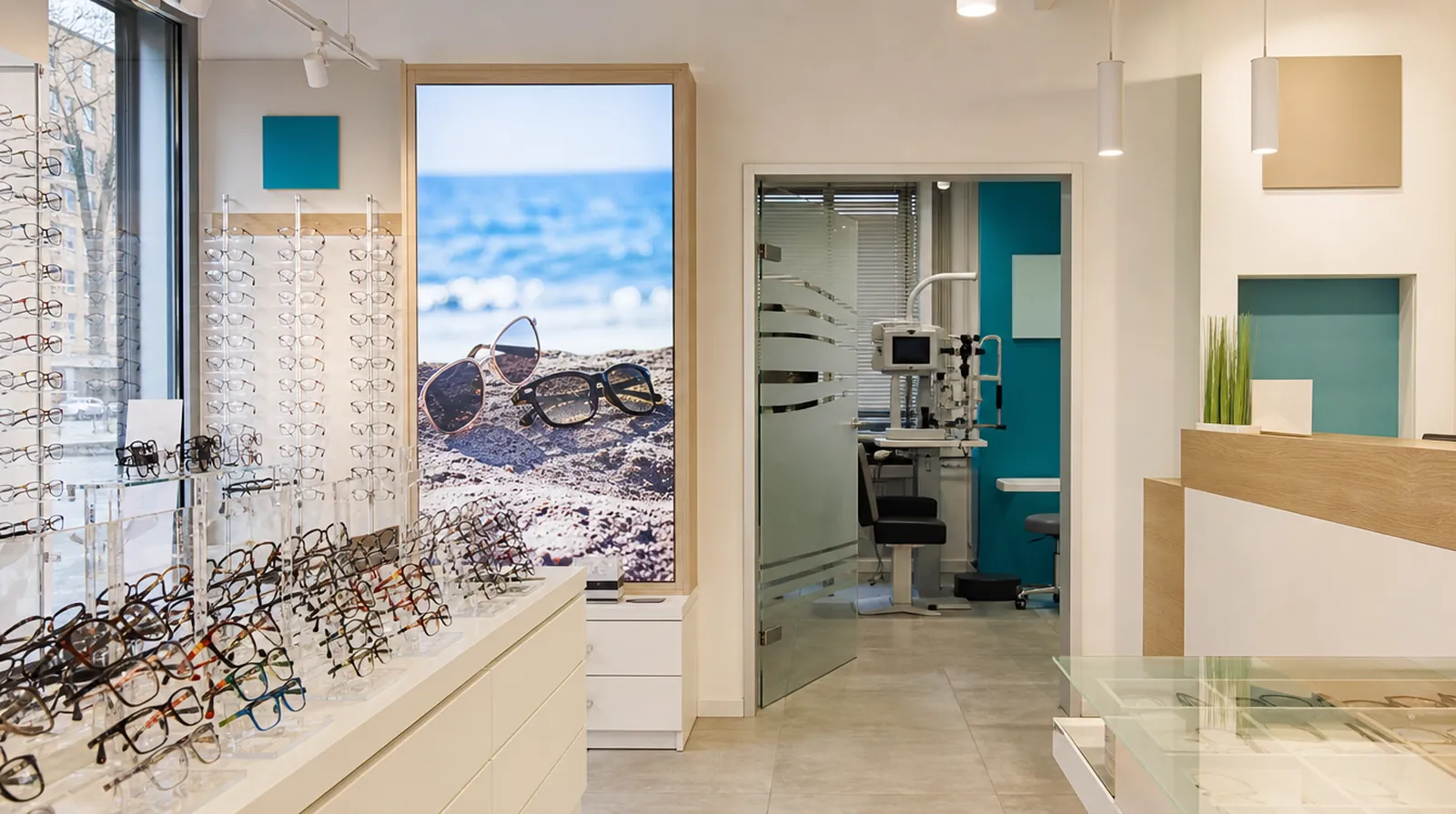 Illustrative visualisation
An optician sells two things at once: a service (eye test, lens fitting) and a product that is also an accessory. The signage has to say 'get your eyes tested here' while showing frames as a boutique would. Customers come rarely (once every year or two) so a lot depends on whether they remember the practice and whether something reminds them of the next visit.
In an optician's the rhythm is set by campaigns: sunglasses in spring and summer, children's glasses before the new school year, contact lenses and eye tests in autumn. Windows and lightboxes change several times a year, so from the start we plan displays with changeable graphics. The other issue is light: frames in cabinets and on display walls are small and shiny, and any reflective film or badly placed backlit poster gets in the way of looking at them.
1. Facade and entrance
An optician often shares the street with several other shops. Illuminated letters look smarter here than a large light box and suit an elegant interior. Add a projecting sign – people walking along the pavement don't see a flat fascia.
- Illuminated letters with the practice name→Front-lit or with a halo effect on the wall. Halo looks subtler and suits practices with premium brands. Front-lit from approx. €46 net per character, halo from approx. €55.
- Double-sided projecting sign mentioning eye tests→The words 'optician' and 'eye tests' can be seen from afar in both directions along the street. From approx. €300 net.
2. Windows and campaigns
An optician's window works in campaigns. We usually advise cutting permanent elements (logo, hours, 'eye tests') from vinyl and printing campaign graphics on a separate film that comes off after the season without touching the rest.
- Hours, phone and 'eye tests' on the door→Permanent lettering is cut from vinyl and applied once. A customer at a closed shop knows at once when to come back and which number to call to book a test.
- Seasonal campaign window graphics→Sunglasses in summer, children's frames before school, contact lenses in autumn. [One Way Vision film](/produkty/oklejenie-witryn-sklepowych) gives a large graphic, and from inside you can still see the street.
- Backlit LED frame with changeable graphic in the window→The campaign image glows even after closing. The graphic changes without taking the frame down; A1 format from approx. €165 net.
- Posters for window and interior frames→When frame manufacturers send campaign files, we print posters in the formats you need. A2, 10 pcs approx. €28 net.
3. Sales floor and frame display
Frames are small, expensive goods. The display must be clear and light, and brand and price information discreet. Acrylic is the natural material here: it doesn't block the view, can be cut to any shape and have the logo printed straight onto it.
- Acrylic frame displays→Counter stands, single-model rests, shelves with the brand logo. We bend acrylic in-house, so the shape is matched to your cabinets.
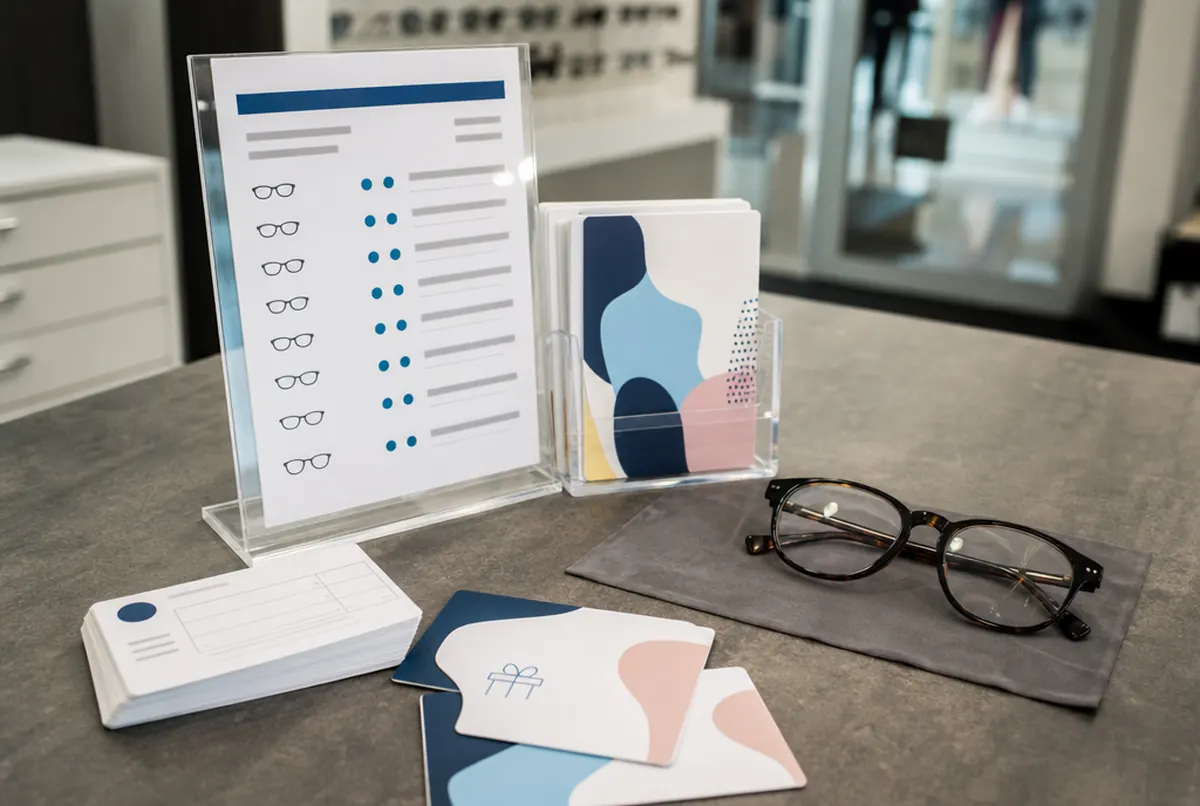
- Lens and service price list holders→Customers compare lens types and coatings themselves before sitting down with the optician. A slide-in sheet – easy to swap when prices change.
- Logo printed on glass or mirror→A logo on the try-on mirror or cabinet glass looks etched rather than stuck on. UV print on customer-supplied glass approx. €24–34 net per m².
- Wall graphic above the cabinets→A large campaign image or a simple pattern in the practice colours. Brings order to a wall holding dozens of frames.
4. Eye test room
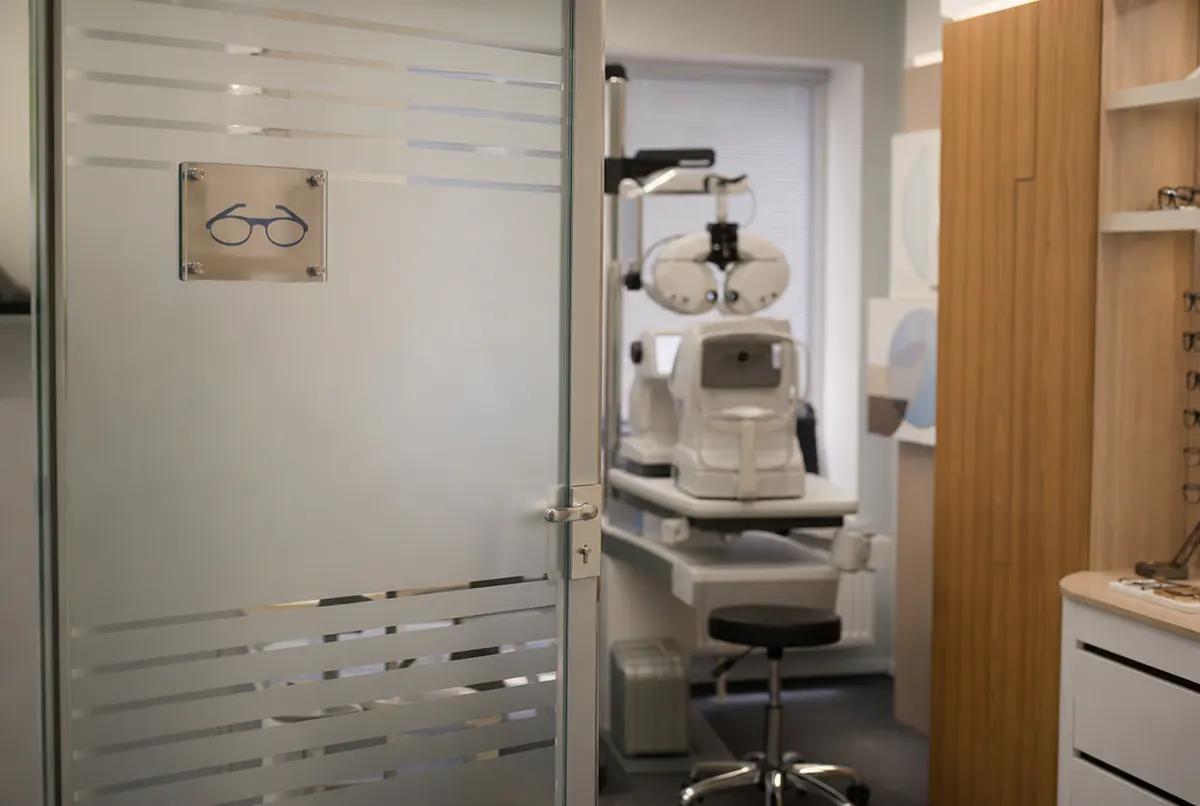
The test room is the part of the practice where the customer should feel they are seeing a specialist, not shopping. Proper door signage and screening of the glazing are enough.
- Test room door sign→'Eye examination room', optionally with the name and qualification of the examiner. Acrylic on stand-offs or dibond in the practice colour.
- Frosted film on the test room glazing→Gives privacy during the test and lets light through. A logo or bands can be cut into it.
5. After the visit and optician chains
Customers come back in a year or two if something reminds them. A card with the next test date in the glasses case does this better than many a text message. For chains we prepare the same materials in a dozen or several dozen sets.
- Next-appointment and customer cards→Name, test date, prescription fields to fill in – slipped into the case with the glasses. We print them with variable data or numbering.
- Eye test and gift vouchers→For Christmas and birthdays – glasses are a common present, but hard to buy without a fitting. A voucher solves that.
- Campaign kits for optician chains→Window film, lightbox graphic, posters and price lists packed separately for each store and shipped on the same day. Kitting approx. €3.30 net per store.
- 01Brief
Description, sizes, site photos and deadline — a few sentences are enough.
- 02Design and quote
Our designers prepare artwork or a visualisation and you get a price.
- 03Approval
You approve the design; for brand colours we provide a proof.
- 04Production
35+ machines in our own plant in Poland: 3.2 m UV print, CNC, laser, 3D, sewing.
- 05Installation or delivery
Own crews and vehicles across Europe, partner network, couriers worldwide.
To start with — an indicative package
An example for a ground-floor practice on a high street – facade, window and small POS.
| Front-lit letters, 8 characters, 30 cm high (8 × approx. €46) | from approx. €368 net |
| Double-sided illuminated projecting sign with bracket | from approx. €300 net |
| Ultra-slim LED A1 light box with changeable graphic | from approx. €165 net |
| One Way Vision window film, 5 m² (5 × approx. €14) | approx. €70 net |
| A2 posters for frames, 10 pcs | approx. €28 net |
| Out-of-hours installation (at night, also in shopping centres) | from approx. €65 net / hour |
Indicative net prices; an exact quote follows a short description and photos of the site. Acrylic displays are quoted from a drawing or a photo of the cabinet.
From our experience — what to watch out for
- Don't place backlit posters right above the frame cabinets. Reflections in lenses and shiny frames tire customers while they try things on.
- Print campaign window graphics separately from the permanent lettering. After the season you remove just one film, and the logo and hours stay put.
- With halo letters the wall behind them should be fairly light and smooth – on a dark, rough facade the glow gets lost.
- Design the next-appointment card so that it fits in the glasses case. It sounds obvious, but it's the most common correction on such jobs.
- In a chain, order lightbox graphics in one size across all stores. Then every campaign is one production run and one shipment.