 Signs & Large Format Print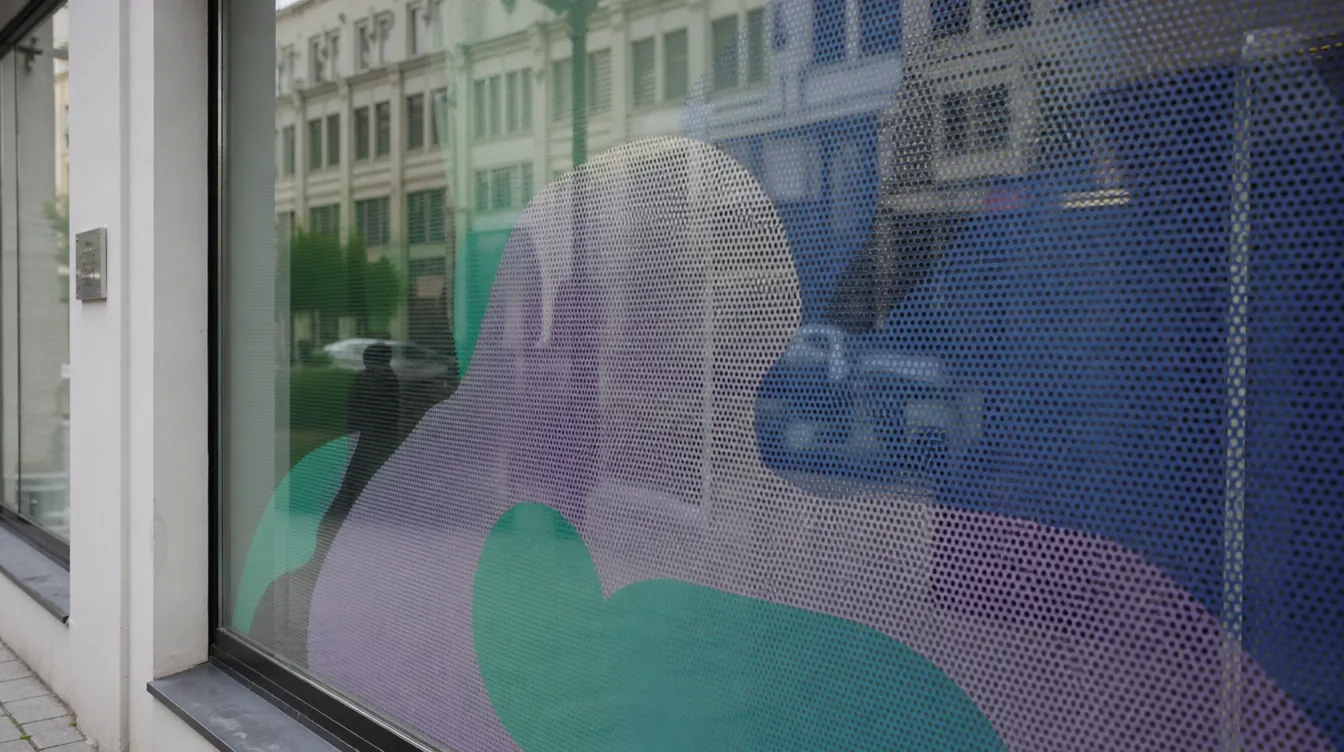
How it works: three sentences and one caveat
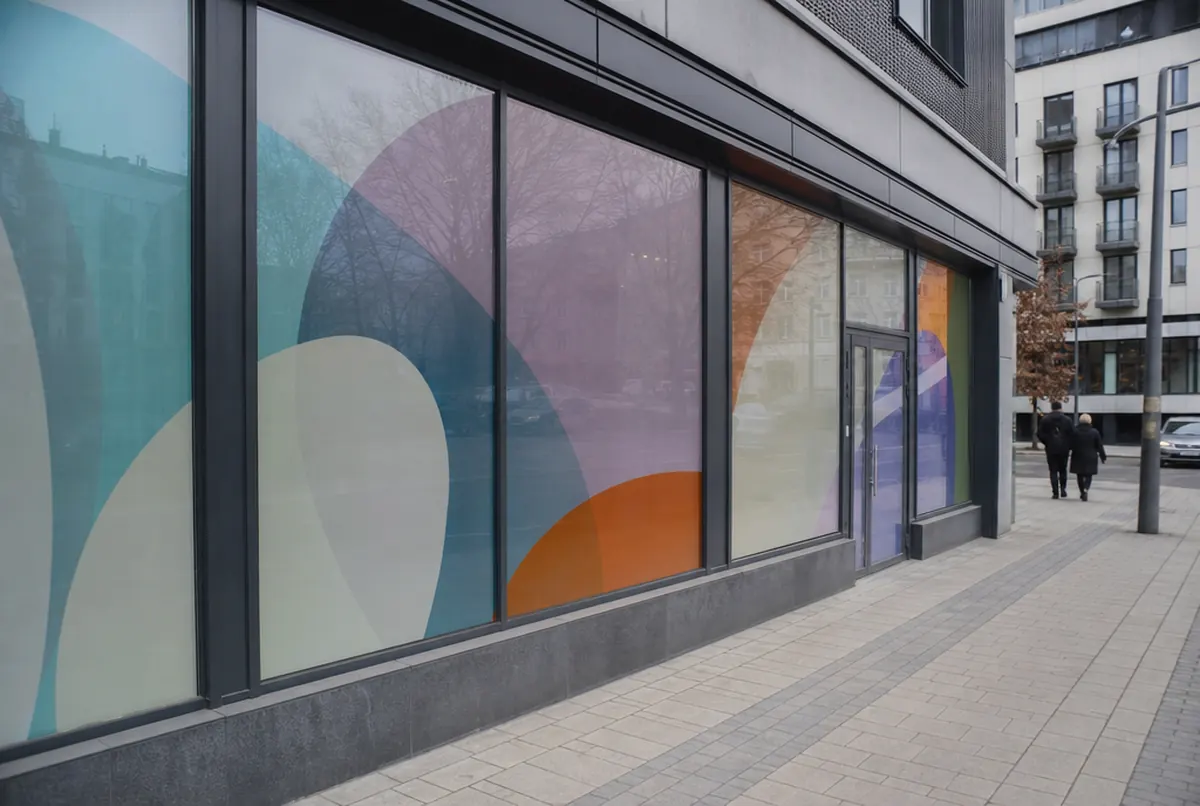
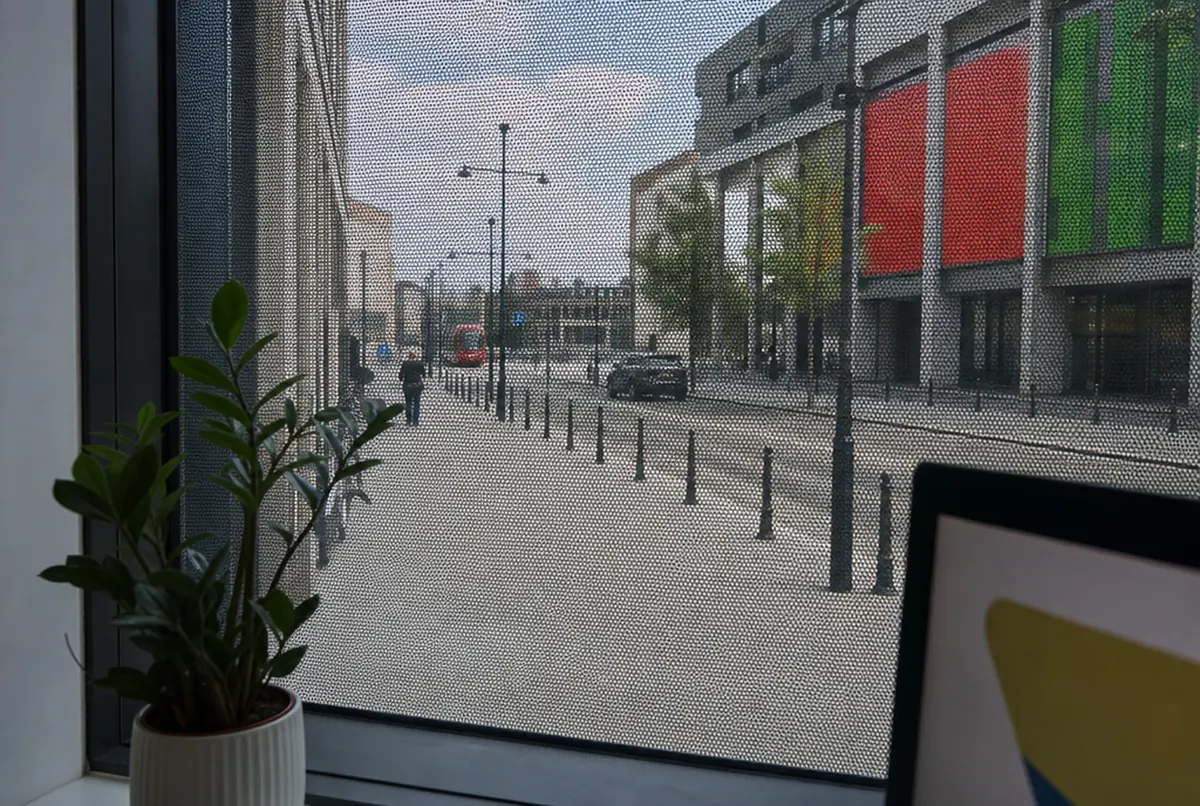
The film has two sides: a white face on which we print the graphic, and a black back on the adhesive side. The human eye picks up whatever is brighter, so from the street you see the bright printed surface and the holes disappear. From inside, the black layer reflects no light, so the eye looks through the holes and sees what is outside, a bit like looking through a fine net.
The caveat we mention to every client: the effect depends on light. In the evening, when the shop is lit and the street is dark, it works the other way round: a passer-by sees the interior through the graphic, and the graphic looks pale. If you need to screen a back room or consulting room round the clock, ordinary white vinyl or frosted film is a better choice.
Pros and cons, honestly
Pros:
- the whole pane works as advertising space, while staff can still see what is happening outside the shop;
- the interior does not heat up as much in the sun as with bare glass, because some of the light is held back;
- it gives a sense of privacy during the day: a customer at the till or in a consulting room is not on display;
- it is relatively inexpensive: at 5–15 m² it is approx. €14 net/m² with print.
Cons:
- small text gets lost: half the surface is holes, so letters under a few centimetres high become illegible from a distance;
- at night the effect reverses (see above);
- water and dirt collect in the holes; outside, in rain, the view from inside drops temporarily;
- it is a little darker inside, which can be noticeable in a small, poorly lit unit;
- it is a film for campaigns and medium-term displays, not for a decade.
Where it works and where it does not
| Location | Do we recommend it | What to watch |
|---|---|---|
| Shop, pharmacy or showroom window | Yes | Keep key content large and high-contrast; move small text to a separate sticker |
| Ground-floor office glazing | Yes, by day | In the evening with lights on, the interior shows |
| Rear vehicle window, van, food trailer | Yes | With a wiper and car washes, we recommend laminate |
| Windscreen and front side windows of a vehicle | No | Regulations set minimum light transmission: check the rules in your country |
| Consulting room, changing room, bathroom | Probably not | Privacy needed round the clock: frosted film is better |
| Glazing in shopping centres | Yes | Usually fitted after closing, at the night rate |
On vehicles we often combine One Way Vision with cast vinyl on the bodywork; more in company vehicle wrapping.
How to design artwork for One Way Vision
- Large, simple elements. Logo, a slogan of 3–5 words, one image. What looks good on screen at 1:10 is visibly broken up by the perforation.
- Contrast. Dark text on a light background or vice versa. Pastel gradients lose the most.
- Do not trust the on-screen preview. Print on perforated film comes out lighter and less saturated than the design. For larger jobs it is worth ordering an A3 test print on the actual material (approx. €13 net, refunded with an order over 20 m²).
- Frames and glazing bars. Design for the visible area of glass; leave about 1 cm clearance from the gasket, because film stuck to rubber will start to lift.
- File. 1:1 or 1:10 scale, CMYK, logo as a vector, images at a resolution suited to the viewing distance. See resolution for large format printing.
If you have no design, our studio will prepare one: a simple graphic design is approx. €42 net with two rounds of changes.
- 24 hexpress printing (UV inks need no drying)
- approx. 3 daysstandard lead time
- up to 14 dayslarge and custom projects with installation
Plus courier delivery. Tell us your date — we plan production around it.
Prices and fitting
140 µm One Way Vision film with UV print costs approx. €18 net/m² for 1–4 m², approx. €14 for 5–15 m², approx. €12 for 16–49 m² and approx. €10/m² above 100 m². Example: a 3 × 2.2 m window = 6.6 m² × €14 = approx. €92 net for the film alone.
External fitting is done by our two-person crew (approx. €42 net per hour, minimum 4 hours per visit, travel approx. €1/km both ways), or by a partner installer abroad. Clients often apply rectangular panes without joins themselves: the film is fairly stiff and easy to guide dry. For vehicles, where a wiper cleans the glass, we add polymeric laminate (approx. €8/m²), which covers the holes and protects the print.
The offer and examples are on the One Way Vision window film page, and the full cost of a shopfront in how much do shop window graphics cost.