 Signs & Large Format Print
Working out power consumption step by step
No guesswork needed. You only need three figures: power, hours lit and the electricity price from your bill.
- Check the power rating. The most reliable source is the label on the power supply or the light box documentation. If the light box does not exist yet, assume roughly 50–100 W per m² of face for LED illumination. For a 300 × 80 cm light box (2.4 m²) that is approx. 120–240 W.
- Add power supply losses. The power supply uses a little too; we add about 10%. That gives approx. 130–265 W.
- Count the hours. A sign switched on from dusk until closing and in the morning before opening is often lit 8–12 hours a day. Let us take 12 h × 30 days = 360 h a month.
- Multiply. 0.2 kW × 360 h = 72 kWh a month for a 200 W light box.
- Convert to money. At €0.25 per kWh (check your own rate, as it depends on your tariff and contract) that is approx. €18 a month, or roughly €220 a year.
That is for 12 hours every day. If the sign is lit only after dark, longer in winter and shorter in summer, the annual figure will usually be lower.
Indicative consumption for different types of illuminated sign
| Sign | Indicative power | kWh / month |
|---|---|---|
| LED light box 100 × 50 cm | approx. 30–55 W | approx. 11–20 |
| LED light box 300 × 80 cm | approx. 130–265 W | approx. 47–95 |
| Double-sided light box 200 × 100 cm | approx. 110–220 W | approx. 40–80 |
| 9 face-lit letters, h = 30 cm | approx. 45–90 W | approx. 16–32 |
| Ultra-slim LED A1, indoors | approx. 15–30 W | approx. 5–11 |
| LED neon on a backboard up to 60 × 40 cm | approx. 15–30 W | approx. 5–11 |
The figures in the table are estimates. We set the actual power at the design stage, because it depends on module density, light box depth and how bright the sign needs to be. A double-sided light box has its lighting inside, illuminating both faces, so it does not need twice the power of a single-sided one.
How long the LEDs last and what fails most often
LED module manufacturers usually quote a lifespan in tens of thousands of hours. For example, if a module is rated at 50,000 hours and the light box is lit 12 hours a day, that is over 11 years. LEDs do not go out suddenly; they gradually get dimmer.
From our service work, failures usually come in this order:
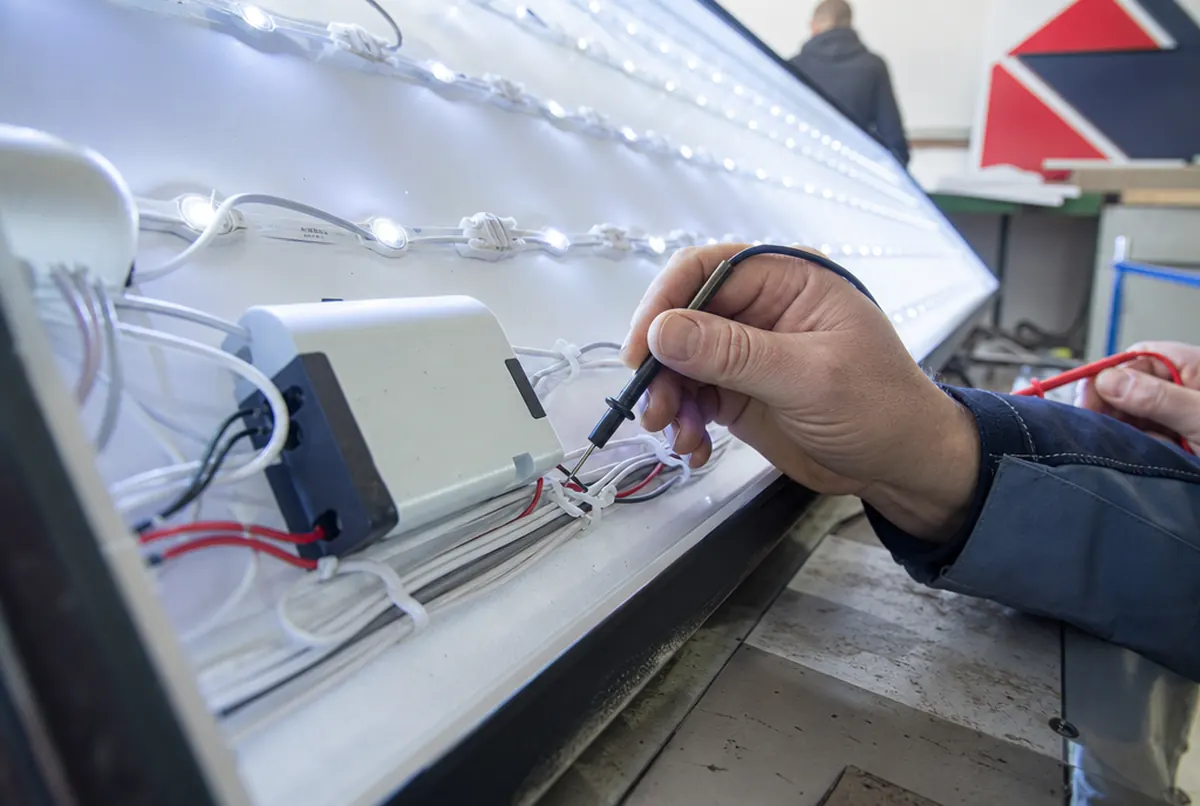
- Power supply. The most common cause when a light box suddenly goes dark entirely. It works in heat and damp, often inside a closed box. That is why we use sealed IP67 power supplies.
- Moisture and connections. Water getting in through leaky corners or the cable gland corrodes the connectors: part of the light box or a single letter goes out.
- Face artwork. On a south-facing wall, vinyl colours fade faster than the LEDs lose brightness. After a few years the face alone is often replaced while the LEDs keep working.
- Individual modules. Voltage spikes or mechanical damage: these happen less often.
Replacing LED modules or a power supply costs from approx. €42 net plus parts, and a service inspection of an illuminated sign from approx. €60 net.
LED vs old fluorescent light boxes
If you have an old fluorescent light box on your building, the difference on the bill is noticeable. Such a box usually has several tubes of a few dozen watts each plus a ballast; it is also deep, heavy and lights unevenly, with darker bands visible at the tube ends.
There are two routes:
- replace the whole light box with a new, slimmer LED light box, from approx. €320 net per m²,
- if the housing is sound, replace the face and the lighting, which we quote after inspecting the structure.
We do not recommend dropping LED strips into an old housing in a hurry without checking the seals and the distance to the face. That usually ends with visible hot spots or bands showing through the face.
- 24 hexpress printing (UV inks need no drying)
- approx. 3 daysstandard lead time
- up to 14 dayslarge and custom projects with installation
Plus courier delivery. Tell us your date — we plan production around it.
Cutting electricity costs without switching the sign off
- A timer or dusk sensor. The sign does not need to be lit in daylight or at three in the morning. Running it from dusk until, say, 11 pm can cut several hours a day.
- The right brightness. A very bright light box in a narrow street dazzles and uses more power. At the design stage we check where the sign will be and from what distance it will be read.
- A dark background on the face. A face with a dark background and light lettering, or a routed face where only the letters glow, gives less stray light for the same legibility.
- An occasional inspection. A clean face and a healthy power supply work more efficiently, and a leak caught early does not turn into replacing half the modules.
You can compare the costs of different sign types in the guide how much does a light box sign cost, and face care and replacement are covered in how to change the graphic in a light box. All light box versions are on the LED light boxes page.