 Signs & Large Format Print
A
- Acrylic (Plexiglas) – acrylic glass: clear or opal, lighter than glass and less brittle. Used for plaques, displays and light box faces.
- Art paper (coated paper) – paper with a smooth mineral coating, matt or gloss. Photos come out sharper and more vivid on it than on uncoated paper.
B
- Backlit – material for illumination from behind: banner, film or fabric that lets light through. It is printed with more saturated colours, because backlighting lightens them.
- Banner – flexible PVC material with an internal reinforcing scrim, printed and finished with welded hems and eyelets. The most popular outdoor advertising medium; the types are described in which banner to choose.
- Bleed – the part of the artwork that extends beyond the format and is trimmed off after printing. It prevents a white hairline at the edge; in small format print it is usually 3 mm on each side.
- Blockout – a banner or film with an opaque layer inside that does not let light through. It allows two different graphics to be printed on the two sides without show-through.
- Blueback – thin poster paper with a blue reverse, used for billboards. The blue layer stops the old poster showing through the new one.
C
- Cast vinyl – the thinnest and most flexible self-adhesive vinyl, made by casting rather than calendering. It conforms to vehicle contours and lasts 8–10 years.
- CMYK – the colour model used in print, based on four inks: cyan, magenta, yellow and black. Its gamut is narrower than a screen's, so some vivid RGB colours look calmer in print; more in CMYK or RGB.
- Commercial print (jobbing print) – small everyday print items: business cards, flyers, letterheads, invitations, tickets. The term comes from traditional printing terminology and means 'occasional' print, as opposed to books and newspapers.
- Creasing – pressing a fold line into paper, board or plastic before folding. Without a crease, heavy paper cracks along the spine and board folds unevenly.
D
- Dibond – a composite panel made of two thin aluminium skins and a plastic core. The standard material for outdoor signs and panels; it does not rust or warp in the sun.
- Die-cutting – cutting a shape with a cutting forme, i.e. a die with blades, for long runs. On short runs it is replaced by plotter or laser cutting.
- DPI – dots per inch, a measure of image or print resolution. For close-up print approx. 300 dpi at 1:1 is the norm; for banners usually 100–150 dpi.
- DTP – desktop publishing, preparing publications for print on a computer. In practice it covers design, typesetting and preparing a file that meets the printer's requirements.
- Dye-sublimation – printing in which the dye turns to gas under heat and penetrates the polyester fibre. The print does not crack and shows through to the other side of the fabric.
E
- Embossing – pressing a raised or recessed pattern into paper with a die. It gives a relief you can feel, with or without colour.
- Engraving – making lettering or a pattern permanent by removing material with a laser or a router. Engraving does not wear off like print, which is why it is used on rating plates and trophies.
- Eyeleting – punching metal eyelets into the edge of a banner, for a rope or cable tie to pass through. Standard spacing is every 50 cm, closer in high wind.
F
- Face – the front, visible surface of a light box or dimensional letter. Most often opal acrylic with vinyl, or dibond with routed elements.
- Foam PVC – a light, rigid plastic board that is easy to work. Good for interiors and shorter outdoor displays.
- Foiling – transferring metallic foil (gold, silver, coloured) onto print. Hot foiling is done with a die; on short runs a digital method without a die is used.
- Folding – machine folding of printed sheets, e.g. flyers into a concertina or a roll fold. Heavy papers are creased before folding.
- Frontlight – a banner for front lighting or display in daylight. It is the most frequently ordered type of banner.
G
- GSM (paper weight) – the mass of 1 m² of paper or material in grams. Flyers are usually printed on 130–170 gsm, business cards on 350 gsm; details in paper weight (gsm).
H
- HIPS – a thin, rigid polystyrene plastic (usually 0.5–1 mm) used for POS materials. Wobblers, shelf stoppers and hang tags are made from it.
I
- Imposition – arranging pages or copies on a press sheet. Done well, it reduces waste and makes catalogue pages fall in the right order after folding.
K
- Kiss-cut – a cut through only the top layer of a material without cutting the backing. That is how stickers are cut that peel off one by one from a sheet or roll.
L
- Lamination – covering a print with a clear film (laminate) for protection or a matt or gloss effect. In large format, anti-slip and anti-graffiti laminates are also used.
- LED – light-emitting diodes used to illuminate light boxes, letters and fabric frames. They use little energy and last for many years.
M
- Mesh – perforated PVC material that lets air through. It is used on scaffolding and facades because it reduces wind load.
- Monomeric and polymeric vinyl – the two basic types of self-adhesive vinyl. Monomeric is cheaper and works on flat surfaces for 2–3 years; polymeric is more stable, copes with gentle curves and lasts 5–7 years.
- Mounting – laminating a print onto a rigid substrate, e.g. a poster onto PVC or dibond. With UV printing directly onto the board this step is often unnecessary.
O
- Offset – a printing technique using printing plates and an intermediate blanket cylinder, cost-effective on long runs. Also the name of an uncoated paper you can write on.
- One Way Vision – perforated window film that shows a graphic from outside while you can see out through the glass from inside. Popular on shop windows and vehicle rear windows.
- Overprint – a setting in which one colour prints over another instead of 'knocking it out'. Useful for black text, but set wrongly it can make a white element disappear from the print.
P
- Panel (tile) – a single strip into which artwork wider than the machine is divided. Panels are joined by welding or overlapped during installation.
- Pantone – a colour swatch system in which every colour has a number. It is used to define a brand colour unambiguously; in CMYK printing its nearest equivalent is achieved.
- Pole pocket – a folded and welded or sewn edge of a banner or flag through which a pole or rope is passed. Used on flags, scaffold mesh and framed banners.
- Preflight – the technical check of a file before printing: size, bleed, colours, resolution, fonts. We describe it in DTP and pre-press.
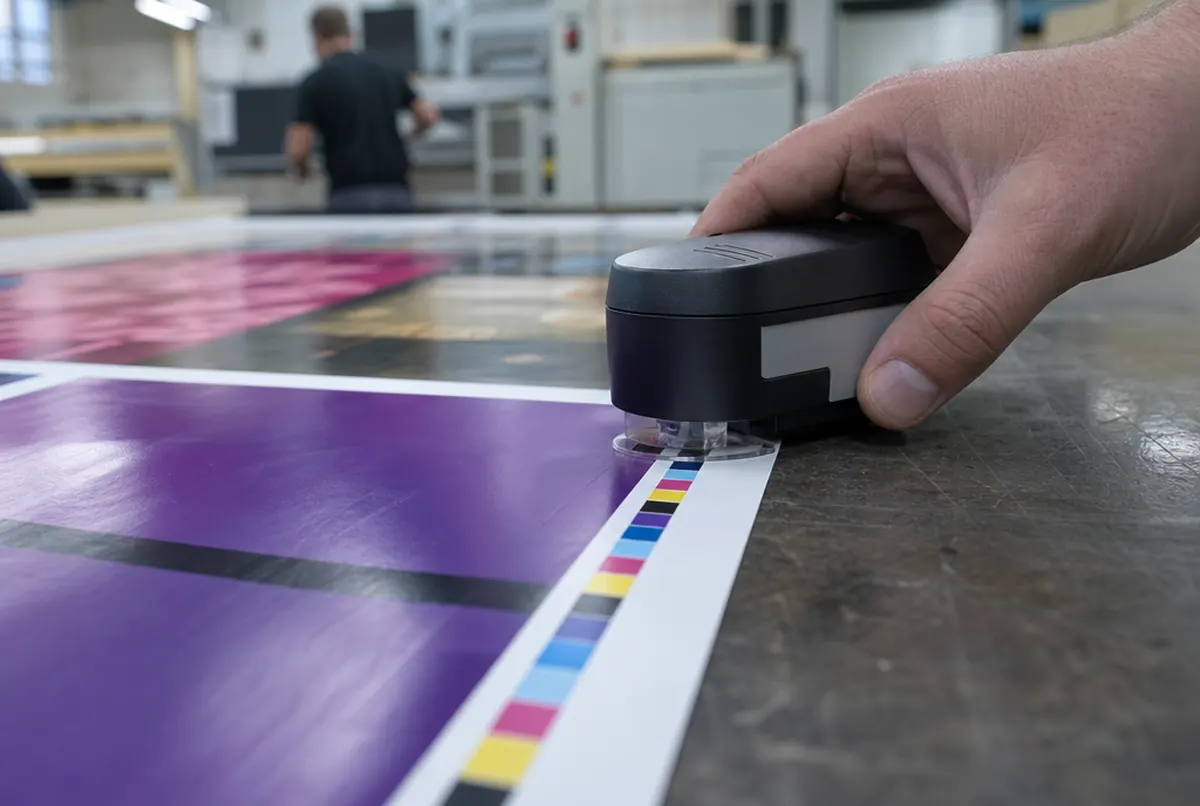
- Proof – a test print showing how the colour will look in the run. A contract proof carries a certificate of colour accuracy and is sometimes required in contracts.
R
- RGB – the colour model of screens: red, green, blue. RGB files are converted to CMYK before printing.
- RIP – software that converts a PDF file into data for a specific printing machine. It is where the material's colour profile and the layout of graphics are set.
- Roller banner – a portable display system in which the graphic rolls up into an aluminium cassette. It sets up in under a minute.
- Run (print run) – the number of copies of one design. The run decides the unit price and the choice of technology, e.g. digital or offset printing.
S
- Safe area – a strip along the edge of the format where no text or important elements are placed. In small format it is usually 3–5 mm; in banners more, because of hems and eyelets.
- SEG – a fabric graphic with silicone edging sewn round its edge, pressed into the groove of an aluminium frame. It gives a taut, flat surface with no visible fixings.
- Solid – a uniform, full area of a single colour, with no tonal transitions. Large solids are the most demanding in print, because unevenness of colour or registration shows most easily on them.
- Spot UV varnish – a clear varnish applied only to selected elements, e.g. a logo, and cured with UV light. It gives a contrast of gloss on a matt background.
- Stand-offs – metal sleeves on which plaques and panels are mounted at a distance from the wall. They give acrylic a 'floating' look and hide the fixings.
U
- UV printing – a technology in which the ink cures under ultraviolet light in a fraction of a second. The print is ready immediately, and the ink can also be applied to boards, glass and metal.
V
- Vector – graphics stored as mathematical curves rather than pixels. They can be enlarged freely without losing sharpness, which is why a logo for printing, routing and cutting should be a vector.
W
- Weeding – manually removing the waste vinyl after letters or shapes have been cut on the plotter. Only what is to be applied remains, ready for transfer with application tape.
- Welding – joining or reinforcing the edge of a banner by melting the material with hot air. It strengthens the edges before eyeleting and joins panels into large formats.
- White label – production under someone else's brand: the printer carries out the job for an agency without its own branding. Details in white label in advertising.
- White underlay – a layer of white ink printed beneath the colour on transparent or dark material. Without it, colours on acrylic or glass come out pale and see-through.
- Wobbler – a small promotional element on a flexible stalk, stuck to a shop shelf. It moves with the slightest air movement and catches the eye.
Have a specific project?Describe in a few sentences what you need — we reply with a price and a lead time. Office Mon–Fri 8:00–16:00 (CET).