 Signs & Large Format Print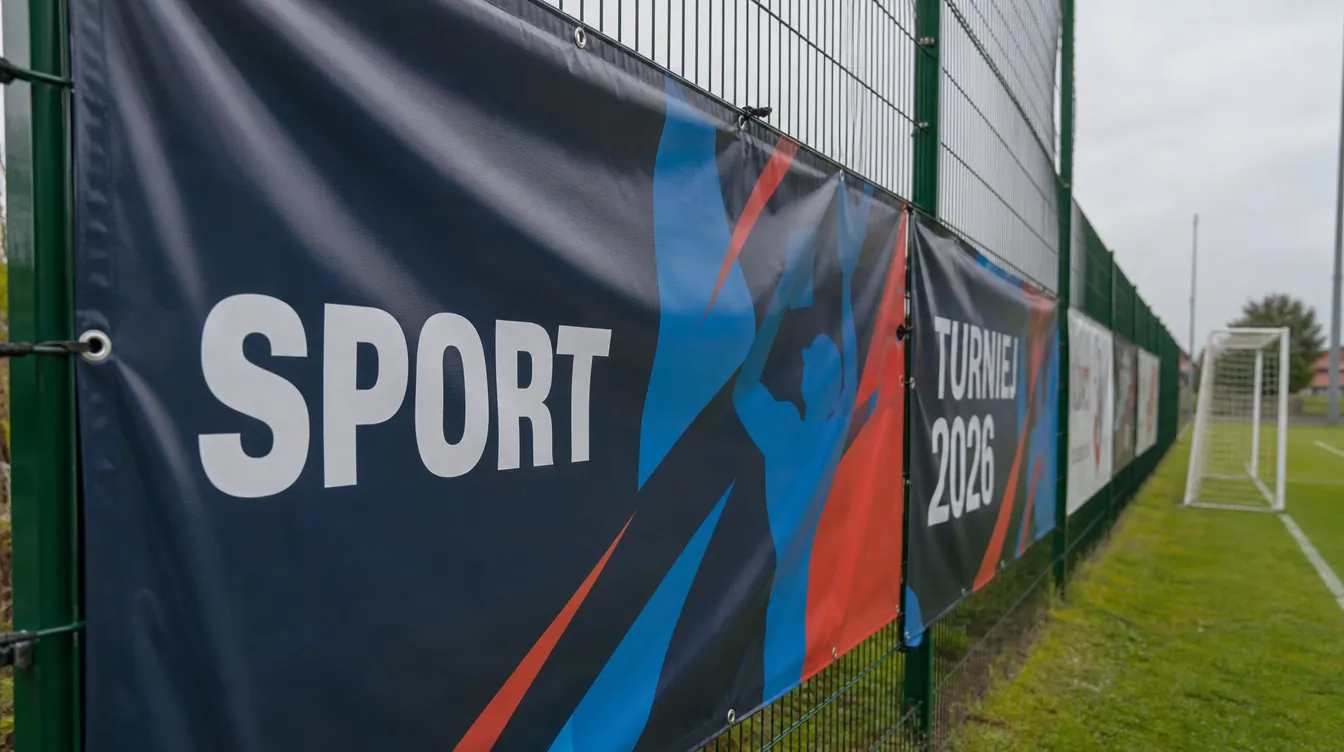
How UV printing works – no drying chemistry
In conventional inks (solvent or water-based) the colourant is dissolved in a liquid that has to evaporate or soak in. Until that happens the print is vulnerable – it can smudge, and it must not be rolled or laminated.
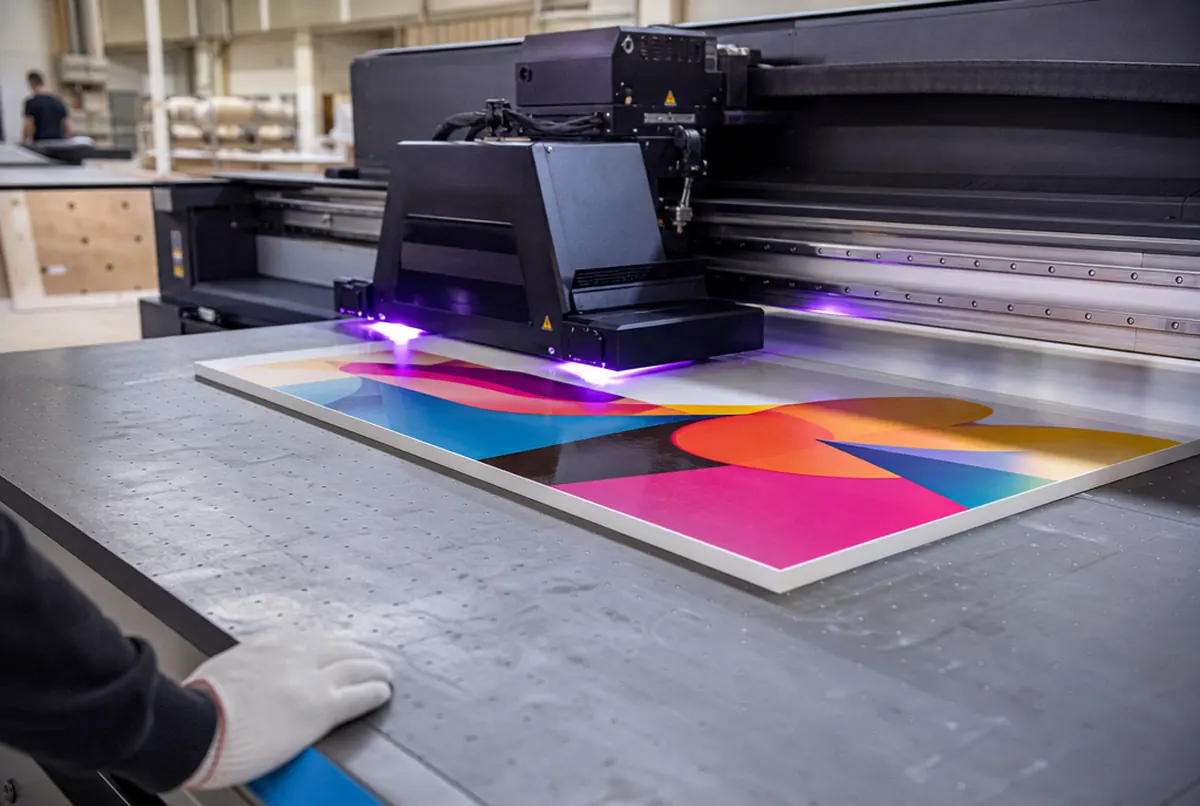
UV ink works differently. It contains monomers and photoinitiators which, under ultraviolet light, bond in a fraction of a second into a hard polymer layer. The head lays down a droplet, the UV lamp passes right behind it, and the ink is cured before the material leaves the machine. Nothing evaporates, so there is no solvent smell and no 'outgassing' time.
In practice that means three things the client notices immediately:
- the print can be cut, welded, eyeleted, mounted and packed straight away,
- the ink sits on the surface rather than soaking in, so non-absorbent materials can be printed: acrylic, glass, aluminium, PVC,
- a thin, abrasion-resistant layer remains on the surface – in many applications laminate becomes an option rather than a necessity.
What we UV print on
UV machines come as roll-to-roll (the material runs from one roll to another) and flatbed, where a rigid board lies on the bed. We run two industrial 3.2 m wide UV printers that handle both, plus a separate LED UV printer with flexible ink for textiles.
From the roll we print banners (frontlit, blockout, backlit, mesh), self-adhesive vinyl, poster papers, wallpaper, canvas and fabrics. From boards – dibond, foam PVC, clear and opal acrylic, polycarbonate, HIPS, card, honeycomb board, plywood and MDF. A 3.2 m width means banners up to that width are printed in one piece, with no weld through the middle of the artwork.
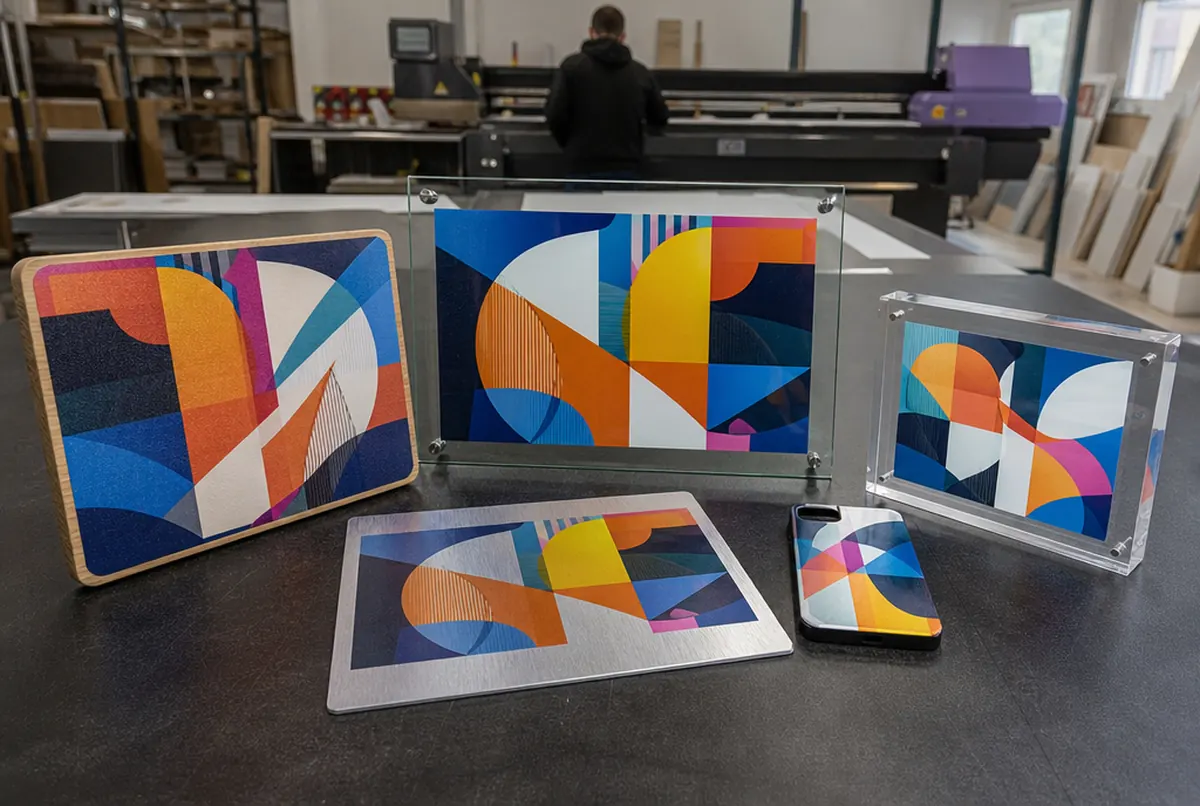
A separate category is printing on customer-supplied material: glass, mirrors, sheet metal, wood, clients' own boards up to 50 mm thick. On glass and mirror we first apply a primer, and a white ink underlay beneath the colour – without it, colours on a transparent substrate come out pale. Details and prices are on the UV printing on glass and printing on boards and panels pages.
What UV printing costs – sample rates
| Material | Use | Net price / m² |
|---|---|---|
| Coated banner 510 g | fences, facades, 2–3 years outdoors | approx. €7–13 |
| White monomeric vinyl | windows, stickers, 2–3 years | approx. €6–12 |
| Satin poster paper 170 g | indoor posters | approx. €6–11 |
| Textile banner 210 g | display walls, frames, interiors | approx. €13–22 |
| Foam PVC 3 mm | plaques, indoor signage | approx. €21–33 |
| Dibond 3 mm | outdoor signs and panels | approx. €35–55 |
| Clear acrylic 3 mm with white underlay | plaques on stand-offs | approx. €43–60 |
| Print on customer-supplied glass / mirror | shop windows, premium interiors | approx. €24–34 |
Example: a 4 × 1 m banner is 4 m², so the highest band (1–4 m²) applies – approx. €13 × 4 = approx. €52 net, with trimming, welded hems and eyelets every 50 cm included. At 20 m² the rate falls to approx. €8/m². The rate covers the area including bleed and allowance for finishing, and very small formats carry a minimum print and finishing value. Full material comparisons are in our guide dibond, acrylic, PVC, HIPS – materials at a glance.
Advantages and limitations – honestly
We chose UV printing as our core technology because it suits large format signage best. It is not magic, though, and it is worth knowing both sides.
What speaks for UV:
- Time. No drying shortens production. Our standard turnaround is approx. 3 working days, and 24-hour express is possible precisely because the ink is ready straight away.
- Versatility. One technology for banner, vinyl, board and glass. The colour on a dibond sign and on the banner next to it comes out consistent.
- White ink. White can be printed as a colour, or as an underlay beneath artwork on transparent or dark material.
- Durability. The cured layer copes well with abrasion and rain; UV-printed banners and vinyl need no laminate for most uses.
- No smell. The print can be hung indoors immediately, for example in an operating hospital or restaurant.
What you need to know:
- The ink layer can be felt very slightly under the finger, especially with a white underlay. On a poster seen close up there is a slight sheen in heavily saturated areas.
- Cured ink is less stretchy than ink that has soaked into the substrate. For vinyl over deep vehicle contours we choose cast vinyl and laminate, and for textiles folded many times we consider sublimation.
- Some substrates (glass, metal, wood) need a primer, otherwise adhesion is poor. That adds a step and a cost.
When UV, and when another technology
UV is the first choice for banners, mesh, vinyl, panels, signs, POS, wallpaper and most interior graphics. Where a very soft fabric hand and colour show-through to the reverse matter (flags, textile banners folded into a bag), we print by dye-sublimation – we describe it in dye-sublimation – how it works and when to choose it.
You will also come across solvent and latex printing. They are proven technologies with their own strengths, but they differ in how the ink is fixed and in the range of substrates. A comparison is in solvent, latex and UV printing.
If you are not sure what to choose, tell us where the print will hang, for how long and in what conditions. We will choose the material and technology ourselves and explain why in the quote.