 Signs & Large Format Print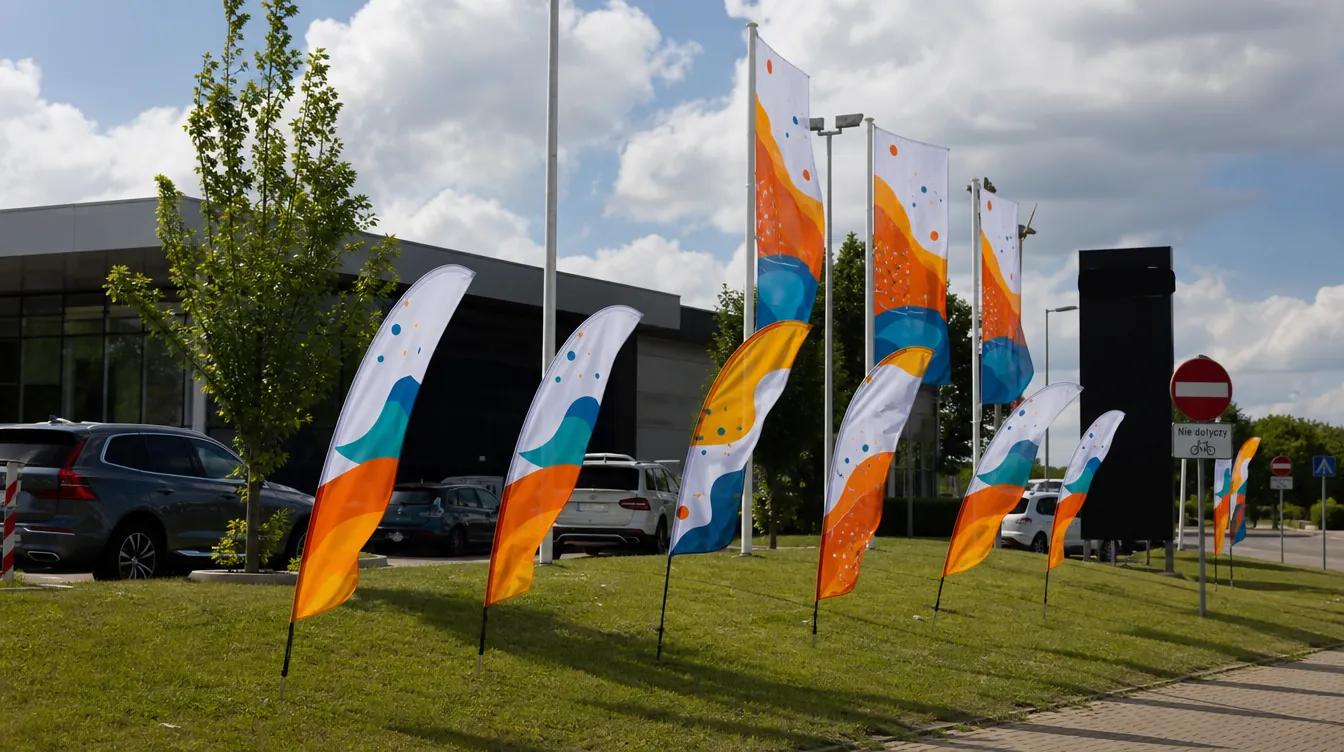
What happens to the ink in sublimation
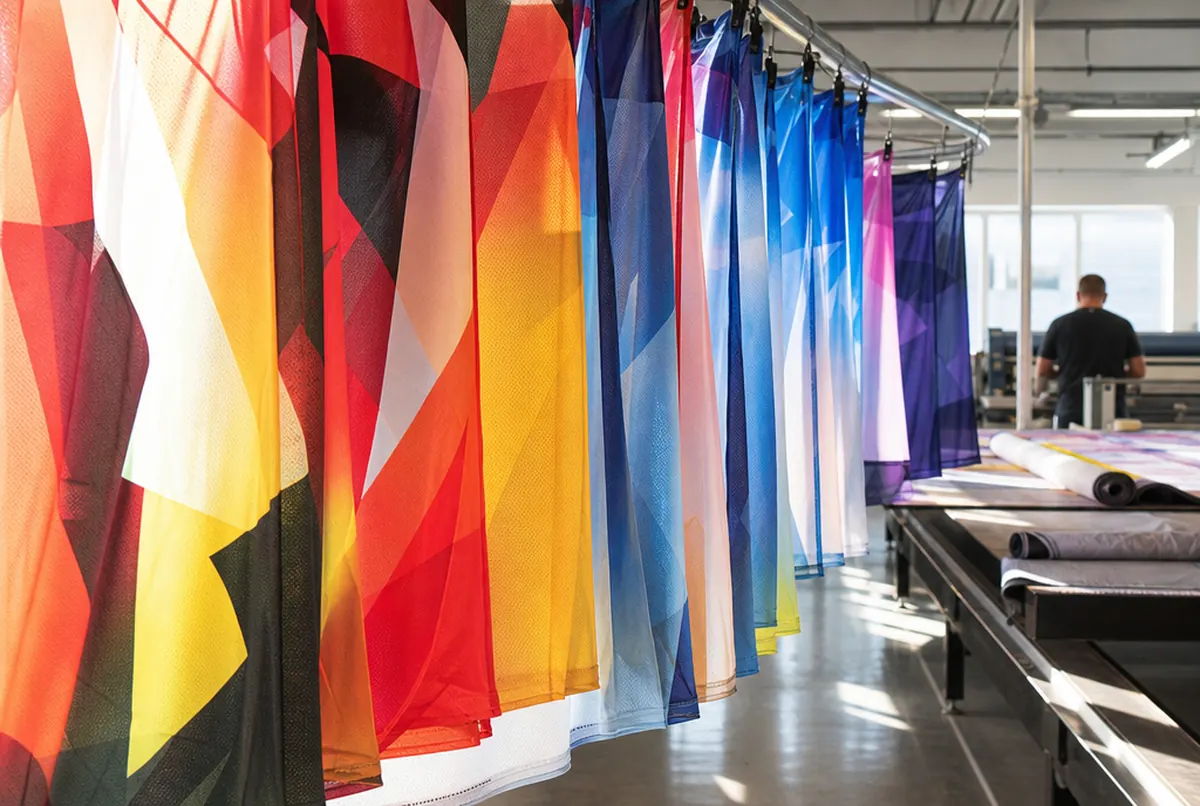
The name comes from physics: sublimation is the transition from solid to gas without passing through a liquid. In the most common, transfer method it works like this:
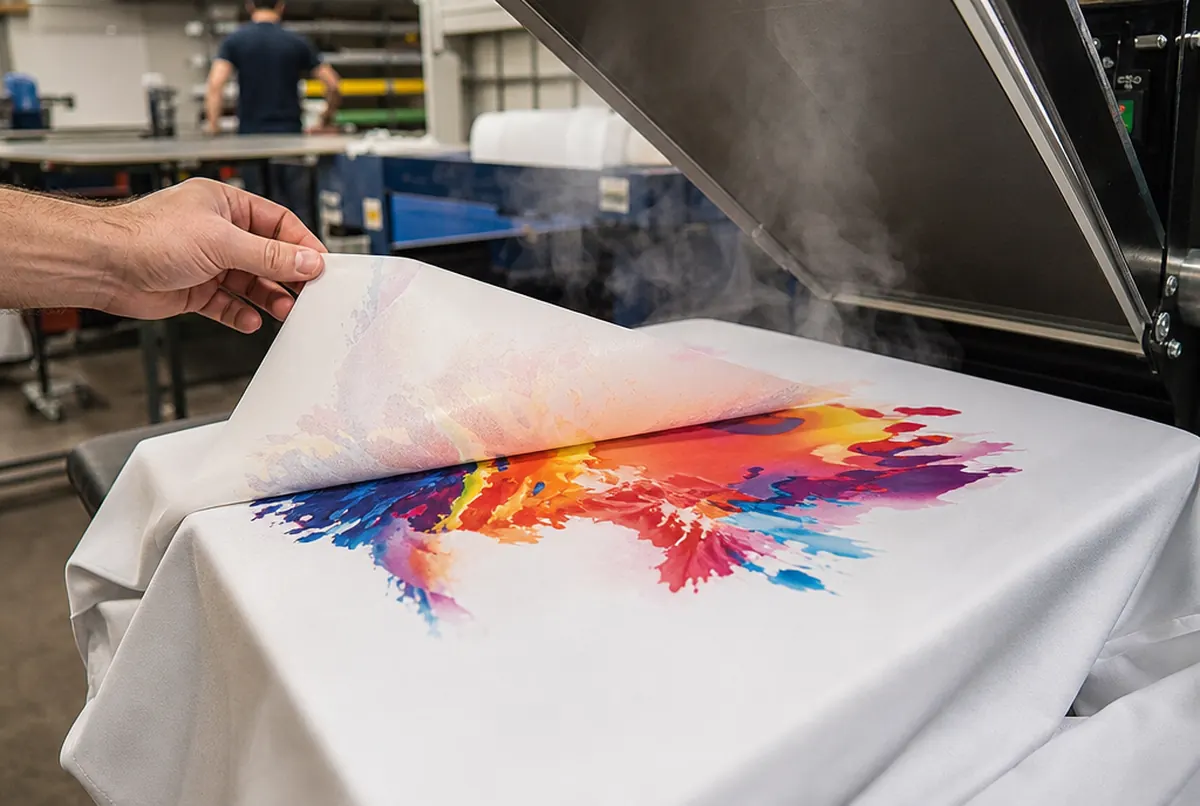
- The artwork is printed mirror-reversed with sublimation ink onto special transfer paper.
- Paper and fabric are fed through a calender – a heated drum that presses them together at approx. 200°C.
- The dye vaporises from the paper, and at this temperature the polyester fibres 'open up' and absorb it.
- As it cools, the fibre closes and the dye stays inside it permanently.
Once the paper is removed, the fabric is ready for finishing: hemming, sewing on SEG edging, pole pockets or clips. There is no ink layer on the surface, so the material feels just as it did before printing.
Where sublimation has the edge
For most promotional textiles we also print LED UV, with a flexible ink designed for fabric. It is faster and cheaper. We choose sublimation when the material will be used in a way where an ink layer on the surface would be a weak point:
- Flagpole flags and feather flags – the fabric flaps in the wind thousands of times a day. Dye inside the fibre does not rub off, and approx. 80% show-through means the flag reads from behind (mirror-reversed).
- Foldable textile banners – display walls, backdrops, counter graphics. Folded into a bag and set up dozens of times, they show no colour breaks at the folds.
- SEG graphics for profile frames – for long-term display and frequent removal from the frame.
- Backlit fabrics – colour has the greatest depth with light from behind.
- Tablecloths, covers, washable textiles – sublimation copes with low-temperature washing.
- Light fabrics: voile, chiffon – stage sets, screens, decorations where breathability matters.
More on choosing for flags in our guide UV-printed or sublimated flags.
Sublimation vs UV printing on fabric – a comparison
| Feature | Sublimation | UV print on fabric |
|---|---|---|
| Where the colour is | inside the fibre | on the fibre surface |
| Fabric hand | unchanged, very soft | slightly stiffer |
| Show-through to the reverse (110 g flag) | approx. 80% | approx. 20–30% |
| Folding, flapping | no cracking | good resistance, weaker with long use |
| Material | polyester only, or substrates with a polyester coating | most promotional fabrics |
| White | no white ink – white is the fabric colour | white underlay possible |
| Time and cost | longer (print + calender), more expensive | faster, cheaper |
| Polyester flag 110 g | approx. €12–21 net/m² | approx. €10–18 net/m² |
The price difference is not large, but over big areas it adds up. For a conference backdrop set up a few times a year, UV print on fabric is perfectly adequate. For flags outside a showroom that fly all season, sublimation pays back in durability.
Prices of sublimated textiles
Indicative net rates per m² (the lower figure applies to large areas, the higher to formats up to 4 m²):
- 110 g polyester flag with hemming and a pole pocket or clips – approx. €12–21,
- double-sided flag with a blockout liner (two different designs) – approx. €28–44,
- 210 g textile banner, very soft – approx. €15–25,
- 220 g SEG graphic with silicone edging sewn on – approx. €18–30,
- backlit fabric for fabric light boxes – approx. €21–32,
- decorative voile / chiffon – approx. €17–27.
Example: a 150 × 90 cm flagpole flag, hemmed, with clips, costs approx. €45 net each. With a dozen or so flagpole flags outside a building, the price per flag falls, because we calculate on the total area. Ready products are in the flagpole and feather flags, SEG fabric frames and printed tablecloths sections.
Limitations we mention before you order
Sublimation has hard limits, and it is better to know them before designing:
- It only works on polyester. On cotton the dye does not hold and washes out after the first wash. Cotton T-shirts use other methods, such as transfer printing.
- There is no white ink. White in the design is simply unprinted fabric. You cannot print white lettering on a coloured material.
- The fabric shrinks. In the calender the material shrinks slightly. We allow for this in file preparation, which is why we ask for the finished product size rather than '1:1 file with an allowance'.
- Dark, saturated solids on thin fabric may look a little lighter than on screen – that is down to the material's translucency, not a print fault.
If your brand colour has to match, order a test print on the final fabric. We describe this in brand colour in print – Pantone, proofs and tests.