 Signs & Large Format Print
Sublimation and screen print in brief
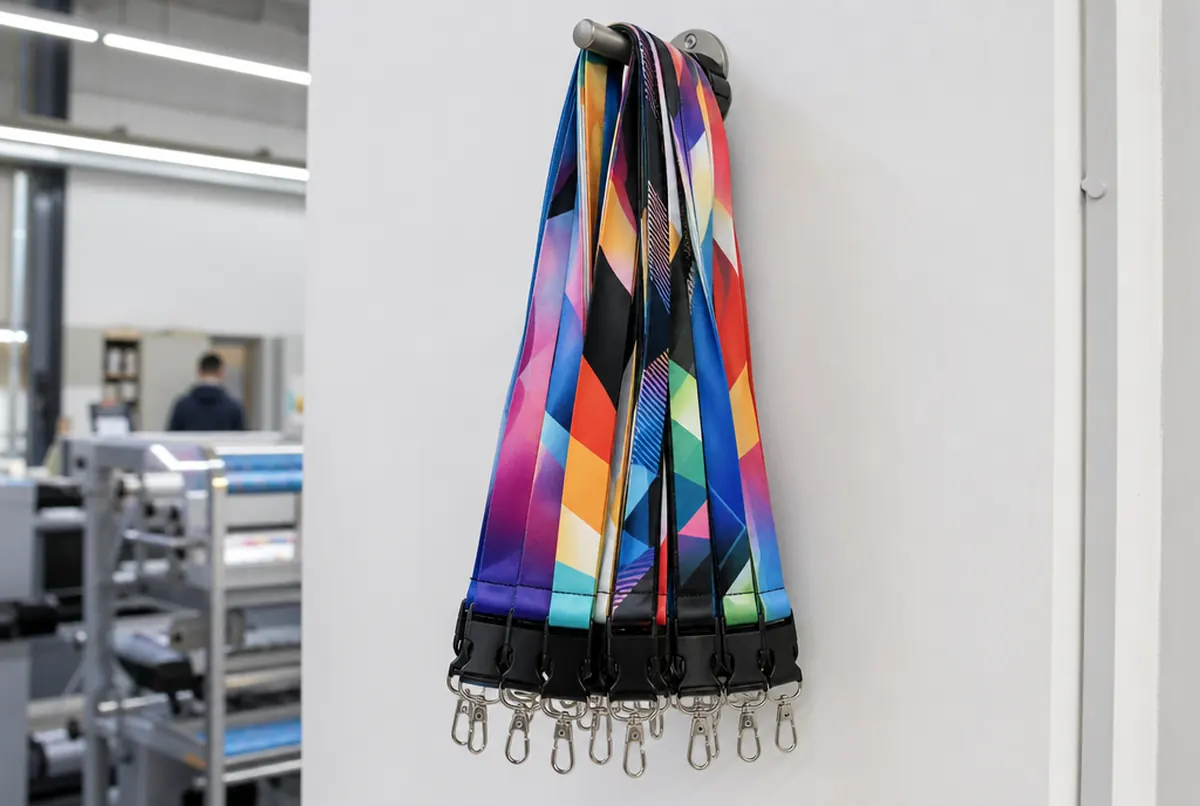
Dye-sublimation prints with a dye that, under heat, penetrates the fibres of polyester tape. The artwork is first printed onto transfer paper, then transferred onto the lanyard in a heat press. The dye becomes part of the material, so the print has no raised layer and does not crack when bent.
Screen printing pushes ink through a mesh screen carrying the design onto ready-made, usually single-colour tape. Each colour needs its own screen and its own pass. The ink sits on the surface of the tape – you can feel it slightly under your finger.
Both techniques have been used for years and both give a decent result. They differ in what can be printed, and in which artwork each one makes sense for.
Comparison: when to use which technique
| Feature | Sublimation | Screen print |
|---|---|---|
| Number of colours | unlimited, full colour | usually 1–2 colours, each extra one raises the price |
| Gradients, photos, patterns | yes | practically no |
| Background colour | any – printed together with the artwork | the colour of the ready-made tape |
| Double-sided print | yes, different artwork on each side | possible, as a separate pass |
| Feel | smooth, print cannot be felt | ink slightly raised |
| Material | polyester (white base) | various tapes, including dark colours |
| Best for | logos with gradients, patterns, sponsors, numbers | a simple one-colour logo |
In practice, for lanyards for events, conferences and sports clubs we almost always choose sublimation. Sponsor logos are rarely single-colour, and organisers want the lanyard in the event colours along its whole length, not just a slogan on black tape.
Lanyard width and how much logo will fit
Width decides how big the logo can be and how the lanyard sits around the neck. The most common are:
- 10 mm – narrow and discreet, for keys and small badges; fits a short word,
- 15 mm – versatile, good for a web address or a simple name,
- 20 mm – the most popular for events, fits a logo with a name and is comfortable to wear,
- 25 mm – wide, for several sponsor logos or a large graphic.
The most common mistake: a horizontal logo is several centimetres tall on a page, but on a lanyard it has to fit into a dozen or so millimetres. A long name with a small strapline then becomes illegible. Better to use just the brand mark, or repeat a short word every 10–15 centimetres.
Fittings and safety
Besides the tape, the fittings matter. There are several options, each with its own use:
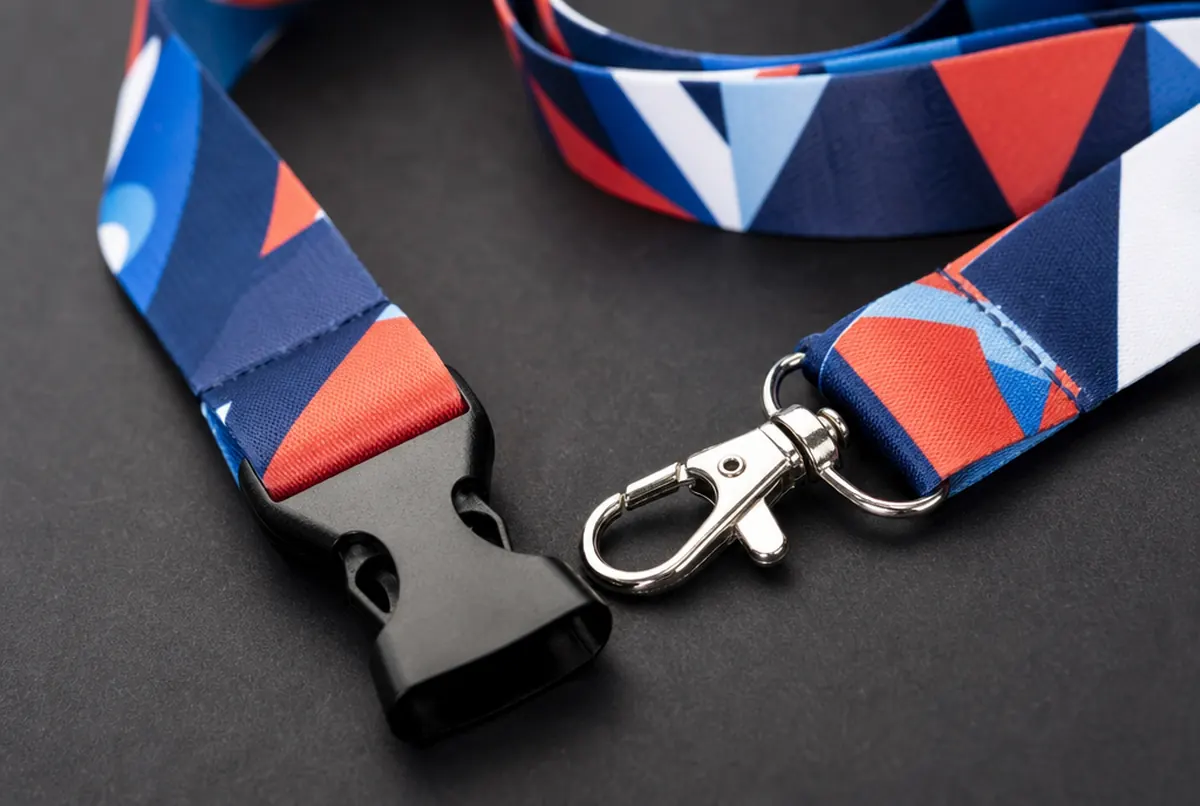
- lobster clip – the most popular, for badges and keys,
- clip or hook for a badge holder – when the badge sits in a plastic sleeve,
- safety breakaway – releases when pulled; we recommend it wherever people work near machinery, with children or in crowds,
- detachable buckle near the end – lets you remove the badge without taking off the lanyard.
For mass events and manufacturing sites we always recommend a safety breakaway. It costs little, and a lanyard that does not release when caught is a real risk.
Lanyards are usually ordered together with badges. Personalised 90 × 50 mm badges printed on both sides cost approx. €60 net for 100 with us; more in our guide to event name badges and lanyards.
- 24 hexpress printing (UV inks need no drying)
- approx. 3 daysstandard lead time
- up to 14 dayslarge and custom projects with installation
Plus courier delivery. Tell us your date — we plan production around it.
Lanyard design – what to watch out for
Most of the corrections we make to lanyards concern the same few things:
- Text direction. A lanyard hangs round the neck in a V shape, so text on one side reads top to bottom and on the other bottom to top. If you want it to read the same way on both sides, the design has to allow for it.
- The area near the fitting. A few centimetres by the clip are hidden by the badge and the fastening. Do not put the main logo there.
- Contrast. Light grey text on white looks fine on a monitor, but is invisible from two metres. Strong colours and simple typefaces win on a lanyard.
- Too much content. Logo, slogan, web address, phone number and social media handle on 20 mm of tape is too much. Choose one or at most two things and repeat them.
If you have no design, our studio will prepare one based on your logo and brand colours.
How to order printed lanyards
- Decide the quantity and the date the lanyards must be on site.
- Choose the width and the type of fitting.
- Decide whether the print is single- or double-sided, and whether the sides carry different artwork.
- Prepare your logo as a vector and your brand colours.
- Check the price in the configurator at printstrap.com – our online shop for printed lanyards, wristbands and neck tubes. There you can see straight away how the price changes with quantity.
- You receive a visual for approval, and after that we start production.
If you need a complete event set (lanyards, badges, wristbands) see the name badges, lanyards and wristbands page.