 Signs & Large Format Print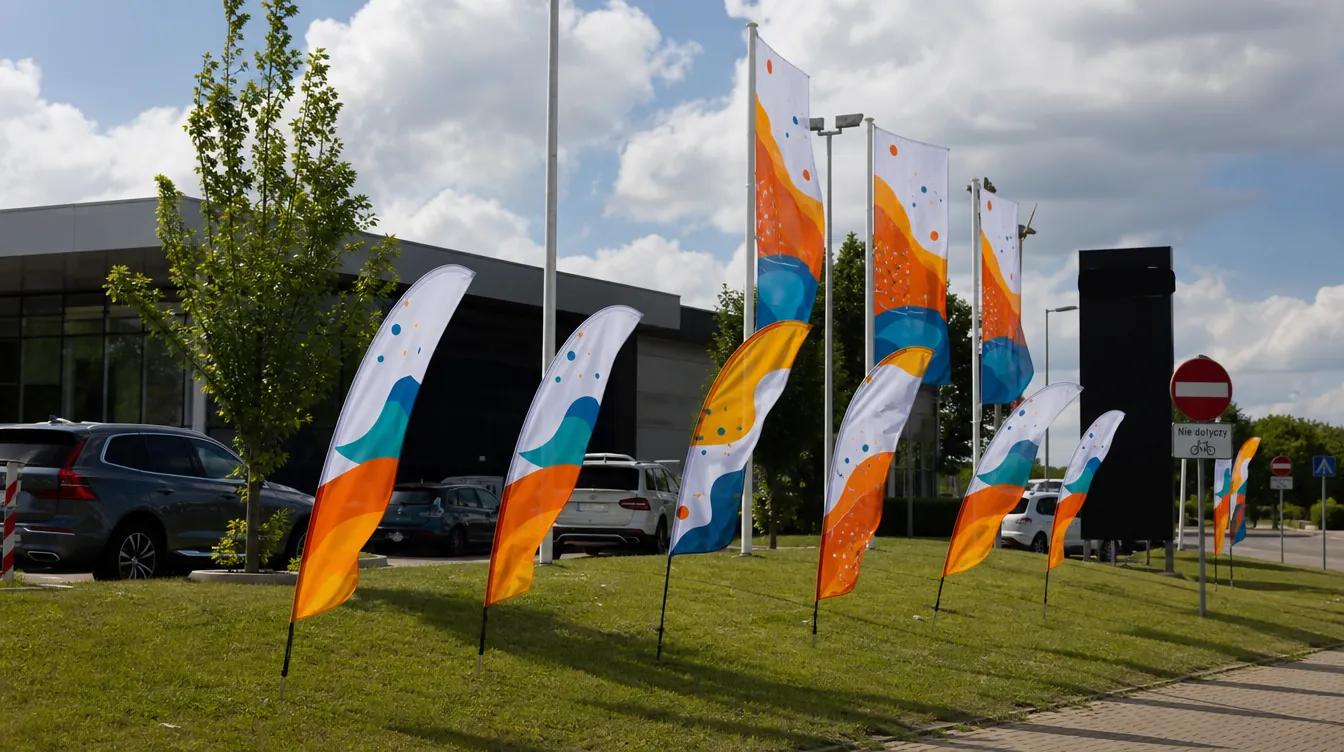
How each technique works
Both techniques print on the same fabric: flag polyester of about 110 g. They differ in what happens to the ink.
UV printing lays ink on the surface of the fibres and cures it instantly with UV light. The ink stays mainly on top. The result: vivid colours on the printed side, but a pale image on the back of the flag. Nothing needs drying or heat-setting, so the flag can be ready very quickly.
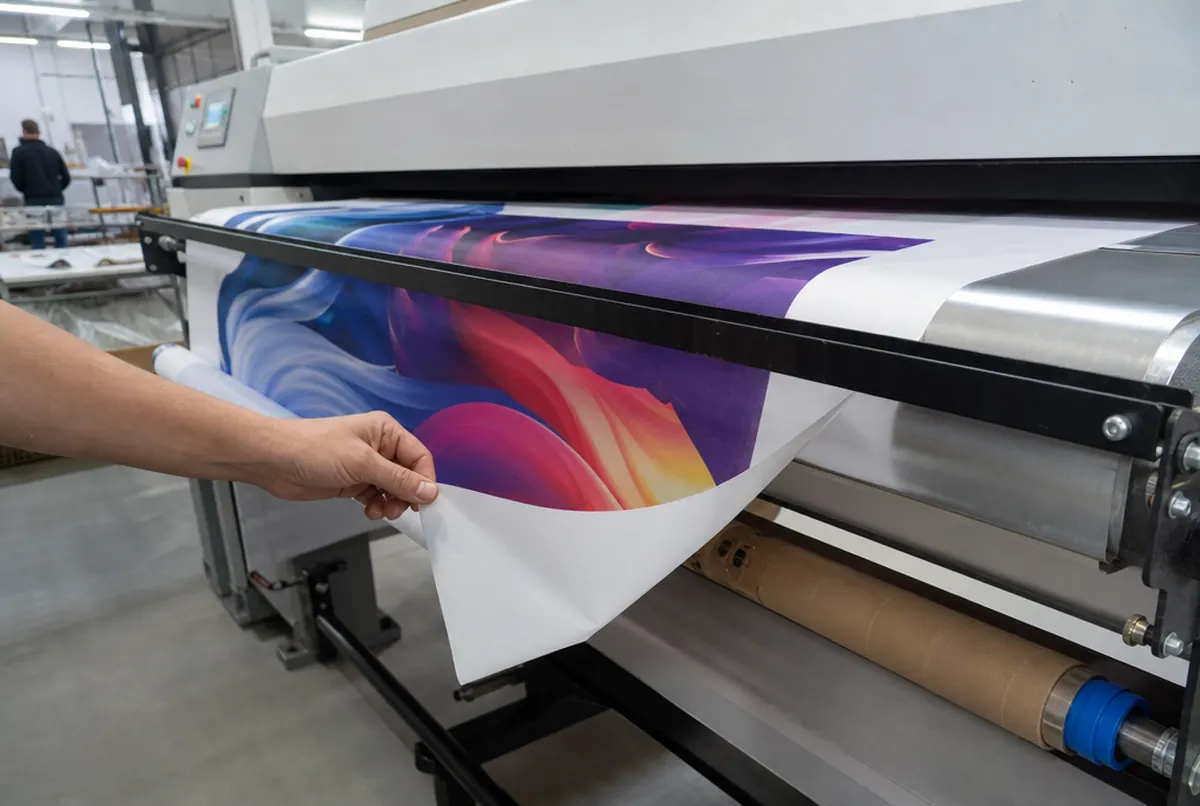
Dye sublimation prints with a dye that, under heat, turns into a gas and penetrates deep into the polyester fibre. The dye becomes part of the fabric rather than a layer on it. As a result it passes through to the other side, the fabric stays soft, and the colour does not crack when folded.
Comparison table
| Feature | UV print | Dye sublimation |
|---|---|---|
| Price per m² | approx. €10–18 | approx. €12–21 |
| Show-through to the reverse | approx. 20–30% | approx. 80% |
| Legibility from the back | poor, pale image | good, mirror image |
| Fabric hand | slightly stiffer where printed | very soft, no ink layer |
| Folding, washing | copes well, but less so with frequent folding | very well: the colour is in the fibre |
| Speed | the fastest | needs calendering, takes longer |
| Finishing included | hemming | hemming + pole sleeve or snap hooks |
The lower end of the price range applies to larger orders (from about 100 m²), the upper end to small ones up to 4 m². For pole flags this matters: ten 150 × 90 cm flags are 13.5 m², i.e. the 5–15 m² band. In UV that comes to 13.5 × approx. €14 = approx. €190 net, in sublimation 13.5 × approx. €16 = approx. €215 net. A difference of about €25 for ten flags.
When to choose sublimation
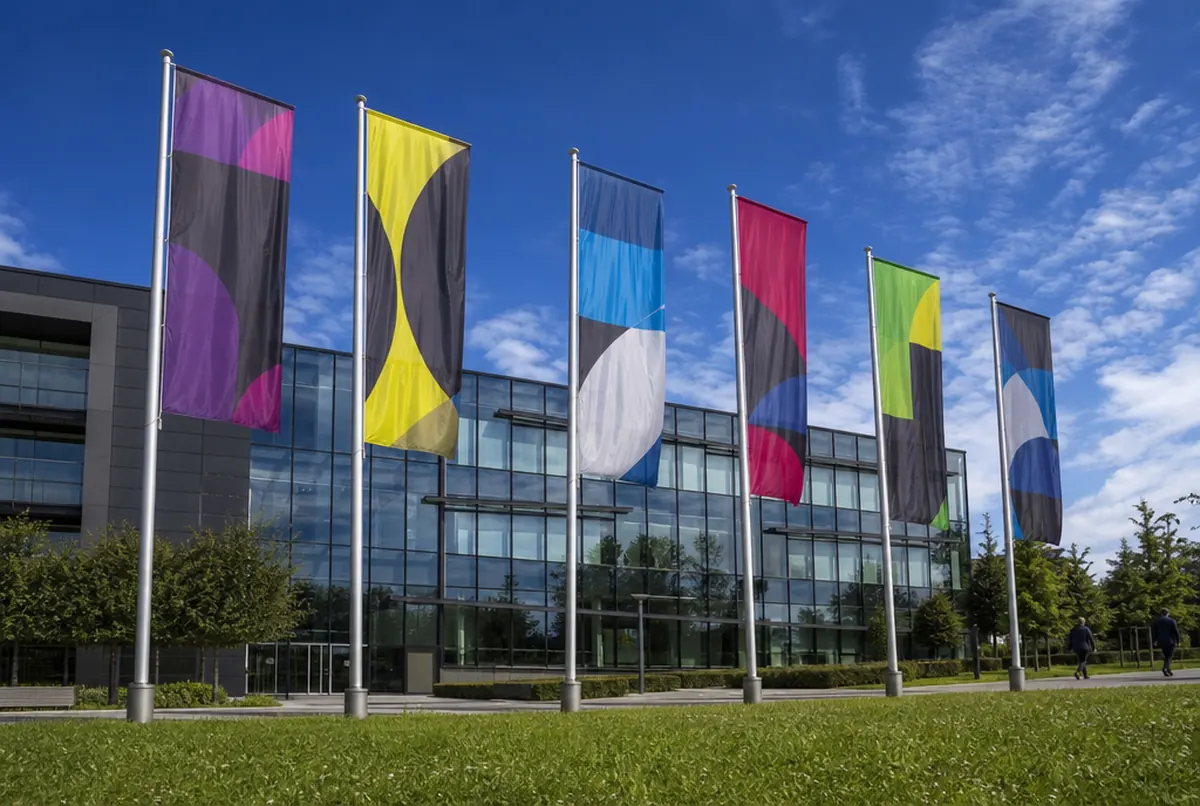
- Pole flags. The flag flies and turns, and people see it from both sides. With UV, from half the directions you see almost white fabric.
- Feather flags by the road and at events: same reason, the flag turns with the wind.
- Flags that will be folded, washed and transported often: sports clubs, fan flags, table flags, hand-held banners.
- Long outdoor display, where the flag works all day every day.
- Fabric display walls and graphics folded repeatedly: there sublimation is the premium option, though not always necessary.
If the flag must carry two different designs, e.g. text in two languages, or the logo must read from both sides without a mirror image, we make a double-sided flag with a light-blocking interlayer. That is two layers of fabric with a blockout interlayer, in sublimation approx. €28–44 net per m². Dearer, but the only one fully legible from both sides.
When UV print is enough
- Flags seen from one side: against a wall, in a hall, on a fence, on a display wall.
- A short campaign: a one-off event, a shop opening, an election campaign.
- A tight deadline: UV print needs no extra steps, so we can make the flag faster.
- Large quantities on a limited budget: with dozens of flags the price difference becomes noticeable.
With UV we can also print on other fabrics: textile banner, stretch fabric for structures, or backlit fabric. For flags, though, sublimation is in our view the better choice in most cases, and we treat UV as the economy and express option.
- 24 hexpress printing (UV inks need no drying)
- approx. 3 daysstandard lead time
- up to 14 dayslarge and custom projects with installation
Plus courier delivery. Tell us your date — we plan production around it.
Mistakes we see when flags are ordered
Most disappointment with flags does not come from the printing technique but from assumptions made when ordering.
- Text that must read from both sides on a single-ply flag. Even with sublimation the back shows a mirror image. A logo mark can live with that; lettering cannot.
- Small text. A flag ripples, so letters smaller than a few centimetres merge from just a few metres away.
- A dark background with UV. Large dark solids on a single-sided flag look like a dirty patch from behind. With UV, designs on a light background work better.
- No information about fixing. Pole sleeve, snap hooks or eyelets need deciding before sewing; changing later means alterations.
- A flag too big for the pole. An overlong flag wraps around the pole and frays faster. Give us the pole height and we will choose the proportions.
How to order a flag: what to tell us
- Flag size and fixing method: sleeve for a pole, snap hooks for a halyard, eyelets, hook-and-loop.
- Where the flag will hang and whether it will be seen from both sides.
- How many and by when.
- An artwork file to scale, ideally with the logo as a vector. If the flag has a Pantone brand colour, say so: fabric renders colour slightly differently from paper.
A single 150 × 90 cm pole flag, hemmed, with snap hooks, costs from approx. €45 net. Ready-made feather flags and pole flags come in sets with poles and bases; more in feather flags: types and prices.