 Signs & Large Format Print
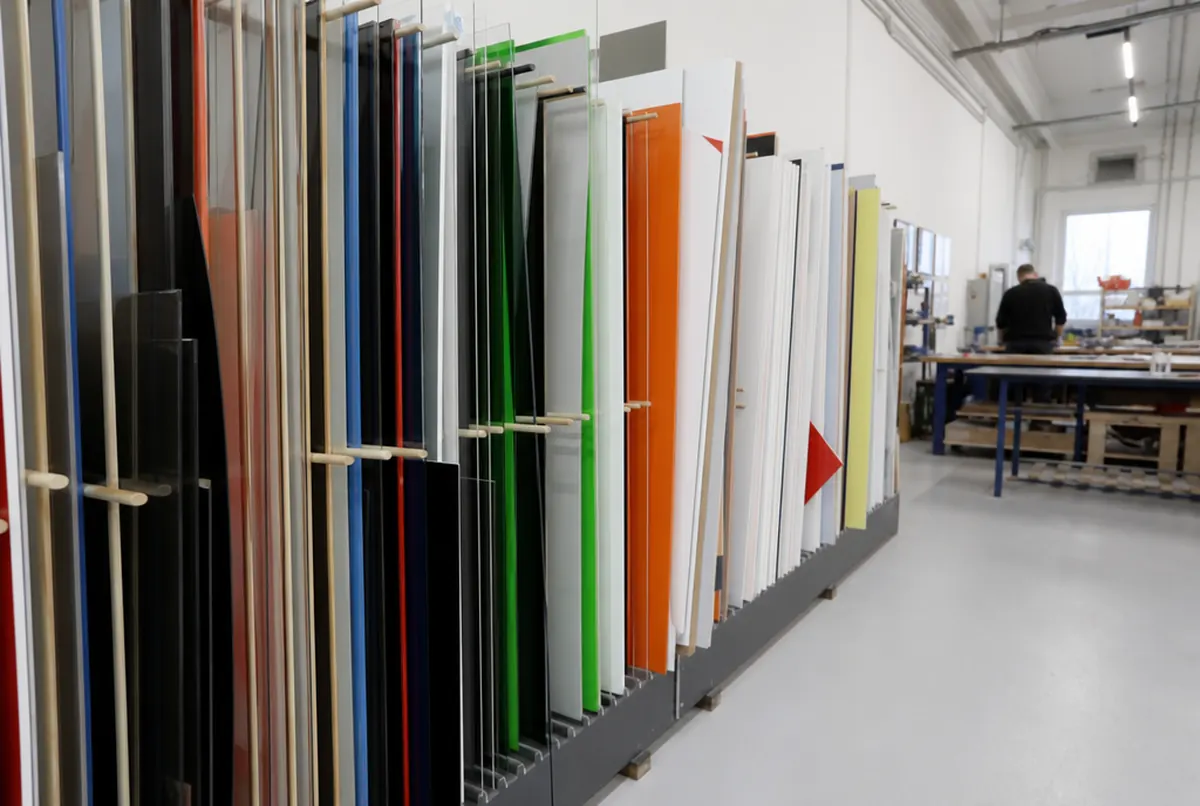
The most popular boards – a comparison table
| Material | Outdoors | Typical use | Net price / m² |
|---|---|---|---|
| Dibond 3 mm (standard) | yes, 10+ years | shop signs, panels, wayfinding | approx. €35–55 |
| Dibond 3 mm premium (thicker aluminium) | yes | facades, large panels, light box faces | approx. €45–65 |
| Clear acrylic 3 mm | yes | plaques on stand-offs, guards, displays | approx. €43–60 |
| Opal acrylic 3 mm | yes | faces of illuminated light boxes | approx. €48–70 |
| Solid polycarbonate 3 mm | yes | vandal-resistant, bus shelters, display cases | approx. €52–75 |
| Foam PVC 3 mm | short term | plaques, interior signage | approx. €21–33 |
| Foam PVC 5 mm | short term | panels, stands, displays | approx. €26–39 |
| Foam PVC 10 mm | short term | routed letters, 3D elements | approx. €42–60 |
| HIPS 0.8 mm | no | wobblers, shelf stoppers, hang tags | approx. €16–24 |
| Corrugated board 3.5 mm | no | POS displays, totems, dump bins | approx. €13–21 |
| Honeycomb board 10 mm | no | lightweight stands, exhibition fit-out | approx. €31–45 |
| Plywood / MDF 10 mm | no (unless sealed) | stage sets, premium stands | approx. €60–85 |
The lower figure applies to large areas (from 100 m²), the higher to single panels up to 4 m². Small formats carry a minimum print and finishing value. Shapes other than rectangles are cut on a router, laser or plotter; see plotter, router, laser – how they differ.
Dibond – when and why
Dibond is a sandwich panel: two thin aluminium skins with a plastic core. The trade name has become the everyday name for the whole group of composites. A 3 mm panel is rigid and light, does not rust and does not warp in the sun, which is why for years it has been the standard for shop signs, construction site boards and EU-funded project signs, house numbers and site signage.
What matters in composites is the thickness of the aluminium skins. A standard panel is enough for signs up to approx. 2–3 m². For large panels on a facade or light box faces we choose the premium version with thicker aluminium – it does not ripple in the sun and stays flatter.
Dibond can be routed, folded after V-grooving (tray forming), drilled and riveted. We UV print on it directly, so there is no vinyl to lift at the edge after years. More in acrylic, dibond or PVC – what to make a shop sign from.
Acrylic and polycarbonate – glass that does not shatter
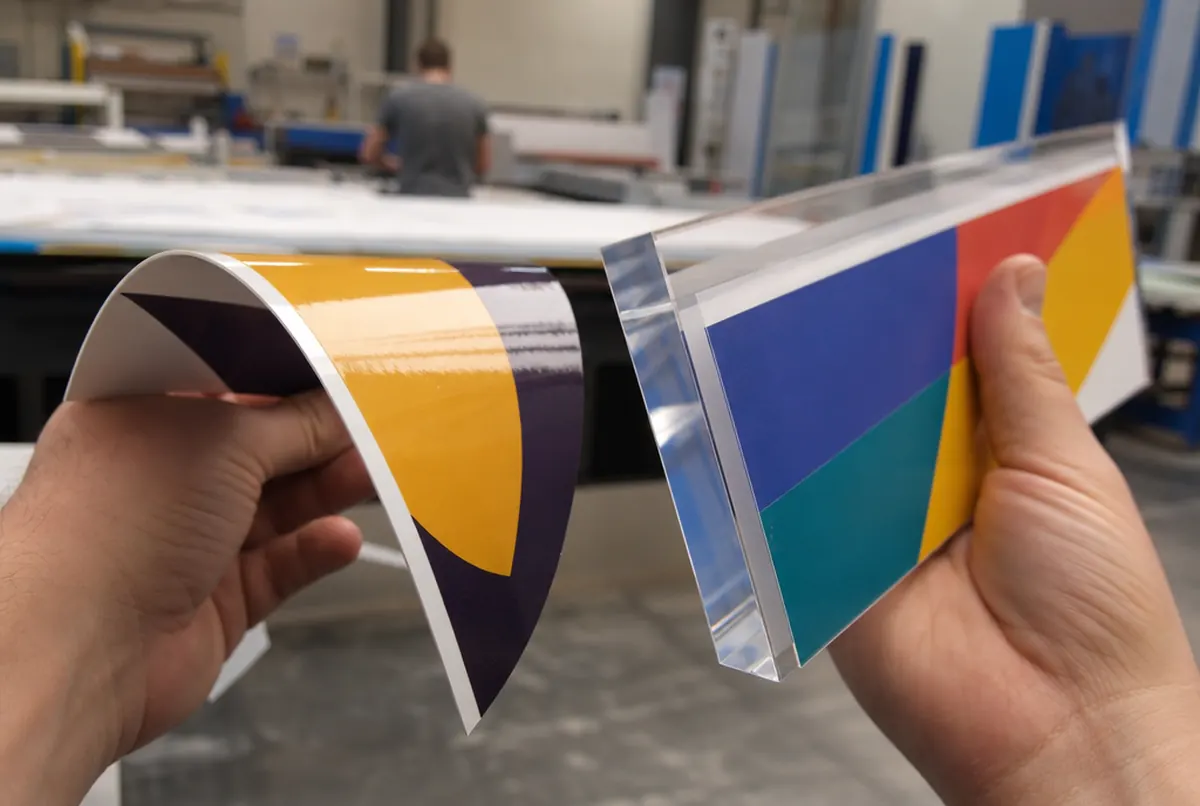
Acrylic (PMMA) is as clear as glass, but several times lighter and much less brittle. We use clear acrylic for plaques on stand-offs, leaflet holders, guards and displays. We print on the reverse with a white underlay – the colour is seen through the acrylic, has depth and is protected from scratches.
Opal acrylic diffuses light, so the LEDs behind it do not show as dots. It is the basic material for light box faces and illuminated letters.
Acrylic can be laser-cut (the edge comes out smooth and glossy), hot-bent and bonded with a clear joint. Remember that it moves with temperature – we make fixing holes larger than the screws so the sheet does not crack at the fixings in summer.
Polycarbonate looks similar but is much more impact-resistant. We choose it where a sign may take a knock: bus shelters, display cases in public spaces, places exposed to vandalism.
Foam PVC, HIPS, board – materials for the shorter term
Foam PVC is a light, white board that is easy to cut and install. Indoors it lasts for years – a good material for door signs, office signage or display elements. Outdoors it lasts less well: in full sun, especially in dark colours, it heats up and can warp. For a season or a campaign it is fine; for a sign meant to last years, dibond is better. 10 mm PVC is a common base for CNC-routed dimensional letters.
HIPS is a thin (0.8 mm), rigid plastic for in-store materials: wobblers, shelf stoppers, hang tags. Cheap, light and easy to cut to shape.
Corrugated board is fluted card with UV print. It is used for displays, dump bins and life-size cut-outs for campaigns lasting a few weeks. It is fully recyclable.
Honeycomb board is very light for its stiffness – it works well for exhibition stands that have to be carried and set up. Examples of in-store use are on the POS shelf stands and totems and cardboard cut-outs pages.
How to choose a material in 4 questions
- Indoors or outdoors? Outdoors for years: dibond, acrylic, polycarbonate. Indoors: anything, with PVC and acrylic leading.
- For how long? A few weeks' campaign in a shop: board, HIPS. A season: PVC. Years: dibond.
- Does it need to light up? Yes – opal acrylic or backlit textiles. No – dibond or PVC.
- Will people touch it, kick it, carry it? A sign by a sports pitch or bus stop – polycarbonate or premium dibond. A trade stand carried by one person – honeycomb board.
Example quote: a 120 × 80 cm information panel in 3 mm dibond is 0.96 m², i.e. the 1–4 m² band – approx. €55 × 0.96 = approx. €53 net including print and trimming. The same panel in 5 mm PVC for indoors: approx. €39 × 0.96 = approx. €37 net. Ready board products are shown on the printing on boards and panels page.