 Signs & Large Format Print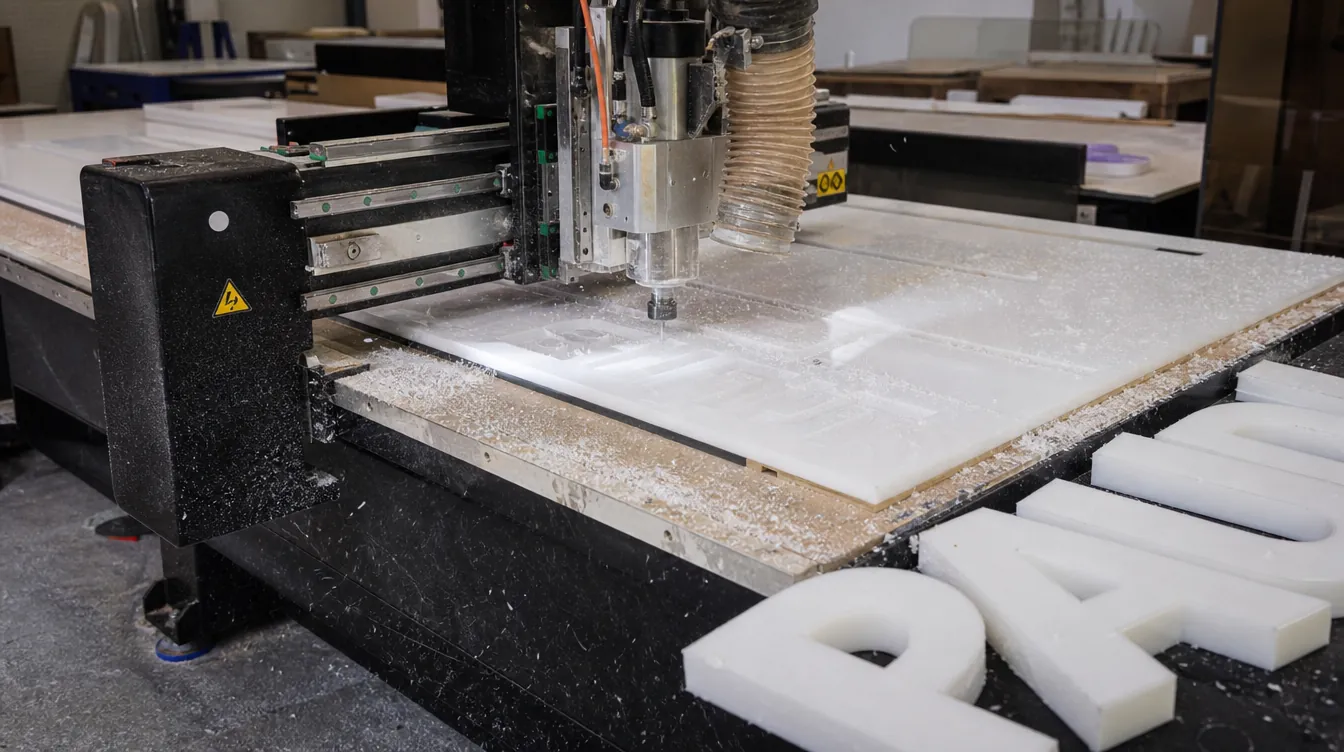
Three machines, three ways of cutting
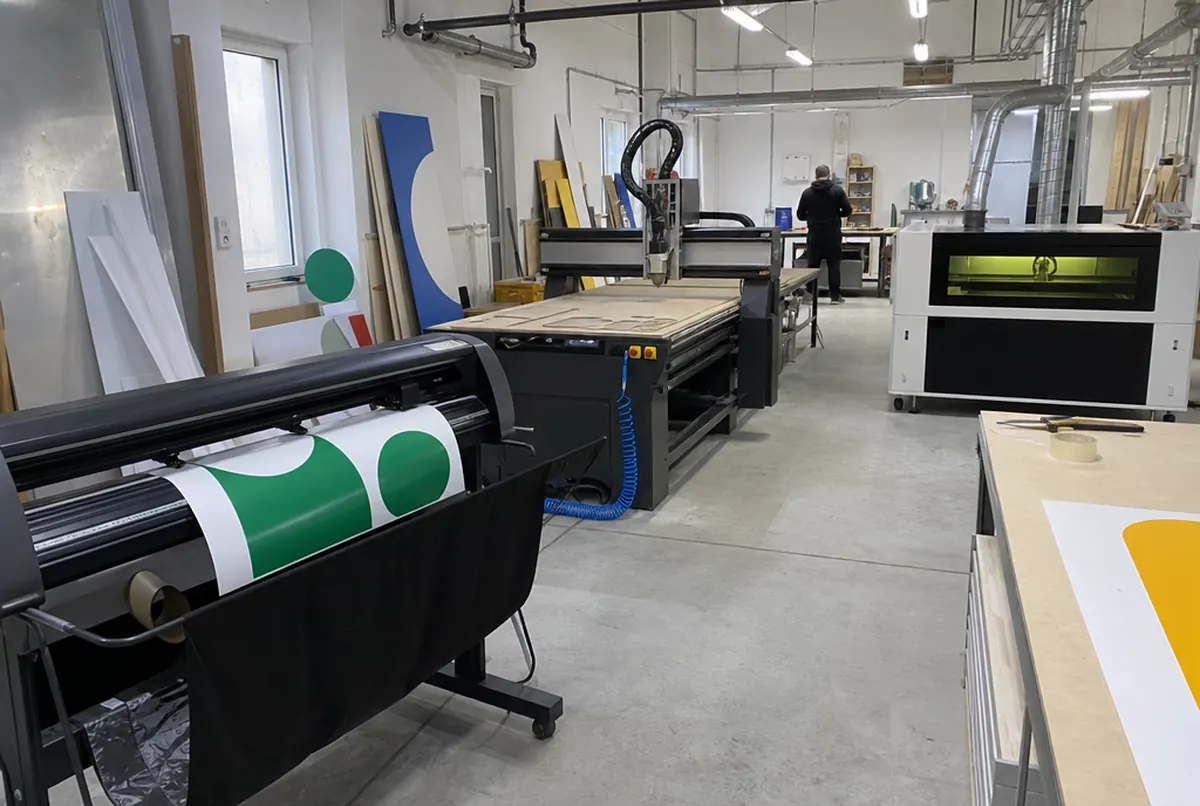
All three do the same thing (cut a shape from a vector file) but each does it differently and on different materials.
A cutting plotter draws a sharp blade across the material. In the vinyl version the blade cuts only the top layer without cutting through the backing – that is how contour-cut stickers and self-apply letters are made. A cutting and creasing plotter with an oscillating knife (vibrating up and down very fast) cuts thicker materials: card, corrugated board, HIPS, PVC up to a few millimetres, and also presses in fold lines, i.e. creases.
A CNC router works with a cutter spinning at high speed that removes material like a very precise drill guided along a path. It copes with hard, thick boards – up to several tens of millimetres. It can also cut grooves for folding (V-cut), chamfer edges and engrave mechanically.
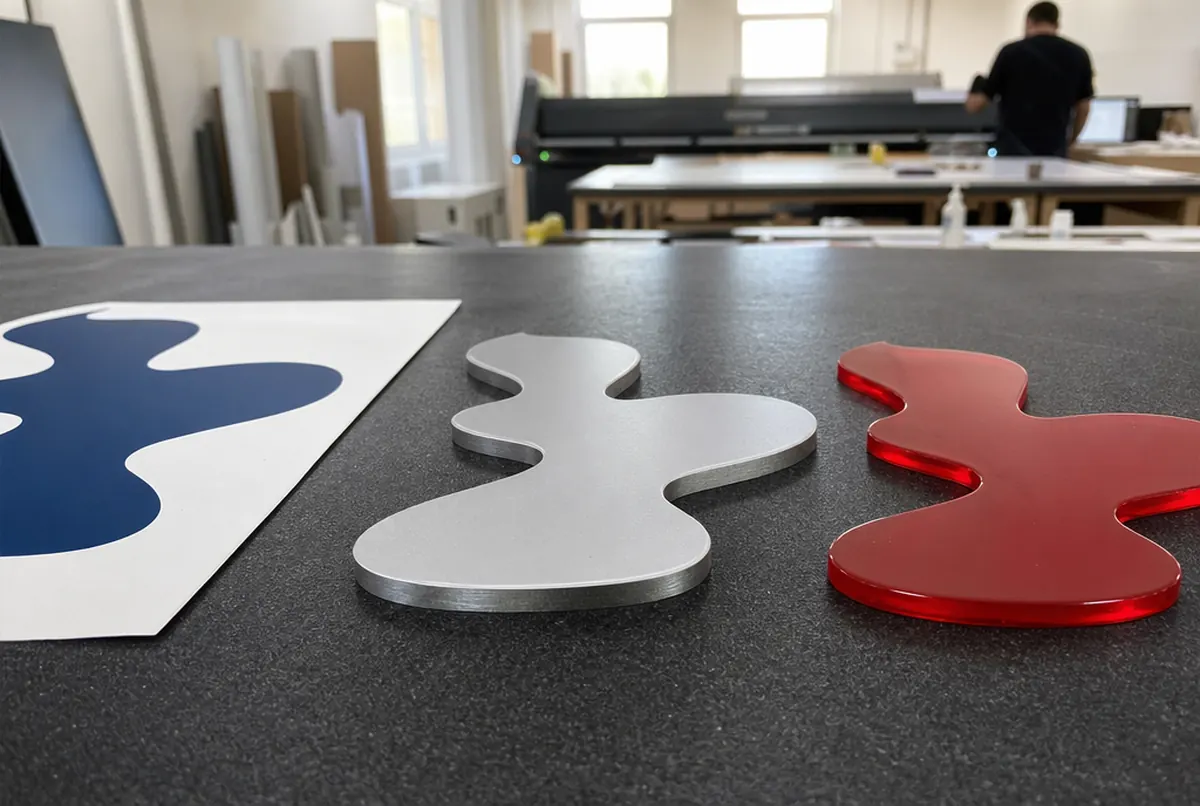
A laser cuts with a focused beam of light that locally vaporises the material. It does not touch the material, so it does not need clamping, and fine details come out very precisely. An acrylic edge from the laser is smooth and glossy, without polishing.
What to cut with what – a table
| Material | Cutting / knife plotter | CNC router | Laser |
|---|---|---|---|
| Self-adhesive vinyl | yes – the standard | — | — |
| Card, corrugated board | yes, with creasing | possible, rarely | possible on thin board |
| HIPS, PP, PET up to 2 mm | yes | yes | PET yes |
| Foam PVC | up to approx. 5 mm | yes, any thickness | no – it gives off harmful gases |
| Dibond (aluminium composite) | — | yes, also V-cut for folding | — |
| Acrylic up to 5 mm | — | yes | yes – glossy edge |
| Acrylic 6–10 mm | — | yes | yes; above approx. 8 mm routing is better |
| Acrylic over 10 mm | — | yes | — |
| Plywood, MDF | — | yes, thick | yes, up to approx. 5 mm, dark edge |
| Felt, rubber, fabrics | partly | — | yes |
| Engraving on wood, acrylic, coatings | — | mechanical engraving | yes – the most common choice |
On wood the laser leaves a scorched, dark edge. Sometimes that is an advantage (a decorative effect), sometimes a drawback – then we choose the router. With acrylic thicker than approx. 8 mm the edge quality from the laser drops, so we recommend routing and polishing.
What cutting costs – price per metre of tool path
Cutting is charged per linear metre of tool path, i.e. the total length of all the lines the tool travels along. Indicative net prices, excluding material:
- Vinyl plotter: contour cutting approx. €1.20/m, cutting letters and shapes approx. €1.40/m, weeding (removing the waste vinyl) approx. €10/m², application tape for transferring letters approx. €6/m².
- Knife plotter (oscillating): card approx. €0.70/m, HIPS and PET up to 2 mm approx. €0.95/m, PVC up to 5 mm approx. €1.30/m, creasing approx. €0.50/m.
- CNC router: material up to 3 mm approx. €1.65/m, up to 5 mm approx. €2.10/m, up to 10 mm approx. €2.80/m, up to 20 mm approx. €6/m, up to 30 mm approx. €8/m; V-cut for folding dibond approx. €3.30/m. File and machine set-up approx. €8 per job, minimum routing value approx. €19.
- Laser: acrylic, PET, felt, rubber up to 5 mm approx. €0.70/m, plywood and MDF up to 5 mm approx. €0.85/m, acrylic 6–10 mm approx. €1.40/m; surface engraving approx. €0.55/dm², deep engraving approx. €1.10/dm². Minimum laser job value approx. €14.
Example 1. A dibond panel in the shape of a logo, perimeter 4 m: 4 m × approx. €1.65 = approx. €7 plus set-up approx. €8. That makes approx. €15, so the minimum routing charge of approx. €19 net applies.
Example 2. 20 letters in 5 mm acrylic, each with a perimeter of approx. 1.2 m: 24 m × approx. €0.70 = approx. €17 net for laser cutting, plus material.
The tool path length grows quickly with fine, decorative typefaces. It is they, not the size of the board, that drive the cost of cutting.
How to prepare a file for cutting
Every one of these machines needs a vector – lines, not a picture. The rules are common to all:
- The cut line in a separate layer and a separate colour, ideally named (e.g. CUT).
- Closed shapes, with no gaps and no lines duplicated on top of each other – otherwise the machine goes over them twice.
- Text converted to outlines.
- No details finer than the tool can manage. A router cutter has a diameter, so internal corners always come out slightly rounded; only the laser gives a sharp internal angle.
- For letters cut from vinyl – a minimum height and stroke width that can be lifted from the backing. With very thin serifs the vinyl tears during weeding.
If you only have your logo as a JPG, we will vectorise it (approx. €26 net). More in our guide vector logo.
What comes out of it in practice
These three machines often work on a single job. A light box with a routed face? The router cuts the letters in the dibond, the laser cuts acrylic inserts, the plotter cuts vinyl for the face. A cardboard display? UV print on board, then the knife plotter cuts the shape and creases the folds.
The most common jobs:
- plotter: contour-cut stickers, window lettering, frosted films with a cut-out pattern,
- router: dimensional letters in PVC and dibond, shaped panels, light boxes, fit-out elements,
- laser: acrylic plaques, leaflet holders, awards, engraving on merchandise and rating plates.
Details are on the CNC routing and board cutting and bending pages, and in our guide laser engraving and cutting.