 Signs & Large Format Print
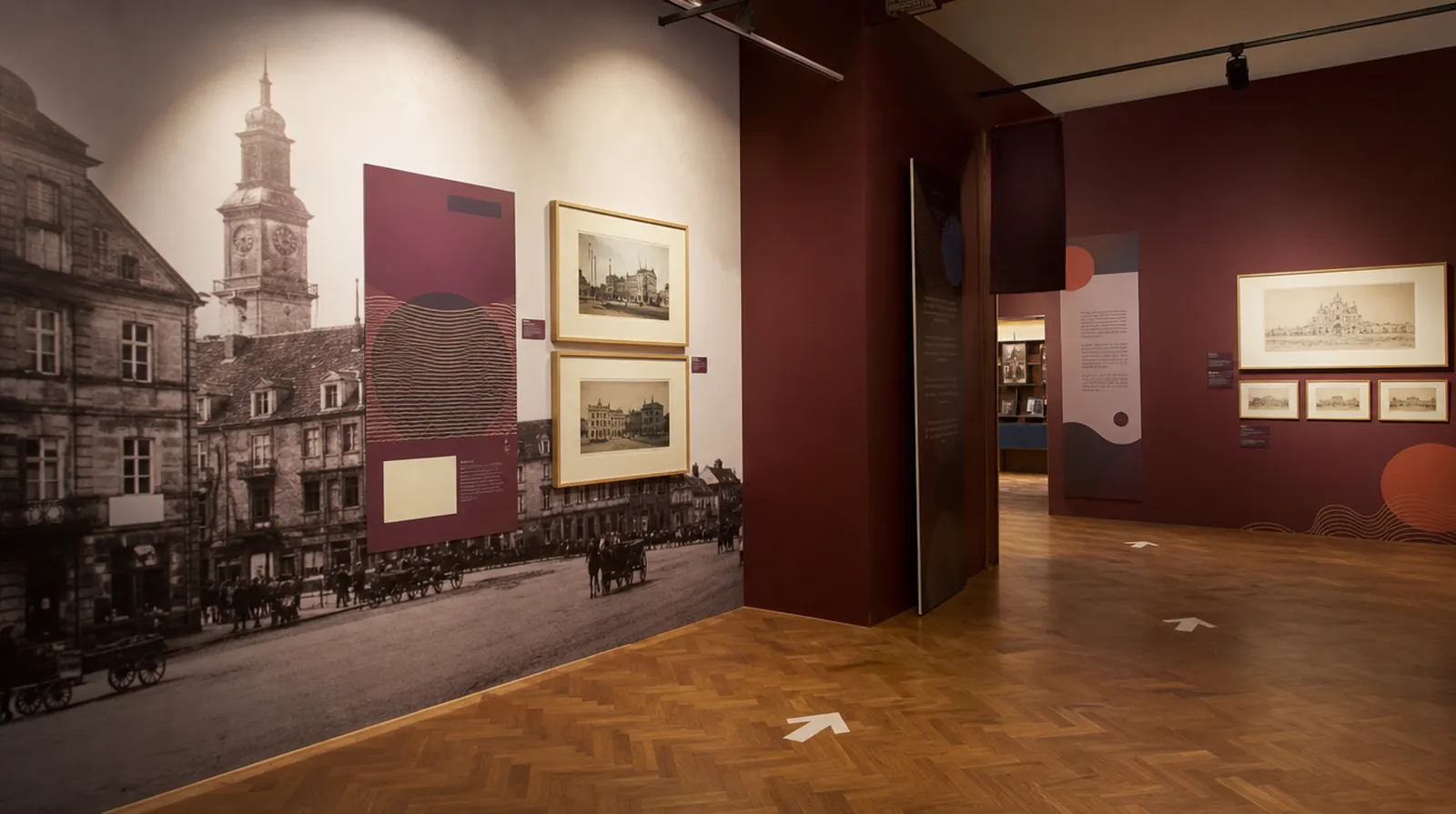 Illustrative visualisation
In a museum, publicity and display are largely the same job. The same printer makes the panel with the curator’s text, the mural behind the display case, the label under a painting and the banner over the entrance that draws people to the private view. What counts is colour true to the original, clear typography and materials that don’t smell and don’t need the room aired before opening.
The other issue is turnover. A temporary exhibition lives for a few weeks or months, then everything has to come down and be done again, usually in a short window between shows. So we usually advise separating the permanent things (building signage, visitor rules, frames, information boards) from what gets changed (graphics, panels, titles). The permanent items we make to last, the changeable ones so they can be swapped quickly. For a large signage project we start with a [wayfinding system](/produkty/systemy-informacji-wizualnej) and a site survey.
1. Display: panels, labels, room design
For panels with text and images we most often use foam board or foam PVC – they are light, hang on tape or wires and don’t load the walls. We keep Dibond for panels that must last years or stand where people touch them. Before a big order it is worth doing an A3 test print on the final material, especially for reproductions of paintings and old photographs.
- Exhibition panels with text and images→Lightweight boards with direct UV print – no mounting, no bubbles. With a series of exhibitions, the same panel format lets you reuse the same fixings.
- Acrylic object labels→Clear acrylic printed with a white underlay looks discreet beside a painting. Fixed on stand-offs, or with tape if the wall must not be drilled.
- Wall murals and full-wall graphics→An archive photo or a background colour at room scale changes how an exhibition feels more than a few extra panels. B-s1,d0 certified non-woven wallpaper has no odour, so the room can open straight away.
- Cut vinyl lettering and quotations→A section title or quotation straight on the wall, without a background. After the exhibition the vinyl comes off without damaging the paint, provided the wall is well painted.
- Reproductions on canvas and fine art paper→Copies for education rooms, touring exhibitions, or in place of an original that cannot leave the store.
2. Exhibition title, entrance and facade
A temporary exhibition has to be visible from the street, otherwise only the regulars come. A banner or mesh on the facade, a roll-up banner by the ticket desk and a 3D title at the entrance to the room are the basic set. On listed buildings anything hung on the facade has to be agreed with the heritage authority first – we cover permissions in general terms in our guide [does a sign need permission](/poradnik/czy-szyld-wymaga-pozwolenia).
- Banner or mesh announcing the exhibition→Large format on the facade or a fence. On a tall building we use mesh, because it catches less wind.
- 3D letters with the exhibition title→Letters in Styrodur or PVC on the wall at the entrance to the room make more impact than a print alone, and make a great photo backdrop for visitors.
- Roll-up banners and stands by the ticket desk→Events programme, workshops, the new exhibition. The graphic in a roll-up can be changed without buying a new cassette.
3. Wayfinding and building signage
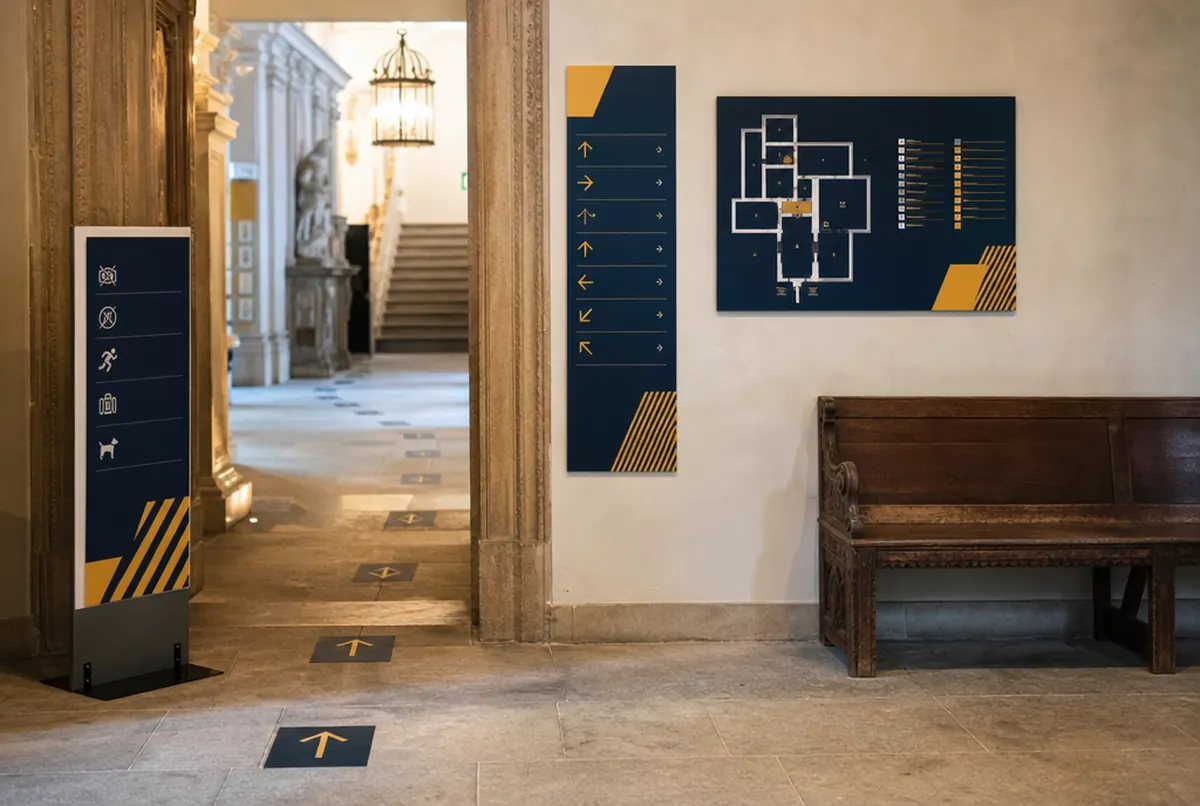
Visitors want to know where the ticket desk, cloakroom, toilets and lift are, and which room to start in. In old buildings with an enfilade of rooms and several staircases people get lost quickly. Good signage uses one typeface, one set of pictograms and room numbers that match the plan in the leaflet.
- Directional signs and floor plans→Signs at the entrance and on every landing. A plan marked “you are here” saves staff dozens of questions a day.
- Arrows and visitor route on the floor→For a one-way route or heavy school group traffic. Film with R10 anti-slip laminate.
- Visitor rules and information at the entrance→Opening hours, ticket prices, photography rules. The museum supplies the wording; we choose the material and format to suit the spot.
- Frosted film for office and store glazingScreens the back-of-house and staff rooms while still letting light in.
4. Education and accessibility
More and more institutions ask about objects visitors can touch. We 3D scan the object and then print a hands-on copy – for children in workshops and for blind and partially sighted visitors. Models of buildings and archaeological sites we make by 3D printing or from CNC-routed boards.
- 3D scan of an object and a touchable copy→The original stays in the case and the copy goes on the education table. The scan is also useful for documenting the collection.
- Models for display→A model of a castle, a hillfort or an old market square shows scale better than a panel of text.
5. Print: catalogues, tickets, souvenirs
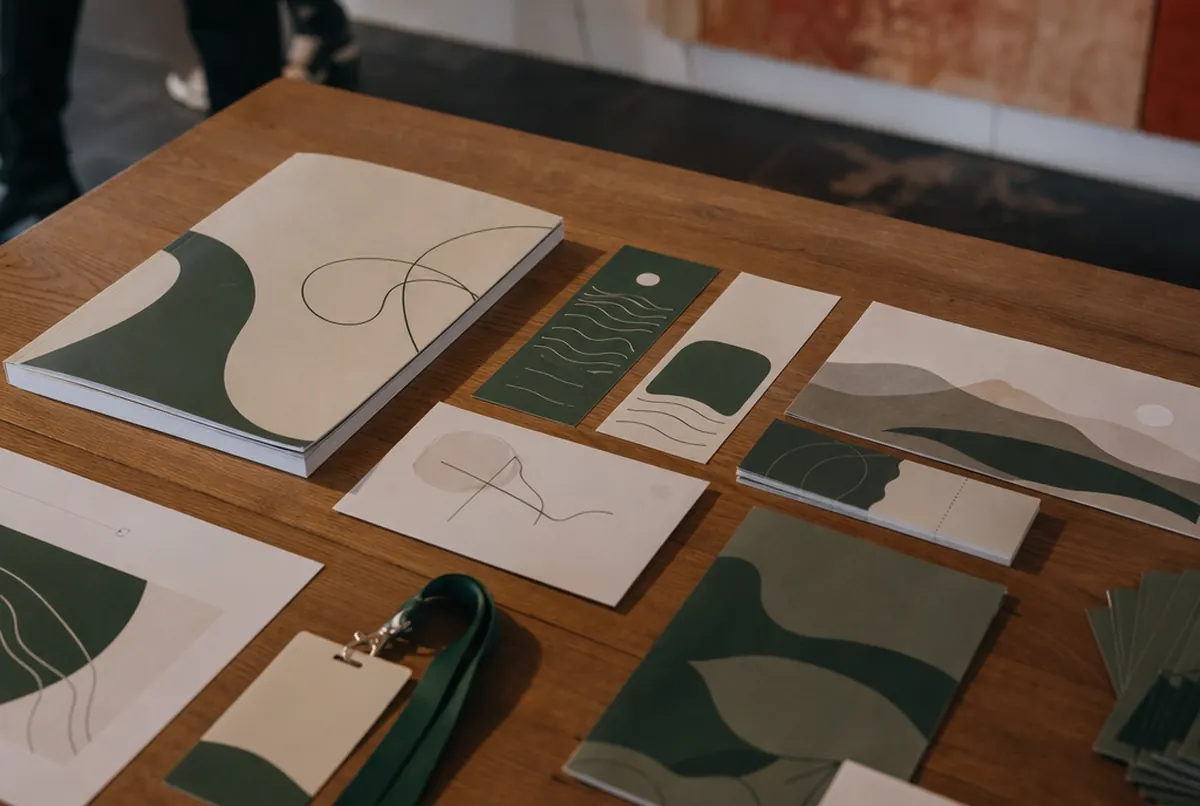
Every exhibition means paper too: private view invitations, a leaflet with a plan, a catalogue, tickets. For short runs we print digitally, so 100 catalogues is no problem.
- Exhibition catalogues and publications→Saddle-stitched A4 catalogue, 16 pages, 100 copies approx. €220 net. For more pages we do perfect binding or hardback.
- Tickets, passes and season tickets→Perforated tickets glued into pads. 1,000 tickets at 55 × 170 mm approx. €75 net.
- Bookmarks, postcards and private view invitationsSmall items for the museum shop that remind people of the institution.
- 01Brief
Description, sizes, site photos and deadline — a few sentences are enough.
- 02Design and quote
Our designers prepare artwork or a visualisation and you get a price.
- 03Approval
You approve the design; for brand colours we provide a proof.
- 04Production
35+ machines in our own plant in Poland: 3.2 m UV print, CNC, laser, 3D, sewing.
- 05Installation or delivery
Own crews and vehicles across Europe, partner network, couriers worldwide.
To start with — an indicative package
A sample set for a medium-sized temporary exhibition in two rooms. Prices from our price list, excluding installation.
| 10 panels 70 × 100 cm on 5 mm foam board (7 m² × approx. €24) | approx. €170 net |
| Non-woven wall mural for a 4 × 3 m wall (12 m²) | approx. €15–25 net per m² |
| Printed 3 mm acrylic object labels | approx. €43–60 net per m² + stand-offs approx. €2.35 each |
| Exhibition title in Styrodur letters | from approx. €13 net per character |
| Coated banner 5 × 2 m for the facade (10 m² × approx. €9) | approx. €90 net |
| Roll-up banner 85 × 200 cm by the ticket desk | from approx. €55 net |
Indicative net prices; exact quote after a short description of the exhibition, a list of panels and photos of the rooms.
From our experience — what to watch out for
- Sign off panel texts before sending them to print. Correcting a comma after 30 panels are printed costs as much as a new run.
- Scan archive photos at high resolution, or bring the originals – we have a large-format scanner. A photo from the internet on a 1 × 1.5 m panel will come out pixelated.
- Give us the private view date rather than “as soon as possible”. It is often possible to make it at standard turnaround, with no express surcharge.
- Don’t go below a readable type size on object labels. Visitors stand a metre from the wall, and in a school group further still.
- For touring exhibitions choose lightweight boards and one format. We pack them so they survive several moves.