 Signs & Large Format Print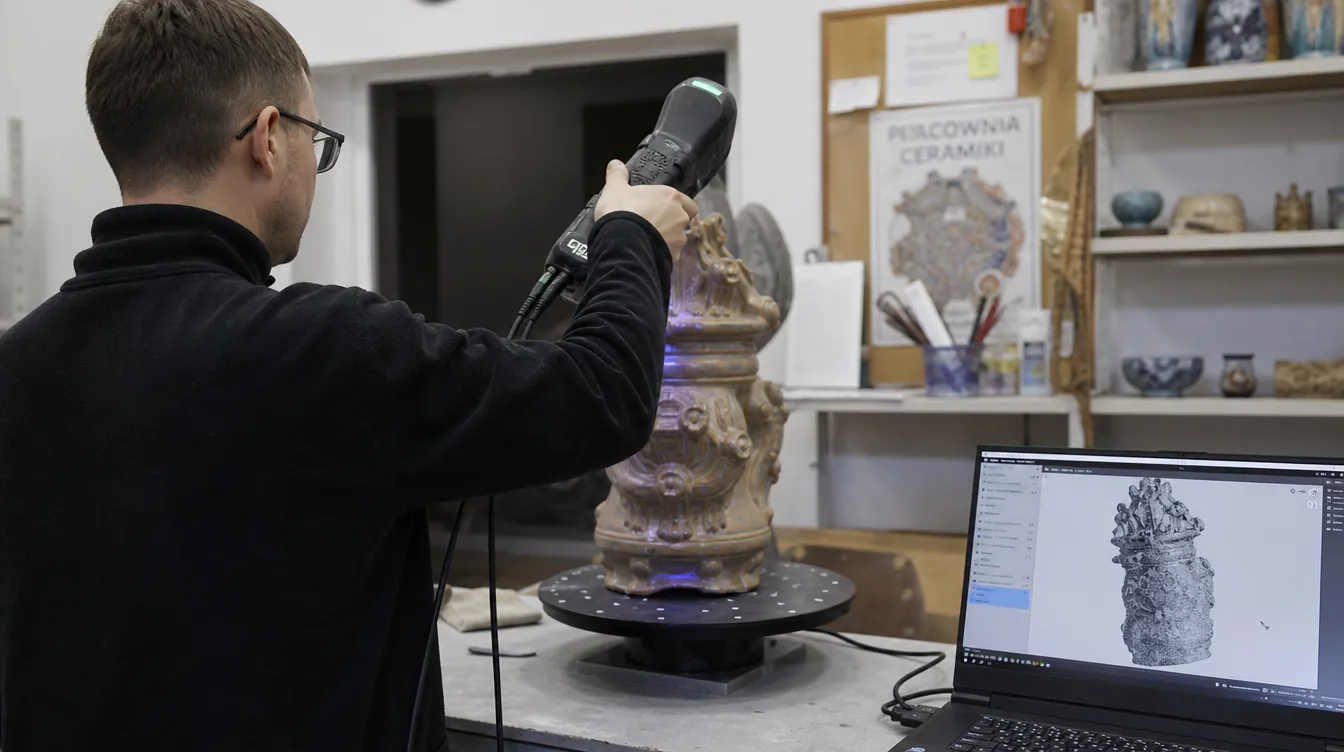
What clients most often order a 3D scan for
A 3D scanner is useful wherever a shape is too complex to measure with callipers and draw from scratch. In our experience these are the main cases:
- A copy of a damaged or unavailable part: a plastic machine component, a bracket, a cover, a knob the manufacturer no longer makes. We scan the original (even if cracked), fix the model and print a new one.
- Enlarging or shrinking an object: a figurine, mascot or sculpture that is to stand on a stand at several times the scale, or a large object to be made as a miniature for an award.
- A logo or 3D element for advertising: an existing emblem that has to be recreated as an illuminated 3D logo or adapted to a new facade.
- Fitting an existing shape: a housing, cover or holder that must sit perfectly against a curved surface, e.g. a dashboard or a handle.
- Documentation and archiving: a digital model of an object to show in a presentation or on a website, or to keep in case it is destroyed.
- Mock-ups and set design: transferring the shape of a real object to a mock-up or exhibition decoration.
How scanning works with us, step by step
- Photos and description. You send a few photos of the object with a ruler or dimensions and tell us what should come out at the end: a 1:1 copy, an enlargement, a print, a routed part, just a file.
- Assessment. We tell you whether the object can be scanned without trouble or needs preparing, and roughly how long processing will take. On that basis you get a quote.
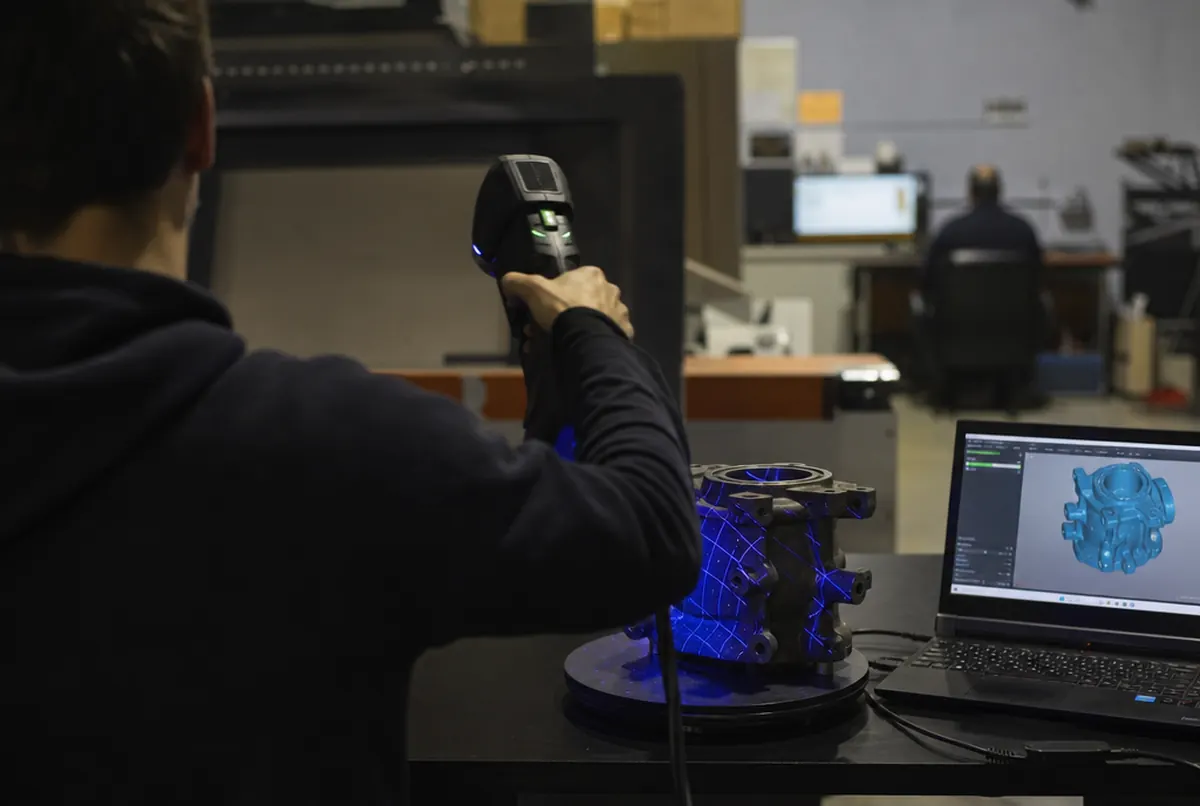
- Scanning. You bring or send the object to us in Wieluń. We scan it with a professional 3D scanner from several sides, then merge the captures into one model.
- Mesh processing. We clean up noise, close holes where the scanner could not reach and smooth surfaces.
- Production model. If the goal is printing or routing, we prepare a production model: correcting wall thickness, adding fixing holes, splitting into parts, scaling.
- Print or file. We hand over the file or print the model straight away: we have a farm of 7 3D printers on site, including machines for large parts.
What you get from a scan, and what a scan will not do
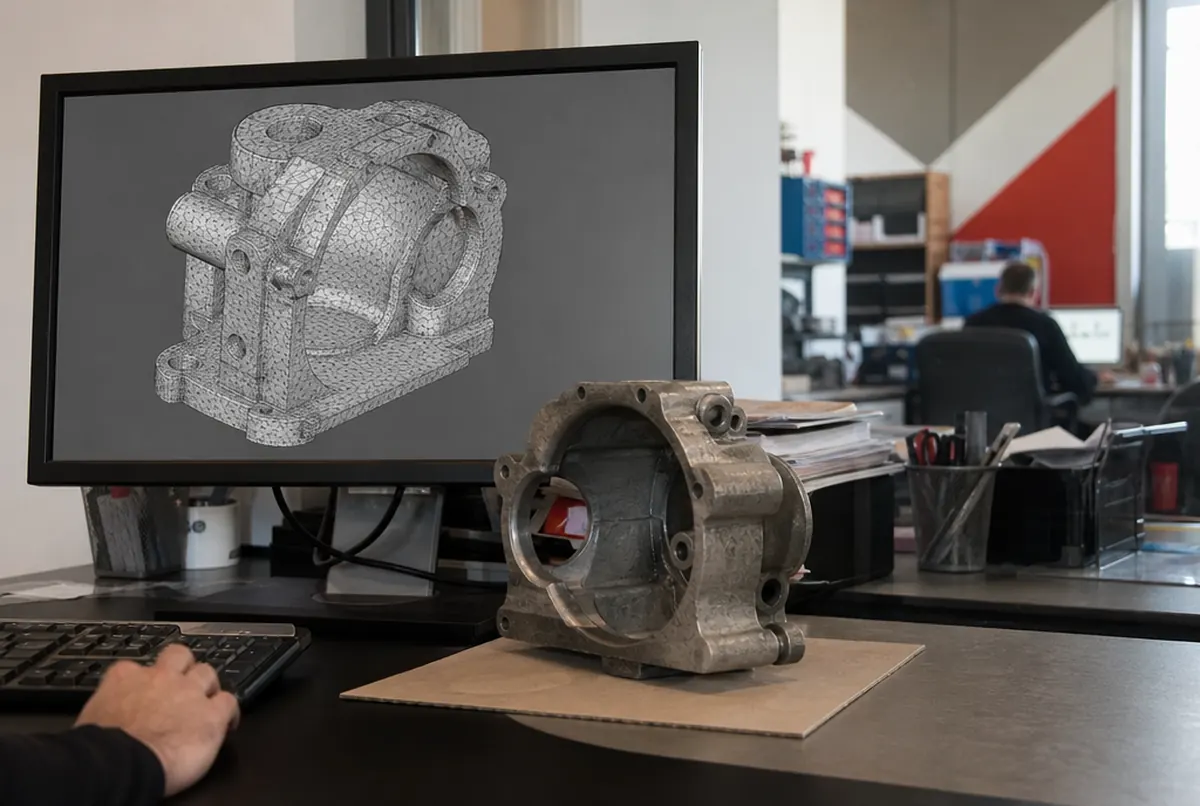
This is the most important thing to understand before ordering. The scanner records the object's surface as a triangle mesh, the same as in an STL file. For 3D printing or visualisation that is usually enough, after processing.
But a scan is not a CAD model from a technical drawing. It contains no "8 mm hole" or "2 mm wall": there are thousands of points describing the shape with an accuracy that depends on the scanner and the object. If the part must have exact fits, bearings or threads, we build a new CAD model based on the scan. That is longer modelling work, but then you get something you can edit by dimensions.
The scanner also cannot see inside a closed object or into completely hidden areas. If something has concealed channels or internal ribs, they have to be modelled from measurements, or the object taken apart.
That is why we always ask about the purpose when you order. For printing a copy of a figurine, a cleaned mesh is enough. For producing a spare part with screw holes, it is better to order a CAD model straight away: dearer at the start, but later any dimension change takes minutes, not a fresh start.
Which objects scan badly
Not every surface is kind to a scanner. The most work comes from:
- shiny and mirror-like surfaces: chrome, polished metal, piano-gloss lacquer,
- transparent ones: glass, acrylic, clear plastics,
- very dark, matt black surfaces: they absorb the scanner's light,
- hair, fur, fabrics with a nap: no clear surface,
- very thin elements, wires and meshes.
In many cases a special matting spray that is removed afterwards helps, but we always ask whether the object can take it. We do not coat historic or valuable objects with anything without the owner's consent.
Before sending the object, clean off dust and grease. If it is a machine part, remove whatever can be removed: a clean, dismantled component scans faster, and that translates directly into the price.
What it costs
| Stage | Price | When needed |
|---|---|---|
| Scanning the object | quoted from photos | always: depends on size and surface |
| 3D processing and modelling | approx. €45 / hour | cleaning the scan, production or CAD model |
| 3D printing: standard printer | approx. €14 / hour + material | copy or model up to 1:1 |
| 3D printing: large-format | approx. €26 / hour + material | enlargements, large parts |
| PLA / PETG material | approx. €0.05 / €0.10 per gram | depending on use |
| Finishing: sanding, priming, painting | approx. €34 / hour | when the model is going on display |
The price of the scan itself depends on the object's size, the number of captures and how "difficult" the surface is, so we give it after seeing photos. For a simple part copy, most of the cost is usually processing and printing, not the scan. Detailed print rates are in how much does a custom 3D print cost, and the service is described on the 3D scanning page.