 Signs & Large Format Print
What paper weight actually tells you
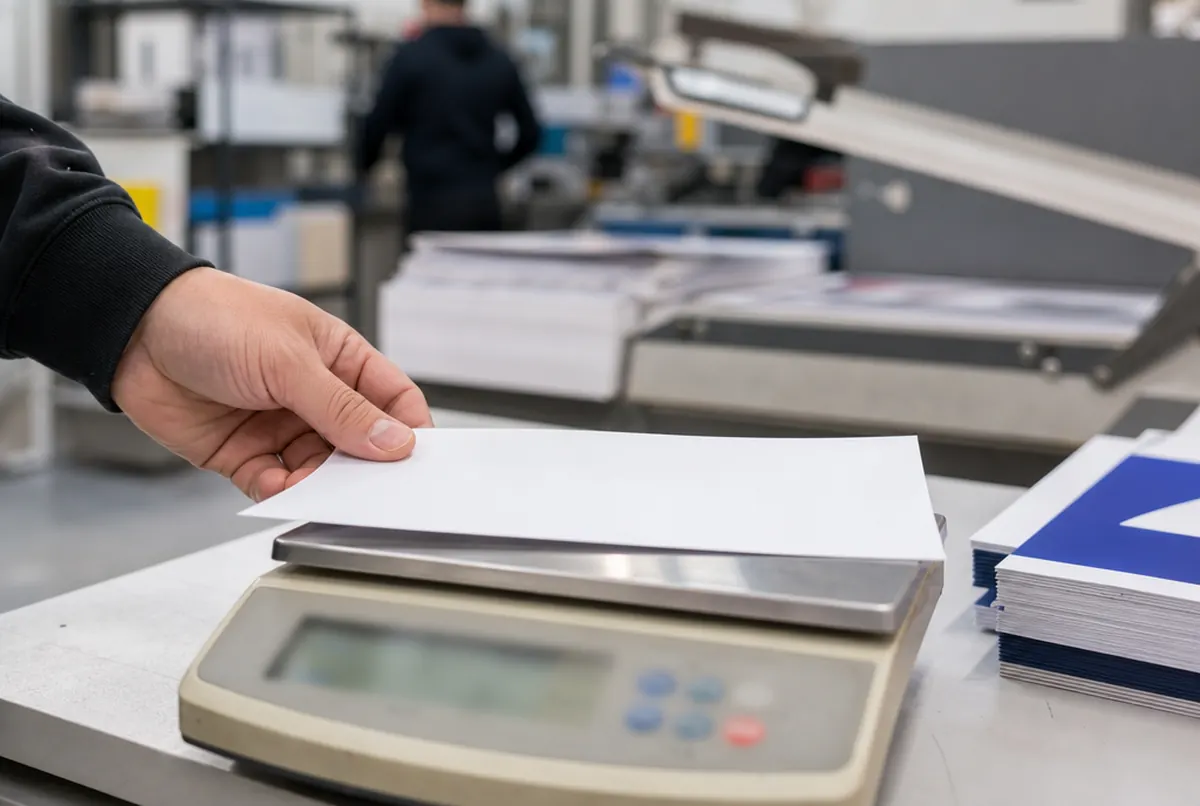
Paper weight is simply that – weight. 80 gsm paper is paper where a 1 m² sheet weighs 80 g. An A4 sheet is 1/16 of a square metre, so a sheet of ordinary printer paper weighs approx. 5 g, and a 90 × 50 mm business card on 350 gsm just under 1.6 g.
In practice clients think of weight as 'thickness', and that is a good approximation, but not always. How it feels in the hand also depends on:
- Paper type. Uncoated offset paper (like office printer paper) is bulky and, at the same weight, thicker than art paper, which is compressed and coated.
- Bulk. High-bulk papers at 90 gsm can be as thick as ordinary 120 gsm paper.
- Format. An A6 card on 170 gsm feels stiff; the same paper at A3 already bends.
That is why, when quoting, we always ask what the print is for, not just how many grams.
Which weight for what – a table
| Weight | Paper type | Typical use |
|---|---|---|
| 70–90 gsm | offset (uncoated) | letterheads, forms, office printer documents, book interiors |
| 115–135 gsm | matt or gloss art paper | mass-distribution flyers, leaflets, catalogue interiors |
| 150–170 gsm | art paper | better-quality flyers, posters, premium catalogue interiors |
| 200–250 gsm | art paper | catalogue and brochure covers, stiff flyers, invitations |
| 300 gsm | coated board | folding cartons, desk calendars, hang tags |
| 350 gsm | matt or gloss art board | business cards, presentation folders, discount cards |
| 120–170 gsm | large format papers | billboard posters, citylight, indoor posters |
These values are a starting point, not a rigid rule. A letterbox flyer in a big run can be on 115 gsm, because cost and postage weight count. A flyer handed over in a premium showroom holds up better on 170 gsm, or 250 gsm with lamination.
Matt art, gloss art, offset – what changes
Weight is one decision; paper type is another, often more important.
Gloss art paper has a smooth, shiny surface. Photos come out vivid and saturated, with deep blacks. The downside: it reflects light and shows fingerprints more easily.
Matt art paper (often silk or satin) is now the most common choice for flyers, catalogues and business cards. Colours are slightly calmer, but text is easier to read, and the whole thing looks more elegant.
Offset has no coating. You can write on it with a pen and run it through an office printer, which is why it is the standard for letterheads and forms. Photos on it are more matt and softer.
A rule from practice: if someone is going to write on the paper or put it through a laser printer after printing – offset. If the print has to sell through images – art paper. Choosing paper for flyers is covered in detail in which paper for flyers.
What printing on different weights costs – examples
A few prices from our product pages, to give an idea of scale (net prices):
- 90 × 50 mm business cards, double-sided, 350 gsm matt art board – 500 pcs approx. €15, 1000 pcs approx. €25,
- A4 letterhead, 90 gsm offset, single-sided – 500 pcs approx. €49,
- DL leaflet, 6 pages, 130 gsm art paper – 1000 pcs approx. €90,
- A4 stitched catalogue, 16 pages, 170 gsm matt art paper – 100 pcs approx. €220,
- A4 folder, 350 gsm matt art board with matt lamination – 100 pcs approx. €135.
Going from 130 gsm to 170 gsm for flyers raises the price less than clients usually expect, because most of the cost is printing, not paper. With catalogues the difference is more noticeable, because there are many pages, and a heavier catalogue also costs more to post.
Indicative prices for small print (business cards, flyers, posters) in each weight and quantity are in our product catalogue. Treat the figures above as a reference point.
Weight in large format printing and banners
In large format, weight is quoted too, but it means something slightly different.
Poster papers have low weights because they work pasted up or in a frame: 120 gsm blueback for billboards (the blue back stops an old poster showing through), 150 gsm whiteback for citylights, 170 gsm satin for interiors.
PVC banners weigh 440–650 g/m², but here a higher figure does not always mean a better material. 440 g strong banner is lighter than 510 g laminated banner, yet thanks to its denser reinforcing scrim (1000 × 1000 weave) it can be more durable. Durability is decided by construction (the scrim inside and the coating method) not by weight alone. The heaviest are 550–650 g blockout banners, because they have a light-blocking layer inside. A comparison is in which banner to choose.