 Signs & Large Format Print
Business card prices: what you pay for the standard
| Quantity | Price per run | Price per card |
|---|---|---|
| 500 | approx. €15 net | approx. €0.03 |
| 1,000 | approx. €25 net | approx. €0.025 |
These are the two most commonly ordered quantities. As you can see, the second five hundred costs very little: for 1,000 cards you pay only about €10 more than for 500. So if you hand out cards regularly, a thousand usually works out better.
The prices are for print-ready files. If the card has to be designed from scratch or an old design reworked, we add studio time, described below. Details and current options are on the business cards page.
Our minimum order value is approx. €24 net. Clients often combine a small run of business cards with other print, such as letterheads or presentation folders, and then the minimum no longer matters.
The price changes with quantity, paper and turnaround, so treat the prices in this guide as a reference point.
What the price of business cards depends on
Several things affect the quote. Clients overlook some of them and are then surprised by differences between quotes.
- Quantity: set-up and cutting costs are spread over more cards, so the unit price drops.
- Single- or double-sided: 4/0 means printed on the front only, 4/4 on both sides. The price difference is small, and the back can carry a map, opening hours or a QR code.
- Board: weight, surface finish and speciality stocks (e.g. textured, recycled).
- Finishing: matt or gloss lamination, soft touch, spot UV, foiling.
- Format and shape: anything other than 90 × 50 mm, rounded corners, die-cutting.
- Number of versions: 10 people in a company means 10 separate artworks, even if only the name changes.
- Turnaround: standard is about 3 working days; 24-hour express is possible at a surcharge.
For special finishes such as raised spot UV or foiling, we do not quote a price upfront, because it depends on the area of the effect and the quantity. We quote from a short description or the file; more on the print finishing page.
Which paper to choose for business cards
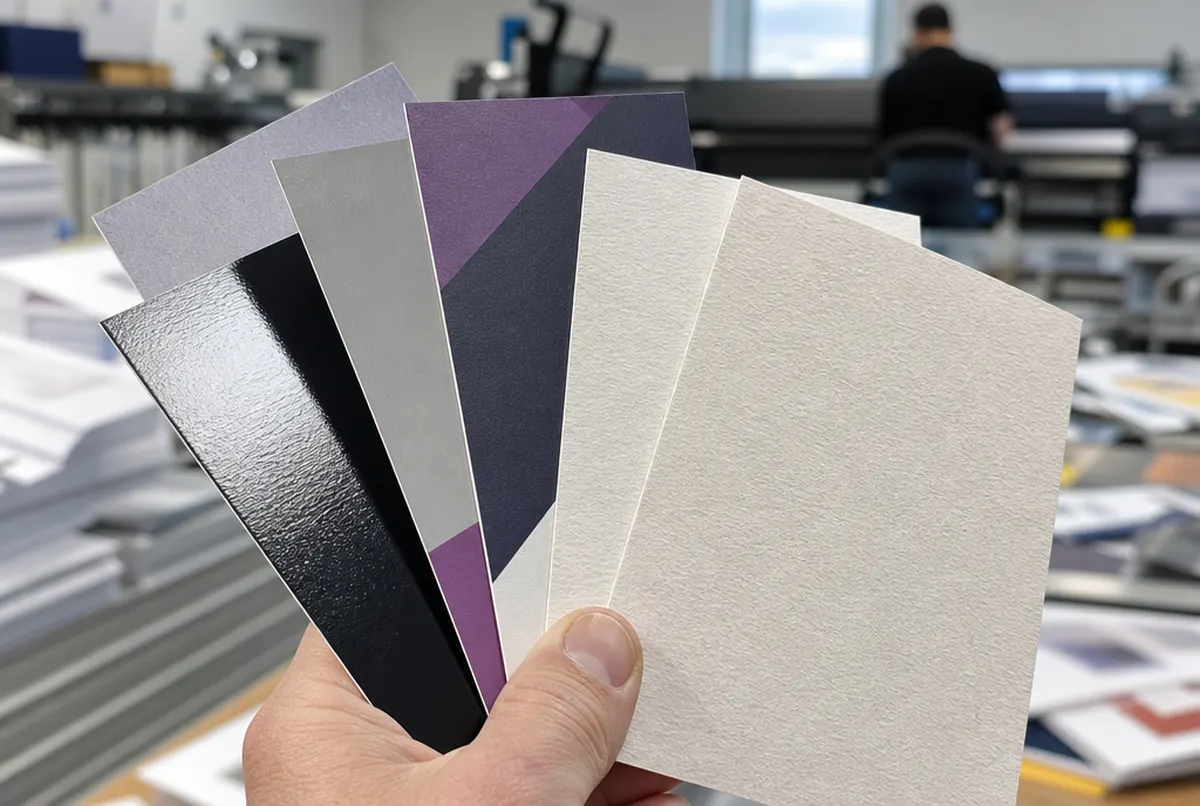
We most often recommend 350 g matt coated board (silk). It is stiff, does not bend in a wallet, colours print evenly on it, and you can write on the matt surface with a pen. It is our standard and the base price is calculated from it.
Gloss coated board gives livelier colours and looks good with photos, but shows fingerprints and glare more easily. We generally do not recommend it for text-heavy cards.
Uncoated and recycled stocks (rough to the touch, often cream or grey) suit businesses that want a natural look: cafes, crafts, architects. Just remember they absorb more ink, so photos and small solids come out slightly darker and less saturated.
In our view, going below 300 gsm is a saving in the wrong place. Such a card is flimsy and simply feels poor in the hand. If you want a premium feel, it is better to stay with 350 g and add soft-touch lamination than to chase thicker board at any cost.
Lamination, spot UV, foiling: are they worth paying for?
Matt lamination protects the card from scuffed edges and dirt. It makes sense if cards are carried in a pocket or sit on a counter for a long time. Soft-touch lamination gives a velvety, rubbery feel; clients often comment on it as soon as they pick the card up.
Raised spot UV and foiling are worthwhile when the logo is simple and bold. With fine, thin lettering the effect is easily lost. We usually advise finishing one element, such as the logo mark, rather than the whole card.
One practical point: matt and soft-touch laminates are hard to write on with an ordinary pen. If you write appointment times or order numbers on your cards, leave that area unlaminated or skip lamination altogether.
- 24 hexpress printing (UV inks need no drying)
- approx. 3 daysstandard lead time
- up to 14 dayslarge and custom projects with installation
Plus courier delivery. Tell us your date — we plan production around it.
Design and file preparation: what we add
We check a correct, print-ready PDF before printing at no extra charge: the technical check is always included in the order. If something is wrong (no bleed, RGB colours, margins too small), we let you know before production.
If there is no file, our in-house studio in Wieluń designs the card. Studio time on designs is charged at approx. €35 net per hour, and a simple card is usually a short job if the logo is ready. If you only have your logo as a photo or a small image from a website, vectorisation costs approx. €26 net and will come in handy for every other piece of print afterwards.
How to prepare the file yourself is explained step by step in how to prepare a business card for print.
How many business cards to order to start with
For one person who does not go to trade shows or hand out cards on the street, 500 is usually enough for a year or more. Sales reps, estate agents and people staffing exhibition stands get through a thousand in a few months.
Do not order a large run if you know your address, phone number or logo will change within a year. Cards with a crossed-out number look worse than having none. In that case it is better to take 500 now and reprint later: with digital printing we produce a reprint quickly and without extra set-up costs.