 Signs & Large Format Print
Paper weight: what it means and which to choose
| Paper | Feel in the hand | Suits |
|---|---|---|
| Uncoated 90–120 gsm | like printer paper, slightly thicker | flyers to write on, forms, inserts sent with letters |
| Coated 130 gsm | thin, flexible | mass-distribution flyers, folded leaflets, newspaper inserts |
| Coated 170 gsm | noticeably stiffer | A5 and DL flyers, small posters, premium leaflets |
| Coated 250 gsm | light card | price lists, discount cards, invitations |
| Coated 300–350 gsm | card like a business card | takeaway menus, loyalty cards, fridge flyers |
Paper weight (grammage, gsm) is the mass of one square metre of paper. The higher it is, the thicker and stiffer the paper. For comparison: ordinary office printer paper is 80 gsm and a business card 350 gsm.
Clients often ask for "thicker paper, so it looks proper". We understand, but a thick flyer does not always make sense. A flyer handed out in the street is, in most cases, read once. Then it is better to spend the money on a larger quantity than on board. A price list the customer will keep in a drawer for six months is different: there the extra weight pays for itself straight away.
Matt silk or gloss: pros and cons
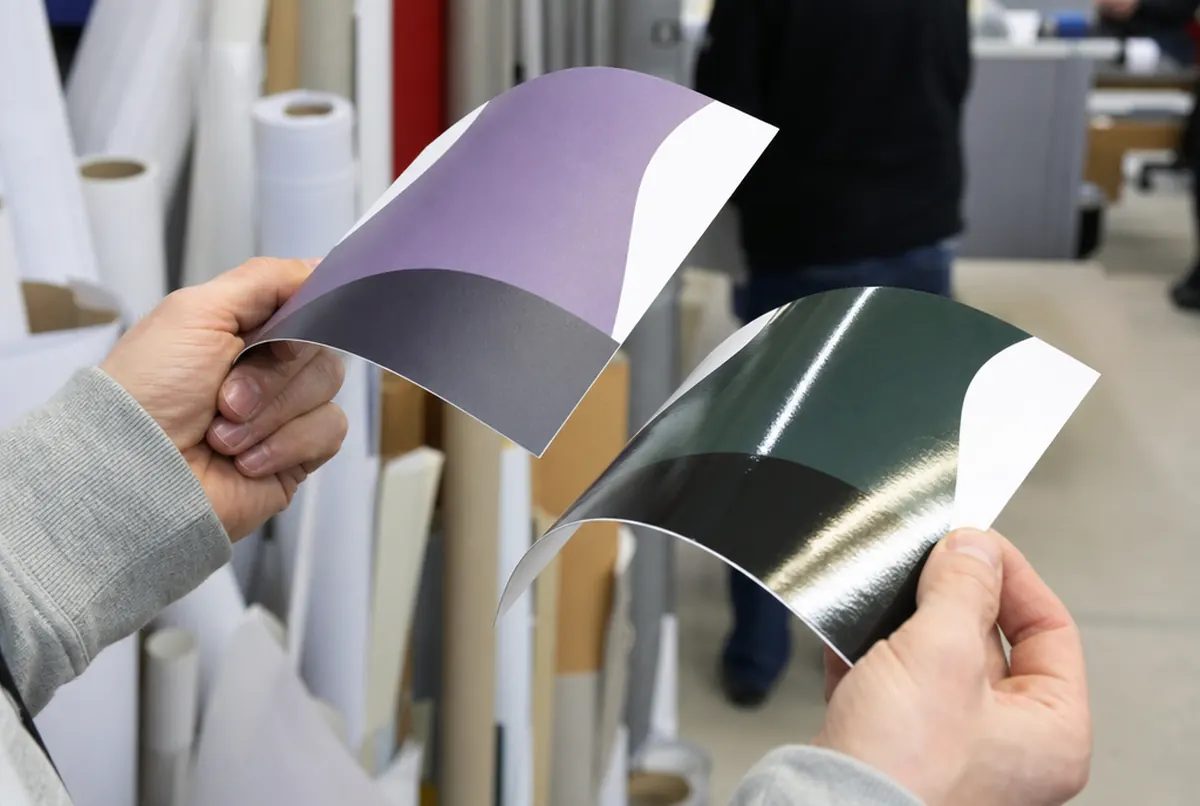
Gloss coated
- Pros: vivid, saturated colours; food and product photos look rich.
- Cons: reflects light, tiring to read with a lot of text, shows fingerprints easily.
Matt coated
- Pros: calm and elegant, text reads well in any light, fingerprints show less.
- Cons: colours are slightly less saturated; large dark solids can scuff at the edges.
In practice most of our clients choose matt, because flyers usually carry a fair amount of text and contact details. We recommend gloss for flyers where the photo does all the work: pizzeria, florist, product catalogue. There is also silk (semi-matt), a compromise between the two.
If the flyer will have a lot of dark background, such as navy or black over the whole surface, consider matt lamination. It protects the print from scuffing and gives a pleasant, velvety surface.
Uncoated and eco papers
Uncoated paper is a good choice when someone needs to write on or fill in the flyer: a coupon with fields, an application form, a survey. A pen on coated paper, especially gloss, can smudge; on uncoated stock it writes normally.
Eco and recycled papers have a rough, natural texture. They suit businesses that themselves emphasise an eco character. You just have to accept that photos will be flatter and slightly darker, because the paper absorbs more ink. If you are after a particular effect, order a test print first.
Flyers for outdoors and frequent handling
Ordinary paper will not survive rain. If a flyer, price list or menu is to hang outside, lie by a pool or be handled daily with wet hands, synthetic paper is better. It is waterproof and hard to tear. We use it for price lists and outdoor signage, among other things; in large format printing it costs approx. €10–16 net per m², depending on the area ordered.
For small formats, the alternative is laminating A4 and A3 sheets in pouch film, at approx. €0.95 net per piece. That is how beer garden menus and till-side price lists are made.
- 24 hexpress printing (UV inks need no drying)
- approx. 3 daysstandard lead time
- up to 14 dayslarge and custom projects with installation
Plus courier delivery. Tell us your date — we plan production around it.
The most common mistakes when choosing paper
- Heavy paper on a folded leaflet without creasing. The ink cracks at the fold and a white line appears. From about 170 gsm we always crease before folding.
- Gloss on a flyer with small text. Under shop lighting, part of the text simply disappears in the glare.
- Coated paper where people need to write. A coupon with space for a name and phone number on gloss coated paper is asking for a smudged pen.
- Thin paper with dark backgrounds on both sides. Held to the light, you can see what is on the other side.
- Choosing paper from a photo online. On screen every paper looks alike. You only see and feel the difference in your hand.
What it costs and how paper choices affect the price
A reference point from our price list: a 6-page DL leaflet printed 4/4 on 130 gsm coated paper is approx. €90 net per 1,000, and a 4-page A5 leaflet on the same paper also approx. €90 net. Heavier paper and finishes raise the price, but for small and medium runs the difference between 130 and 170 gsm is usually not large. Heavier stocks also need creasing before folding.
We quote a specific paper from a short description: size, number of pages, quantity, paper and whether lamination is needed. Sizes and their uses are covered in which flyer size to choose, and current options are on the flyers and folded leaflets page.
If you are unsure which paper to choose, order a test print: an A3 sheet on the actual stock costs approx. €13 net. It is much easier to decide with the sheet in your hand than by looking at a gsm figure in a table.