 Signs & Large Format Print

Two kinds of spending that must be kept apart
The most common mistake in budgeting is throwing everything into one pot. Yet small business advertising consists of two quite different parts.
One-off investment – things you buy once that work for years: a sign or light box, window graphics, directional signs, vehicle graphics, a roller banner, a feather flag, a gazebo for events, company stationery. A light box or dibond sign is an outlay for 10 years or more. It is not counted monthly – it is more like fitting out the premises.
Ongoing cost – everything that has to be renewed: flyers for each promotion, seasonal posters, online advertising, sponsorship, trade shows and fairs. Here you plan a monthly or quarterly amount and check what brings in customers.
Once you separate them, sensible decisions get easier: you make the one-off investment properly once, and you can raise or lower the ongoing budget depending on results.
How to work out the ongoing budget – three approaches
1. A percentage of revenue. The simplest method. Business guides often recommend a few per cent of revenue, though new businesses spend considerably more at the start because they are still building awareness. The drawback: if there is no revenue yet, there is nothing to calculate from.
2. Customer value. Work out what you earn from one customer over a year, and consider how much you can spend to win one. Suppose a regular salon customer spends a few hundred euros a year. If a flyer with a voucher costing a similar amount brings in a dozen new regulars, it is a good spend – even if it does not pay back in the first month.
3. The job to be done. You start from the goal: 'I want everyone within 5 km to know I have opened a garage'. Then you list what that takes (a roadside banner, flyers on the estates, a Google profile, a branded van) and add it up. This is the most practical method for small businesses.
In practice most of our clients combine the second and third: they know what they want to achieve, and make sure the cost does not exceed what they can realistically earn.
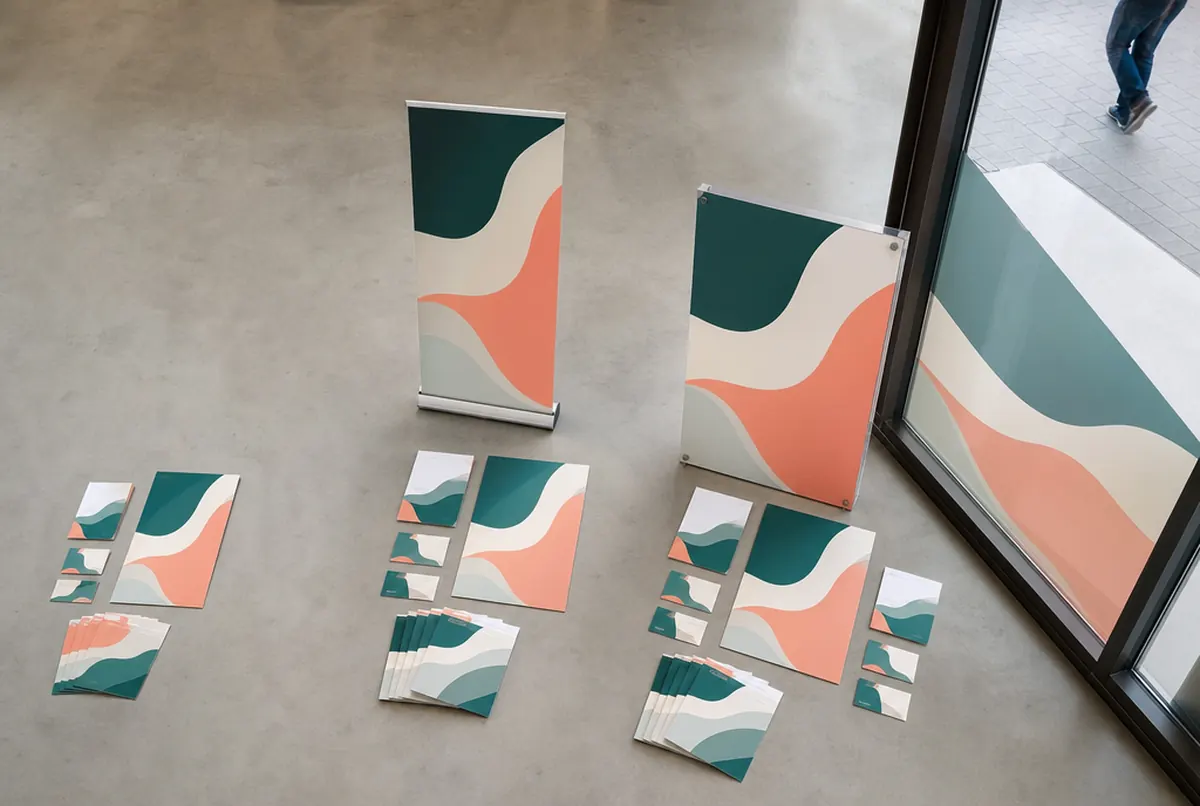
Three sample material packages
| Package | What it includes | Amount |
|---|---|---|
| Modest start | 200 × 60 cm dibond sign (approx. €66), 4 m² window vinyl (approx. €48), 500 business cards (approx. €15), 1000 A5 leaflets (approx. €90) | approx. €220 |
| Street-front premises | 250 × 60 cm light box (1.5 m² × €320 = approx. €480), 6 m² One Way Vision window film (approx. €80), 1000 business cards (approx. €25), 1000 DL leaflets (approx. €90), 85 × 200 cm roller banner (approx. €55), Midi feather flag (approx. €75), 1 m² magnetic sheet for a car (approx. €32), light box installation: 4 crew-hours (approx. €168) and 80 km travel (approx. €80) | approx. €1,090 |
| Service business with vans | illuminated letters, 10 characters × 40 cm (approx. €570) with installation (approx. €220), wraps for 2 vans at approx. 8 m² each in cast vinyl with laminate (approx. €510), 3 × 3 m gazebo (approx. €750), 2 feather flags (approx. €150), 100 × 200 cm roller banner (approx. €65), print on 50 T-shirts (approx. €150), 100 folders (approx. €135), business cards and 2000 leaflets (approx. €200) | approx. €2,750 |
The figures are based on our price list: dibond approx. €55/m², monomeric vinyl approx. €12/m², light boxes from approx. €320/m², face-lit letters from approx. €46 per character at 30 cm plus approx. €11 for each further 10 cm of height, cast vinyl approx. €24/m² at 5–15 m² plus laminate approx. €8/m², A4 transfer print approx. €2.35 each at 50–99 pieces (print only, T-shirt extra). Design may be added – a simple banner or sign design is approx. €43 net. A detailed opening checklist is in signage and print for a new business.
- 01Brief
Description, sizes, site photos and deadline — a few sentences are enough.
- 02Design and quote
Our designers prepare artwork or a visualisation and you get a price.
- 03Approval
You approve the design; for brand colours we provide a proof.
- 04Production
35+ machines in our own plant in Poland: 3.2 m UV print, CNC, laser, 3D, sewing.
- 05Installation or delivery
Own crews and vehicles across Europe, partner network, couriers worldwide.
How much for online, and how much for print
It depends on where your customers are and how they buy. A few rough rules from our experience:
- A business with premises and footfall – a shop, café, salon, pharmacy. Signage and the window first, because they work every day at no extra cost. Online: a Google Business Profile, social media, and in time local-area ads.
- A business that travels to customers – an installer, a gardening or cleaning firm. A branded vehicle and a good Google profile are the basis. Flyers on specific estates, online ads targeted at the local area.
- A business selling online nationwide – most of the ongoing budget goes into online channels. Print is useful in the parcels: a flyer with a code for the next purchase, logo tape, stickers.
Search and social media campaigns are run by the owner or a marketing agency – you set the daily budget yourself and can pause it at any time. The two worlds are compared in print advertising or online.
Where to save, and where not to
Do not skimp on:
- entrance signage – a cheap banner instead of a sign looks bad after a year and has to be replaced,
- legibility – a simple design by someone who knows print beats attractive artwork that cannot be read from the street,
- a vector logo file – it pays for itself on every subsequent order.
You can save on:
- quantities – 1000 flyers now and a reprint in two months instead of 5000 in stock,
- express service – it costs approx. 40% of the print value, and with the deadline given up front you can usually manage without it,
- merchandise without a plan – mugs and pens make sense when you know who you will give them to and when,
- changeable materials – a premium roller banner with a replaceable cassette or a frame with a fabric graphic lets you change the message without buying a new structure.