 Signs & Large Format Print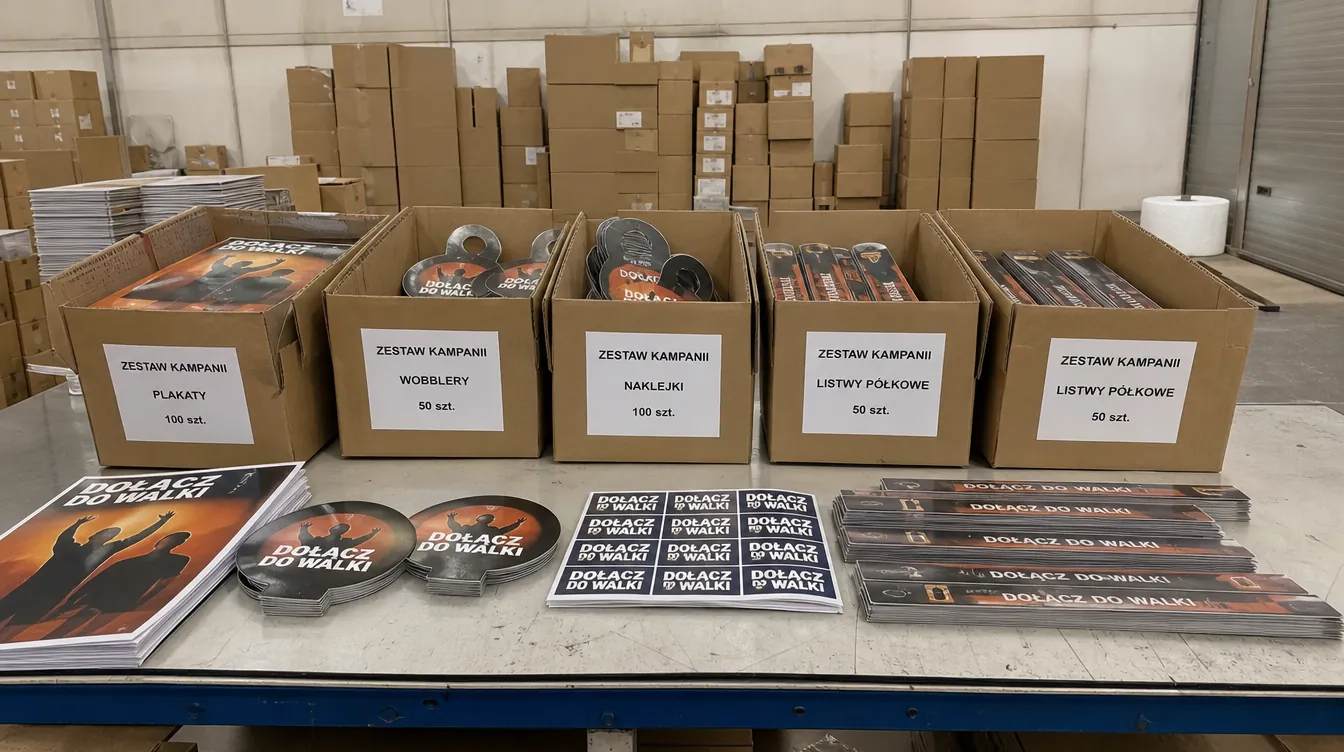
Where '360°' comes from
'360 degrees' means the brand surrounds the customer on every side: they see it on TV and on their phone, on a roadside billboard, on a shop shelf, on an exhibition stand and on a delivery van. A 360° agency is meant to ensure it says the same thing everywhere, in the same language and the same colours.
In the industry the phrase is heavily overused. 'Full service' appears on the websites of large network agencies with strategy, media and production departments, and of small teams that in practice do design and social media and organise the rest as needed. Both can work well – you just need to know which you are dealing with.
What full service should include
- Strategy – market and competitor analysis, target audience, message, choice of channels and budget.
- Creative – campaign concept, slogan, key visual, scripts for spots.
- Design and DTP – adapting the key visual to dozens of formats: from a social post to a building wrap.
- Media – planning and buying advertising on TV, radio, press, outdoor and online.
- Digital – search and social campaigns, websites and landing pages, content.
- PR – media relations, press releases, events for journalists.
- BTL and events – in-store activations, trade shows, conferences, company events.
- Production – print, outdoor advertising, signage, POS materials, merchandise, stands.
- Reporting – what worked, what it cost, what to change.
The standard advertising agency has its own guide: what an advertising agency does.
Pros and cons of working with a 360° agency
Pros:
- one account manager and one contract instead of several suppliers,
- a consistent message across all channels, because the designs come from one place,
- time saved on the client side – you do not need to understand media, print and installation,
- easier comparison of results across channels in a single report.
Cons:
- the cost of coordination: you pay for the account manager and project management, and a margin is often added to third-party production,
- for small jobs it is overkill – one shop sign does not need a 360° strategy,
- the risk that some services are 'bolted on' and done less well than by a specialist,
- less price transparency, if the agency does not split its quote into its own work and third-party costs.
The companies that gain most from this model run campaigns regularly, across many channels and locations. A small local business is often better served by two or three suppliers chosen for specific tasks.
A mixed model is also increasingly common: the agency is responsible for strategy, creative and digital, and the company orders production directly from a trusted supplier. The client keeps control of production costs, and the agency does not have to deal with logistics and installation.
- 01Brief
Description, sizes, site photos and deadline — a few sentences are enough.
- 02Design and quote
Our designers prepare artwork or a visualisation and you get a price.
- 03Approval
You approve the design; for brand colours we provide a proof.
- 04Production
35+ machines in our own plant in Poland: 3.2 m UV print, CNC, laser, 3D, sewing.
- 05Installation or delivery
Own crews and vehicles across Europe, partner network, couriers worldwide.
Seven questions that show whether it really is full service
- Which services do you deliver with your own team? The list should be specific: strategy, creative, studio, digital – not 'everything'.
- Who do you work with on production? The agency need not name names, but it should know who prints, who installs and what experience they have.
- Who is responsible for a supplier's mistake? The right answer: the agency, towards the client.
- How is the quote structured? It is good when the agency's work and third-party costs are shown separately.
- Can you show a campaign where you did the whole job? From the concept to installation photos.
- How do you report results? In digital – specific figures; offline – at least photos of the work and the number of sites.
- Who will be my day-to-day contact? And will they stay on until the end of the project?
An agency that can answer these calmly is usually what it claims to be.
Full service in signage production – this is where we come in
360° agencies need a supplier who will take on the whole physical side of a campaign. That is what we do: design and file preparation, large and small format print, illuminated signage, 3D letters, wayfinding, POS materials, exhibition stands, and finally installation and logistics. How such a project runs from brief to installation is shown in a separate step-by-step guide.
For chain campaigns we assemble campaign kits for every site (kitting approx. €3.30 net per site) and dispatch them to multiple addresses (approx. €2.80 net per site), and we can store rotating graphics in our warehouse. For agencies we work on a white label basis: neutral packaging, and installation crews without Wielka Reklama branding, acting on the agency's behalf. We already work this way with agencies in London and Berlin, among others. How it works is described in white label in advertising.