 Signs & Large Format Print
Why you cannot just print an ordinary banner on both sides
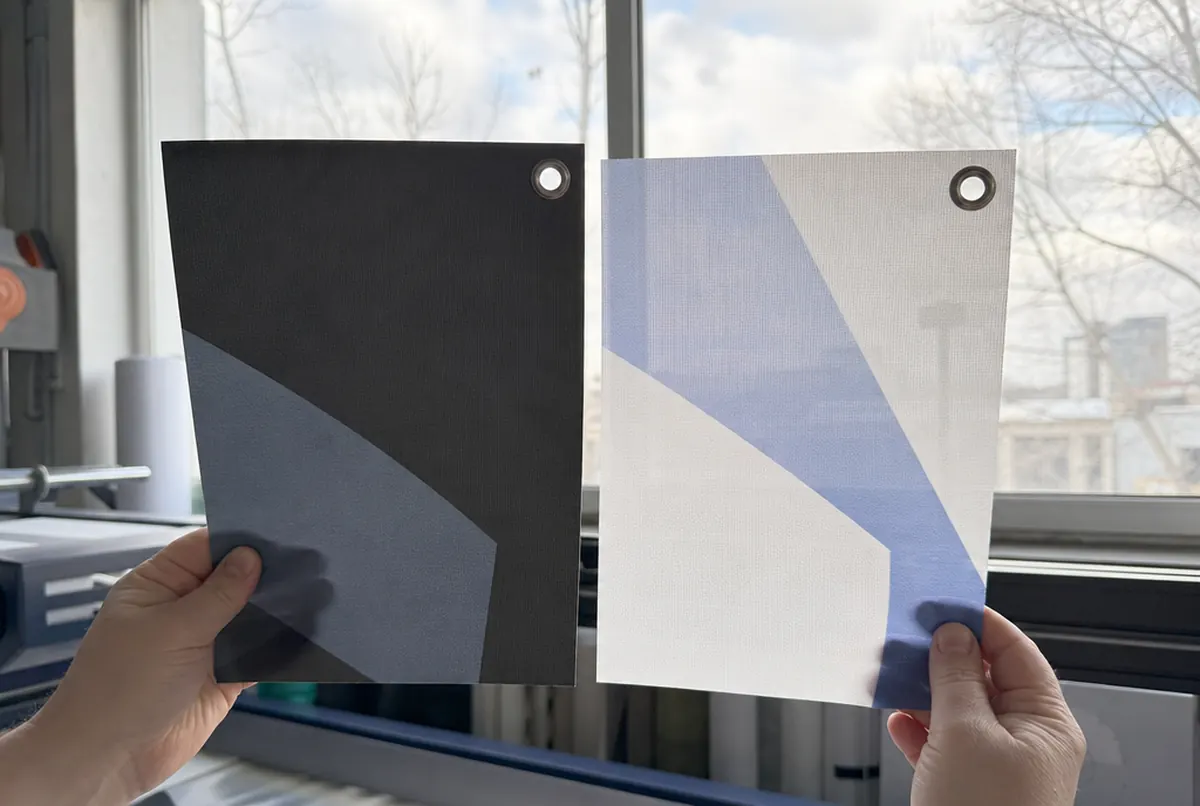
A standard frontlit banner lets some light through. On a wall that does not matter. But when it hangs freely with the sun behind it, you can see through the material whatever is printed on the other side, mirror-reversed. A "Welcome" starts to mix with a back-to-front logo and the whole thing looks like a mistake.
Blockout has a light-blocking interlayer. That means each side can carry a different design and neither shows through. The 650 g version is made for double-sided printing; the 550 g version for single-sided use, when full opacity is all you need.
So in practice the question is not "can both sides be printed" but "what will the banner hang on". If each side has a wall, a board fence or another solid surface behind it, light cannot get through and two ordinary banners will do. If there is only air, mesh or a window behind the banner, you need a material that does not show through.
Three options compared
| Option | When it works | Drawbacks | Price per m² |
|---|---|---|---|
| Blockout 650 g, double-sided print | Freely hanging banner, two designs | Heavier than a standard banner | €13–24 |
| Blockout 550 g, single-sided print | Full opacity, no show-through, one side | The other side is blank | €11–20 |
| Two coated banners 510 g | Each on its own backing: both sides of a fence, two walls | Print shows through when hanging freely | €7–13 each |
| Two black-back banners 550 g | See-through fence viewed from both sides | Dearer than blockout for the same size | €9–16 each |
When double-sided blockout is a good choice
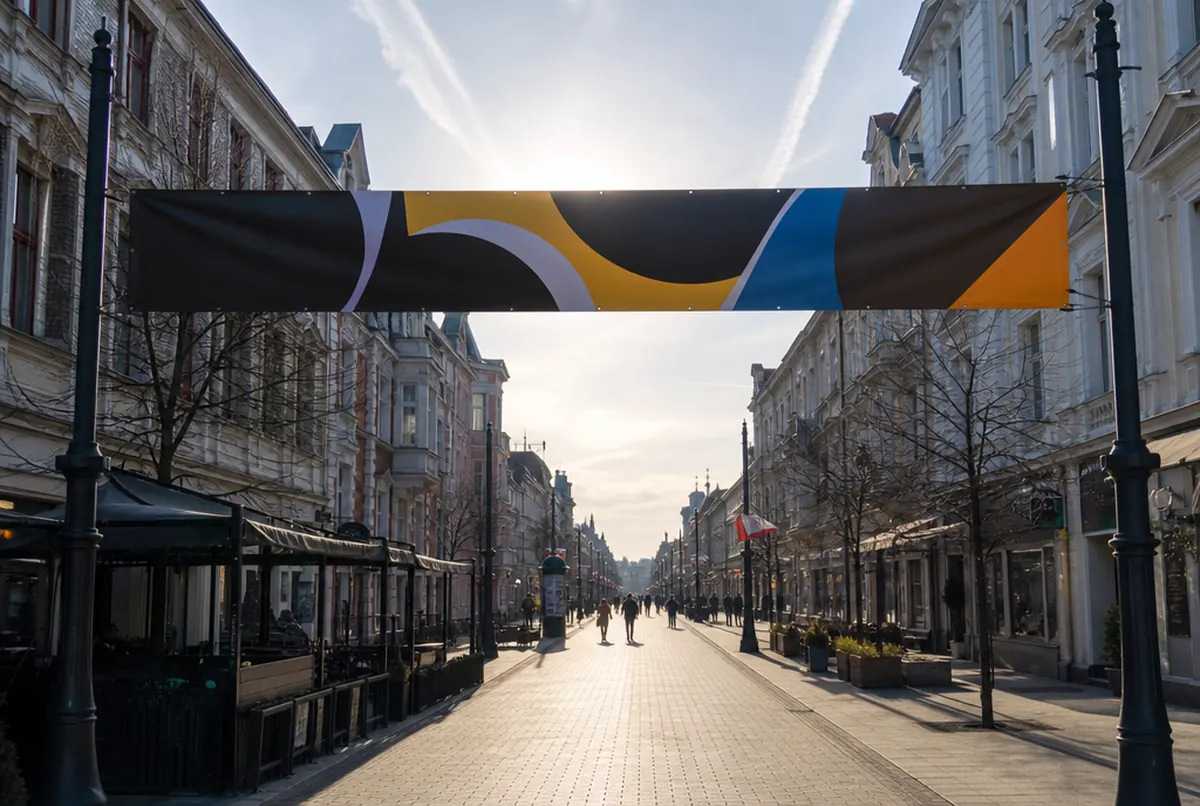
- A banner over an entrance or gate, hanging at right angles to the wall or strung between posts: people approach from two directions.
- Sports halls, warehouses, shopping centres: banners suspended from the ceiling, visible from both ends of the hall.
- Barriers and event fencing: barrier covers are often made from double-sided blockout, because fans and participants stand on both sides. See barrier covers.
- Banners at stands and pitches, where the same sheet is seen from the pitch side and from the street. More in banners for stands and pitch fencing.
- Two different messages: e.g. "Welcome" on one side and "See you soon" on the other at the entrance to an event site.
We use single-sided 550 g blockout when the banner must let nothing through: covering a window or shopfront, hanging in front of a light source on stage, or masking an old advert.
What it costs: blockout vs two banners
We often hear that blockout is expensive. But compare it with two banners that would give the same effect.
Banner 3 × 1 m (3 m²):
- Double-sided 650 g blockout: 3 × approx. €24 = approx. €72 net.
- Two black-back banners of 3 m² each (6 m² in total, band 5–15 m²): 6 × approx. €12 = approx. €72 net.
- Two standard coated banners (6 m²): 6 × approx. €9 = approx. €54 net, but only if each hangs on its own backing.
Banner 6 × 1 m (6 m²):
- Double-sided blockout: 6 × approx. €17 = approx. €102 net.
- Two black-back banners (12 m²): 12 × approx. €12 = approx. €144 net.
- Two coated banners (12 m²): 12 × approx. €9 = approx. €108 net.
So for a freely hanging banner, blockout is usually the cheapest option that actually works, and it is one sheet to hang rather than two to line up. The full material price list is in how much does a PVC banner cost.
- 24 hexpress printing (UV inks need no drying)
- approx. 3 daysstandard lead time
- up to 14 dayslarge and custom projects with installation
Plus courier delivery. Tell us your date — we plan production around it.
What to watch out for in design and fitting
Eyelets go through both sides. The safe margin, at least 5 cm from the edge, applies on both sides. When designing two sides, keep logos and text within the same zone.
Orientation. If the banner hangs from a top pocket, both sides must have their top in the same place. It sounds obvious, but with two separate files it is easy to flip something. Send both files labelled "side A" and "side B", and we will check they match during preflight.
Weight and wind. Blockout is heavier than a standard banner and solid, so in wind it acts like a sail. Outdoors we recommend eyelets every 25 cm (approx. €0.80 net/lm) or a pocket with rope (approx. €4/lm). For large sheets, webbing as well.
A banner over a street. Stringing a banner across a public road needs approval from the highway authority and sometimes the municipality. Check the local requirements before ordering.
Fabric instead of PVC. For interiors and double-sided flags, instead of a PVC banner you can use a double-sided flag with a blockout interlayer, sewn from two layers (approx. €28–44 net/m²). It is lighter and softer, but dearer. We describe the differences in UV-printed or dye-sublimated flags.