 Signs & Large Format Print
The five main types of printer in one table
| Type | How it prints | Typical products | When it pays off |
|---|---|---|---|
| Digital (small format) | toner or ink straight from the file, no plates | business cards, flyers, invitations, short catalogue runs, personalised print | from 1 copy to a few hundred or thousand, depending on the product |
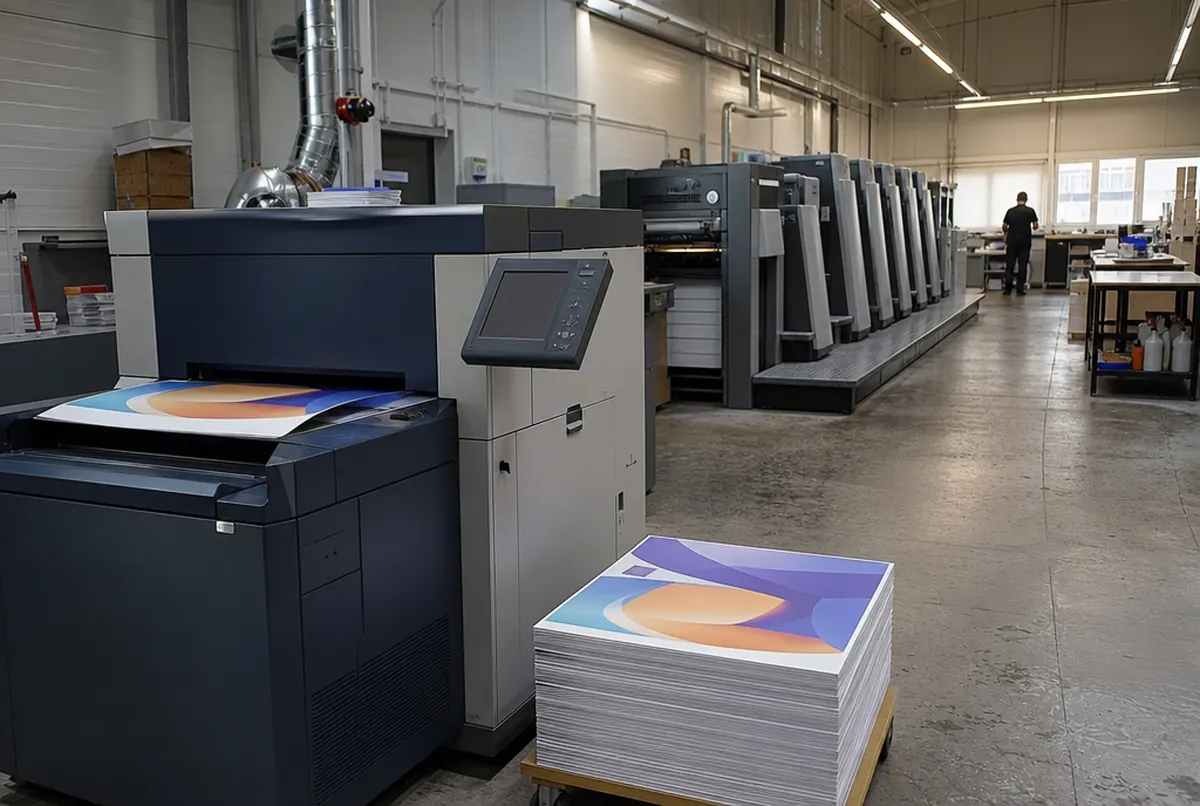
| Offset | ink transferred from a printing plate via a rubber blanket cylinder | long runs of flyers, catalogues, magazines, books, cardboard packaging | on long runs, where the set-up cost is spread over many copies |
| Large format | inkjet printers on rolls and boards: UV, solvent, latex, sublimation | banners, mesh, vinyl, posters, signs, fabrics, wallpaper | whenever the format exceeds a normal sheet – from 1 copy |
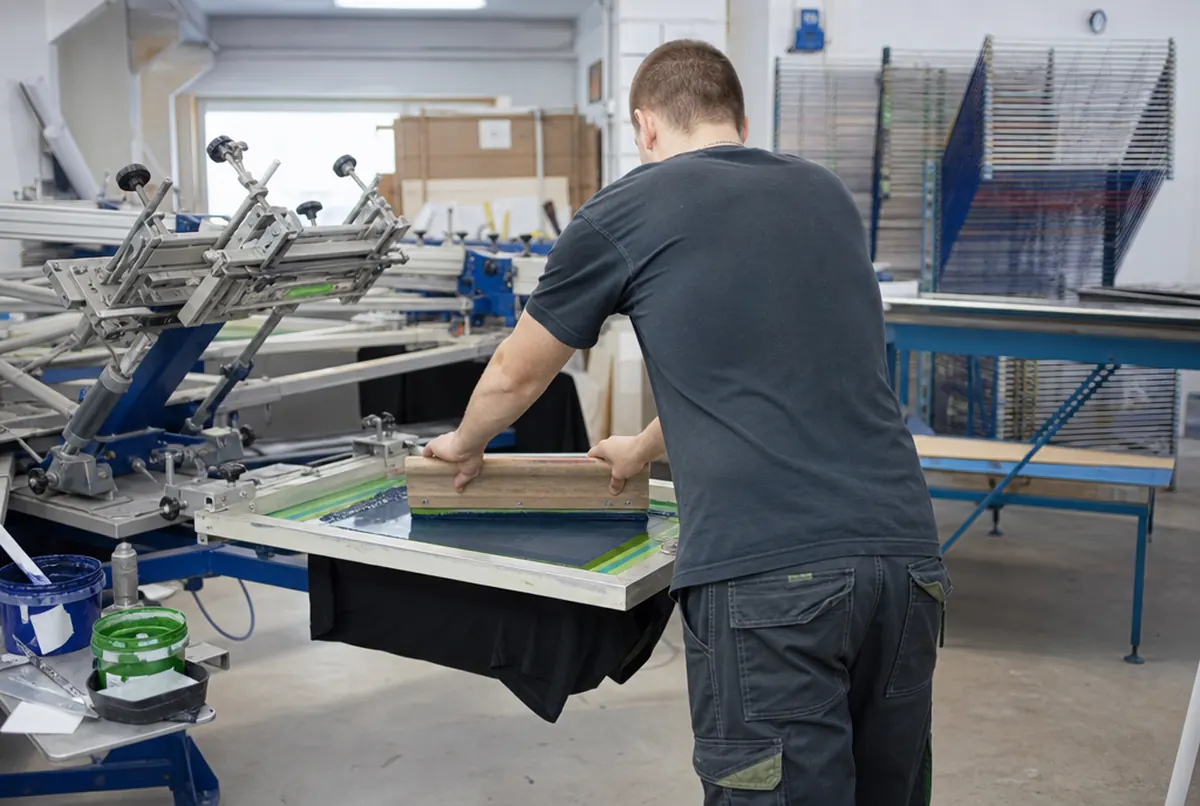
| Screen printing | ink pushed through a mesh screen, a separate screen for each colour | clothing, bags, merchandise, glass, signs with a thick ink layer | with few colours and longer runs of the same design |
| Flexography | flexible polymer plates, printing roll to roll | labels on rolls, packaging films, packing tape, bags | for repeat, long runs of packaging |
Beyond these there are more niche technologies: pad printing (small prints on pens, caps, housings), gravure (huge runs of magazines and flexible packaging) and dye-sublimation, which many companies treat as a separate specialism for fabrics and flags. 3D printing is increasingly mentioned too, though it is really manufacturing objects rather than printing in the classic sense.
Digital and offset – the biggest misunderstanding
Clients often ask why 100 flyers cost almost as much as 500. The answer lies in the difference between these two technologies.
In digital printing the machine prints straight from the file. There are no plates and no ink set-up; the first sheet is right straight away. The cost per copy is therefore roughly constant whether you print 10 or 300. And every sheet can be different – hence numbered tickets, personalised invitations, name badges.
In offset, plates first have to be made for each colour, the press set up and the ink balanced, and the first sheets go to waste. That start-up cost is the same for 1,000 copies as for 50,000. After that, though, each extra sheet is very cheap. So offset loses on short runs and wins on long ones.
Exactly where the crossover lies depends on format, page count and paper – we work through it in digital or offset printing. In practice a good printer will tell you which technology works out cheaper rather than pushing whichever one it happens to have.
Large format printing – a world of its own
Large format print is counted in square metres, not copies. Machines print from rolls from about 1 to over 3 metres wide, or directly onto rigid boards: dibond, PVC, acrylic, card, glass. Here it does not matter whether you want one banner or ten – each is printed separately, and the price per m² falls with the total area.
Within this group there are differences too. Solvent printing is cheaper, but it smells and needs time for the solvents to evaporate. Latex works well indoors. UV printing cures the ink instantly under a lamp, so the material can be finished straight off the machine, and the press prints on boards as well. Sublimation is for polyester fabrics: flags, display walls, tablecloths. There is a comparison in solvent, latex and UV printing, and large format itself is covered separately in what is a large format printer.
- 01Brief
Description, sizes, site photos and deadline — a few sentences are enough.
- 02Design and quote
Our designers prepare artwork or a visualisation and you get a price.
- 03Approval
You approve the design; for brand colours we provide a proof.
- 04Production
35+ machines in our own plant in Poland: 3.2 m UV print, CNC, laser, 3D, sewing.
- 05Installation or delivery
Own crews and vehicles across Europe, partner network, couriers worldwide.
Screen printing and flexography – when you will come across them
You usually meet screen printing with clothing and merchandise. Each colour needs its own screen, so a one-colour logo on 200 T-shirts is cheap, while a full-colour photo on 15 T-shirts is expensive or not possible at all. For short runs with many colours, transfer printing, DTG or sublimation work better. With us an A4 transfer print on a T-shirt is approx. €1.90–3.30 net per piece, depending on quantity; details on the printed clothing page.
Flexography is the world of packaging. It prints roll to roll, fast and cheaply on long runs, but needs plates to be made. You will meet flexo when ordering product labels on rolls or logo packing tape. An example from our range: 36 rolls of 48 mm tape printed in 3 Pantone colours cost approx. €290 net. Labels on rolls are quoted on request.
How to match a printer to the job
The simplest way is to start with three questions.
- What format is it? Anything larger than A3+ (B1 posters, banners, signs, vinyl graphics) means a large format printer.
- How many? A few to a few hundred – digital. Thousands of the same thing – ask about offset.
- On what? Paper means digital or offset. Fabric – sublimation, UV on textiles or screen print. Vinyl, board, glass – UV large format. Packaging on a roll – flexography.
Most companies do not need five printers. They need one that has two or three technologies in-house and will say honestly what it does itself and what it prices using another technology. We print large format on two industrial 3.2 m wide UV machines, and we have small format digital print, sublimation, UV print on textiles and a farm of 3D printers. Longer runs of catalogues or flyers are quoted individually, matching the technology to the run, and for small print our product catalogue gives indicative prices.