 Signs & Large Format Print
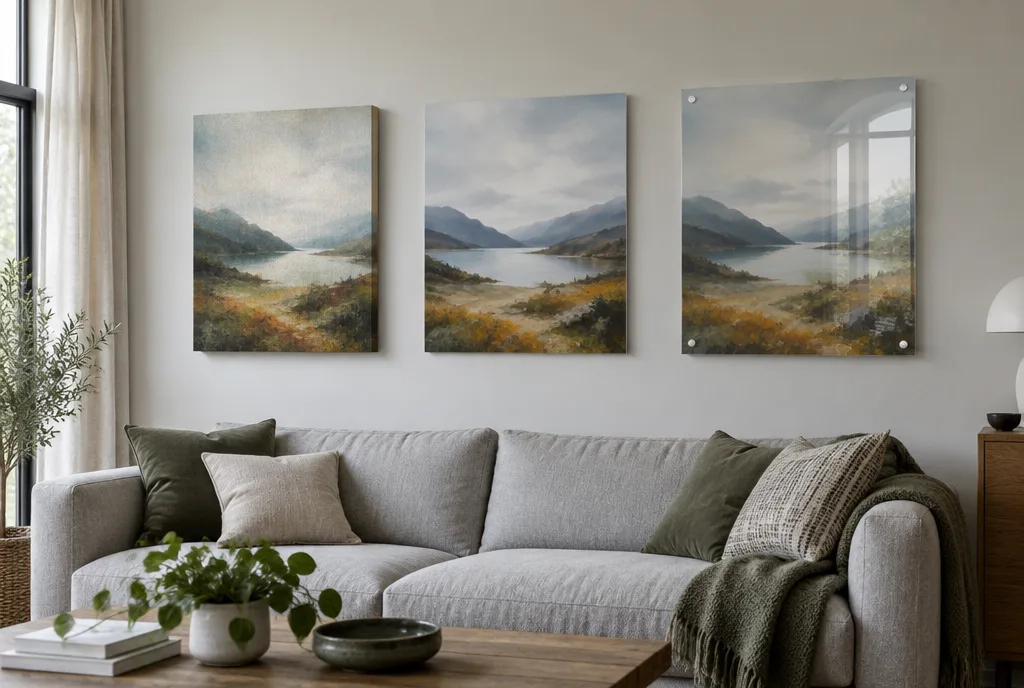
Canvas on a stretcher frame: classic look and texture
Canvas is a fabric with a visible weave on which we print a photo or artwork, then stretch it over a wooden stretcher frame. The edges of the image wrap around the sides of the frame, so it looks like a painter's canvas and needs no frame.
Advantages:
- matt surface – does not reflect windows or lamps,
- the weave texture softens minor flaws in the photo (noise, slight softness),
- light, easy to hang on a single nail or hook,
- a warm, homely character.
What to watch: wrapping around the frame sides takes a few centimetres of the image on each side. Important elements (faces, text) must not sit right at the edge. We usually suggest coloured sides or a mirrored edge of the photo – then nothing in the frame is lost.
With us: UV printing on 380 g canvas approx. €15–24 net/m² (the more m², the lower the rate), stretching on a pine frame approx. €27 net/m², and pigment printing on fine art canvas for reproductions and galleries approx. €60 net/m². See canvas prints.
Dibond: direct UV print or a mounted print
Dibond is a composite panel: two thin aluminium skins with a plastic core. It is rigid, flat, does not warp with moisture and is not affected by temperature changes. Two technologies are used for wall art:
Direct UV printing – we print straight onto the panel. The result is matt or satin, colours are vivid, and the image resists scratches and cleaning. It is the most common choice for offices, waiting rooms, hotels and corridors. 3 mm Dibond with print costs approx. €35–55 net/m² with us, and a premium version with thicker aluminium (for large formats, no rippling) approx. €45–65 net/m².
Mounted print – we print the photo on photographic paper and mount it on Dibond. This gives a photographic character and a wider tonal range, which photographers value for exhibitions. Mounting on Dibond costs approx. €27 net/m² plus the print (e.g. pigment on photo paper approx. €47 net/m²).
Graphics with white areas look good on Dibond – we can print on a white panel and leave white areas unprinted. More on boards in our guide Dibond, acrylic or PVC and on the printing on panels and boards page.
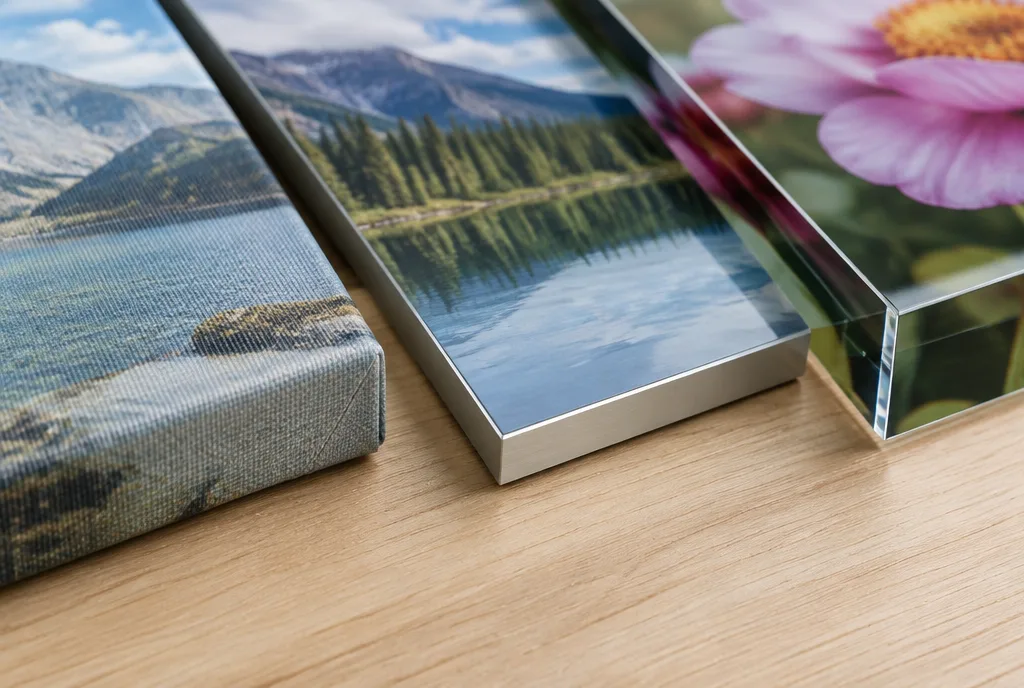
Acrylic (face-mounted photography) and glass
An image under acrylic is a print seen through a clear sheet. Most often we UV-print on the back of clear acrylic with a white underlayer – colours gain depth and the photo looks embedded in glass. 3 mm clear acrylic with UV print and white underlayer costs approx. €43–60 net/m².
Advantages: very intense colours, depth, a modern look, easy cleaning. Drawbacks:
- reflections – the glossy sheet reflects windows and lamps; on a wall opposite a window the image can be hard to see at certain times of day,
- scratches – acrylic is softer than glass and must not be wiped with a dry, rough cloth,
- heavier than canvas at large sizes.
Glass gives a similar effect, is harder and does not scratch, but is heavier and fragile. We UV-print on glass and mirrors supplied by the client or ordered by us – approx. €24–34 net/m² for printing with primer and white underlayer, excluding the glass. See UV printing on glass.
The premium option – a print laminated between acrylic and a Dibond back – is quoted individually.
What photo resolution for which size
| Print size | Viewed up close (150 dpi) | Viewed from 2 m or more (100 dpi) |
|---|---|---|
| 40 × 30 cm | approx. 2400 × 1800 px | approx. 1600 × 1200 px |
| 60 × 40 cm | approx. 3550 × 2400 px | approx. 2350 × 1600 px |
| 90 × 60 cm | approx. 5300 × 3550 px | approx. 3550 × 2350 px |
| 120 × 80 cm | approx. 7100 × 4700 px | approx. 4700 × 3150 px |
| 150 × 100 cm | approx. 8850 × 5900 px | approx. 5900 × 3950 px |
A photo from a good phone (about 12 MP, 4000 × 3000 px) is easily enough for a print of about 60 × 45 cm viewed up close, and for a wall seen from further away even a larger size. Canvas is more forgiving than acrylic, because the texture hides small flaws. Acrylic and glossy surfaces mercilessly show every bit of softness.
Photos from messaging apps and social media are heavily compressed – for print we always ask for the original from the camera or phone. We check every file before printing and tell you if the resolution is too low. Details in our guide large format print resolution.
- 24 hexpress printing (UV inks need no drying)
- approx. 3 daysstandard lead time
- up to 14 dayslarge and custom projects with installation
Plus courier delivery. Tell us your date — we plan production around it.
Hanging: rails, stand-offs, hangers
- Canvas hangs on its stretcher frame – a nail or hook is enough, two points for large sizes.
- Dibond is mounted on hangers or a batten bonded to the back (the picture sits about 1–2 cm off the wall and the fixing is invisible), or on stand-offs through holes in the corners. Fitting a hanger or hanging system costs approx. €1.65 net each.
- Acrylic is most often mounted on stainless steel stand-offs – part of the look, not just a fixing. Fitting a stand-off costs approx. €2.35 net each including the hardware.
- Glass needs sturdier fixings and a wall that can carry the weight.
In offices and hotels with many pictures we suggest a picture rail system – easy to move or swap a picture without drilling. For projects in hotels and office buildings we can come and install.
Indicative prices and matching the interior
Example: one picture 100 × 70 cm (0.7 m²). For single pieces we use the rate for the smallest area band:
- Canvas on a frame: print approx. 0.7 × €24 = approx. €17 + frame approx. 0.7 × €27 = approx. €19 → approx. €36 net in total.
- 3 mm Dibond with UV print: approx. 0.7 × €55 = approx. €39 + 2 hangers approx. €3.30 → approx. €42 net in total.
- 3 mm acrylic, reverse-printed: approx. 0.7 × €60 = approx. €42 + 4 stand-offs approx. €9.40 → approx. €51 net in total.
For several to a dozen or so pictures for an office the rate per m² drops, because we price the total area. The minimum order value is €24 net. These prices are indicative – we confirm them once we receive the photos and dimensions.
How to match the medium to the interior:
- living room, bedroom, classic study – canvas,
- office, reception, corridor, meeting room – Dibond (durable, easy to clean, no glare),
- modern interior, photos in strong colours – acrylic, but not on a wall opposite a window,
- bathroom, kitchen, wet area – Dibond or glass, not canvas,
- a whole wall – instead of a picture, consider custom photo wallpaper.