 Signs & Large Format Print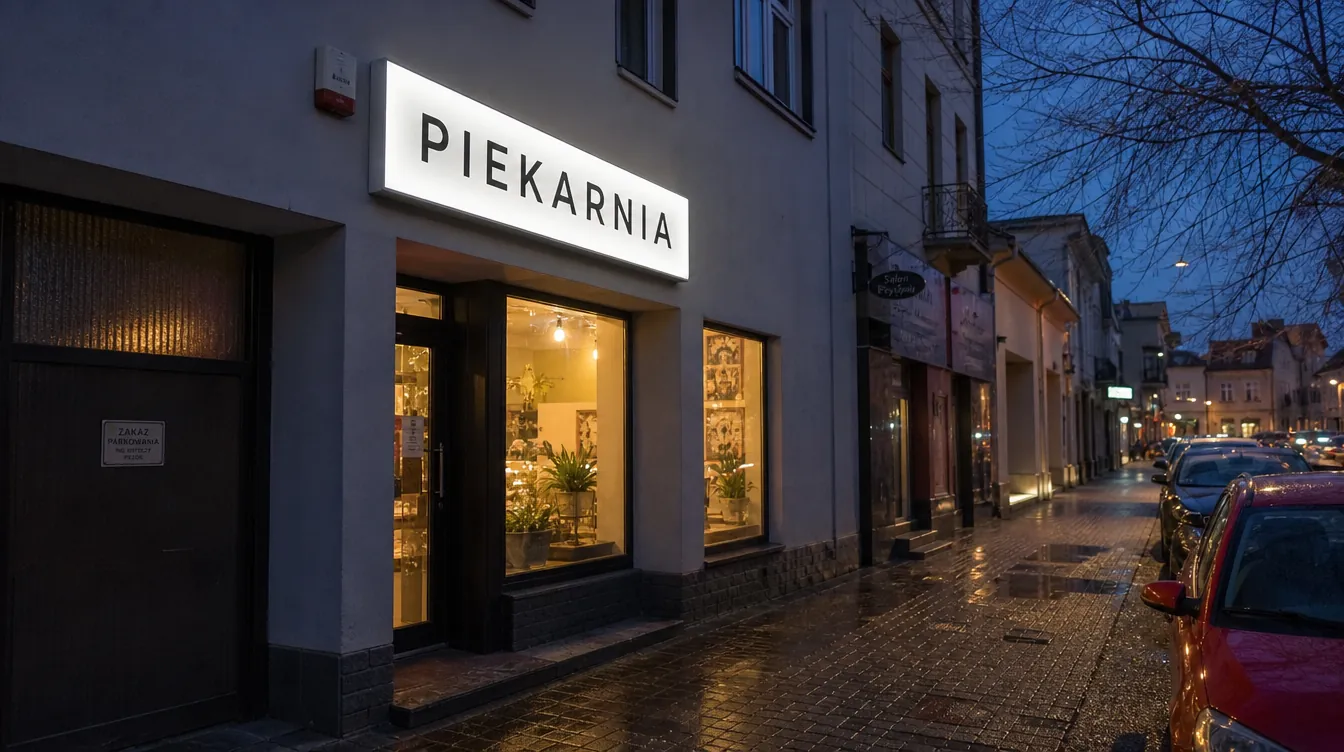
Printer vs sign manufacturer – a comparison
| Printer | Sign manufacturer | |
|---|---|---|
| What the client receives | a print: a sheet, banner, vinyl, poster | an item: a light box, letters, a pylon, a sign on a frame, an applied window graphic |
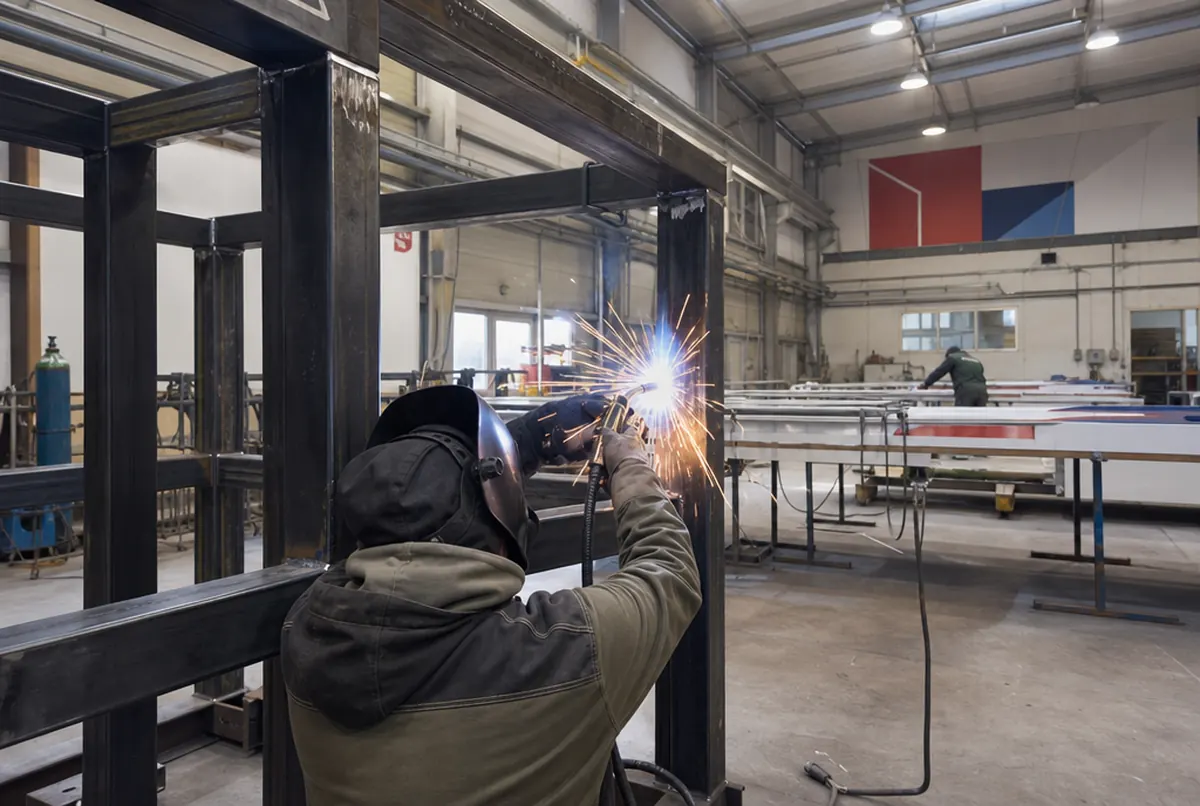
| Machinery | printing and finishing machines | print plus a CNC router, laser, acrylic bender, plotter, tools for structures and electrics |
| Expertise | colour, paper, print materials | plus strength, fixings, LED lighting, weatherproofing, work at height |
| Site survey | usually not needed | often essential – size, surface, power, lift access |
| Installation | rarely | standard, with own crews and equipment |
| After-sales service | not applicable | replacing faces, LEDs, power supplies, inspections |
In practice many companies combine both roles. A large format print operation is the natural base for a sign manufacturer: a light box face, a dibond sign or window vinyl have to be printed anyway. The difference lies in what happens after the print leaves the machine. The classic printer is described in what a printing company does.
What a visual signage manufacturer makes
The range is wide, but it falls into a few groups.
- Illuminated signage: single- and double-sided light boxes, projecting signs on brackets, face-lit and halo-lit letters, LED neon, light boxes with routed faces where only the letters glow.
- Dimensional signage: 3D letters and logos in dibond, acrylic, PVC and foam, as well as 3D-printed bodies for channel letters.
- Free-standing structures: pylons, totems, signs on posts, billboard structures.
- Signage and wayfinding: shop signs, door signs, wayfinding systems in office buildings, hospitals and hotels, building numbers.
- Vinyl graphics: shop windows, office glazing, vehicles and fleets.
- Fit-out: exhibition stands, shop-in-shops, displays, fabric frames.
Most of this is made to measure. There is no 'size M light box' – there is a light box for the space above your door, with fixings to suit your facade. That is why a manufacturer asks more questions than a printer, and a quote often starts with a photo of the building. For the same reason two apparently identical signs can differ in price – a different fixing method, a different cable length, a different installation height.
What typical items cost
| Item | Price from |
|---|---|
| Single-sided light box, acrylic face + vinyl, LED | approx. €320 / m² |
| Double-sided light box (projecting or free-standing) | approx. €410 / m² |
| Double-sided illuminated projecting sign with bracket | approx. €300 |
| Face-lit letters, 30 cm high | approx. €46 / character |
| Halo-lit letters, 30 cm high | approx. €55 / character |
| LED neon on a PVC board, up to 60 × 40 cm | approx. €210 |
| Non-illuminated totem, 2.5 m high | approx. €750 |
| Double-sided illuminated pylon, 3 m high | approx. €2,070 |
| Site survey and inventory | approx. €85 (refunded when you order production) |
These are starting prices – every project is quoted individually from a technical design. Example: a 300 × 60 cm light box is 1.8 m² × approx. €320 = approx. €580 net, excluding installation. Details on the illuminated light boxes and illuminated letters pages, and a comparison of the two in light box or 3D letters.
- 01Brief
Description, sizes, site photos and deadline — a few sentences are enough.
- 02Design and quote
Our designers prepare artwork or a visualisation and you get a price.
- 03Approval
You approve the design; for brand colours we provide a proof.
- 04Production
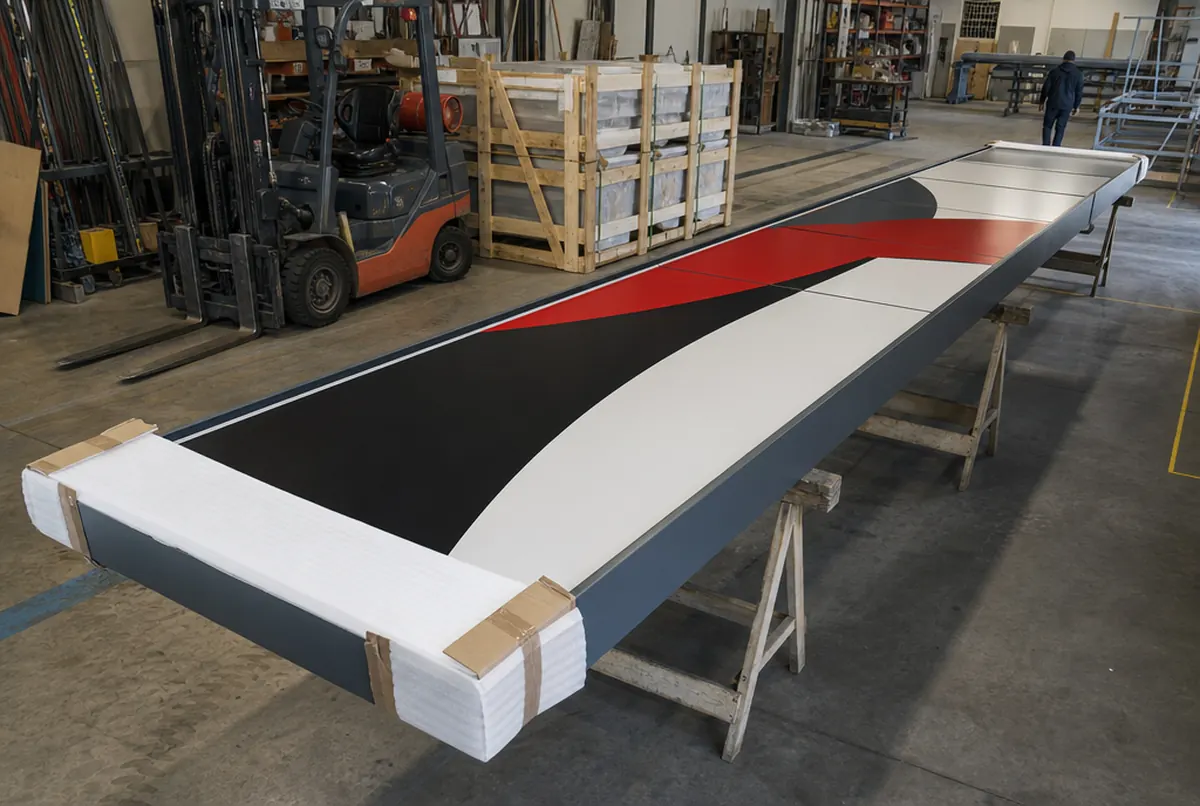
35+ machines in our own plant in Poland: 3.2 m UV print, CNC, laser, 3D, sewing.
- 05Installation or delivery
Own crews and vehicles across Europe, partner network, couriers worldwide.
What to prepare before you call a manufacturer
- A photo of the installation spot – straight on and slightly from the side, showing the surroundings. A photo shows at once whether it is an insulated facade, cladding, brick or glass.
- The dimensions of the space – the width and height available, and the height from the pavement to the bottom edge.
- Power – whether there is a cable, junction box or socket nearby. Illumination is connected by the client's electrician or our qualified crew.
- The logo as a vector – for letters and routed faces it is a must, because the file becomes the router's tool path.
- The deadline – a specific opening or campaign date.
- Permissions – some towns have local design rules for signage, conservation areas need approval, and on a shared building you need the managing agent's consent. Check with the local authority or the building manager; the general principles are covered in does a shop sign need permission.
For larger sites we come out to survey. It costs approx. €85 net, and that amount comes back off the production price if the order goes ahead. On a survey we check things that do not show in a photo: whether there is insulation under the render and how deep the anchors must go, how to route the cable, whether a lift can get to the building and whether a car park or tree is in the way.
How it works with us
We have been operating in Wieluń, Poland, since 1991 as a large format printer and sign manufacturer. Under one roof we have two industrial 3.2 m UV printers, a CNC router, a laser, plotters, a bender, a farm of 7 3D printers (including for channel letter bodies) and a professional 3D scanner. Graphic and technical design are done in-house, and installation is carried out by our own trained crews with a lift reaching 18 m – in Poland and abroad, supported by partner installers across the EU.
After installation we stay in touch: we replace light box faces, LED modules and power supplies, and carry out service inspections (from approx. €60 net). For companies with many branches we design and produce complete wayfinding systems.