 Signs & Large Format Print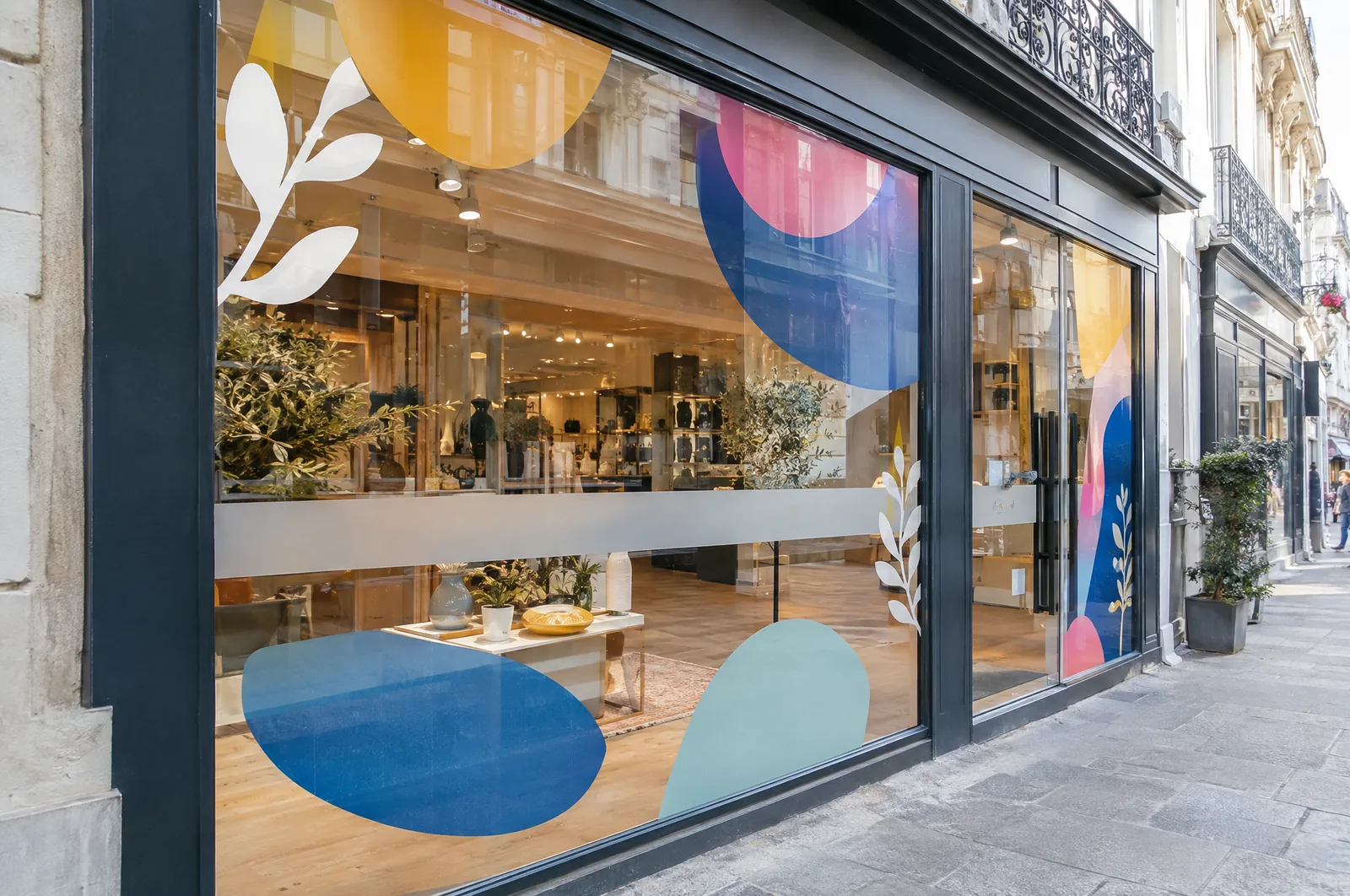
How much glass to cover: view into the interior vs the message
This is the most common dilemma and there is no single answer. A shop that sells visually – clothing, flowers, a bakery, a jeweller – should show its products and interior. A fully covered window takes away its best advertising. On the other hand, a consulting room, an office, a pharmacy or a salon with a back room by the window needs privacy, and full coverage makes sense there.
In our experience this rule works:
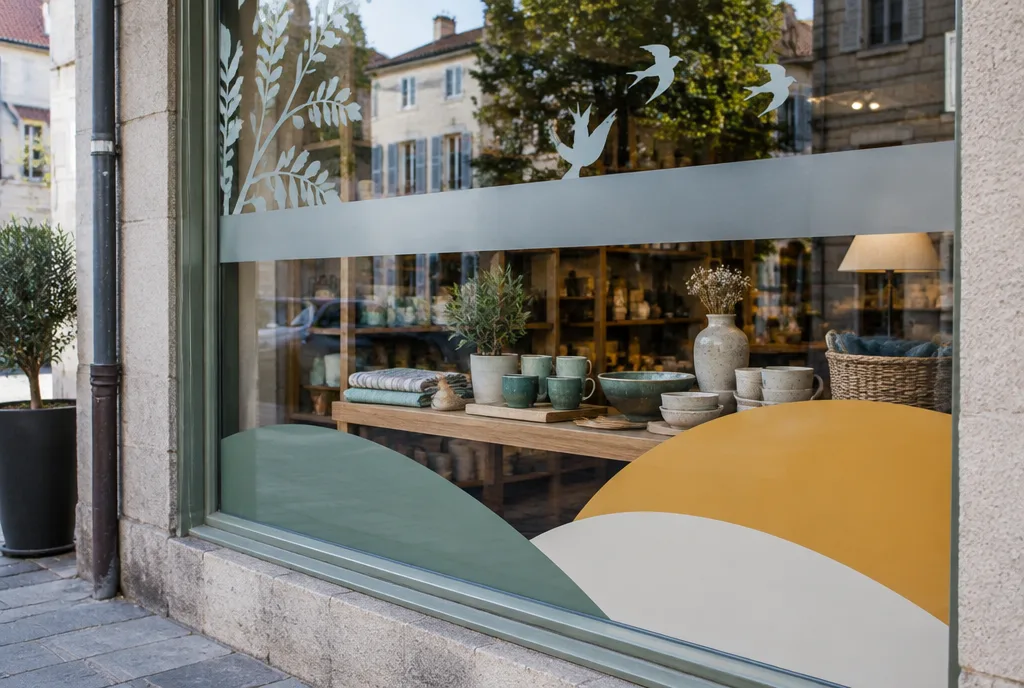
- shops with products on display – graphics on about 20–30% of the glass: a band at the bottom, the logo, opening hours, one piece of offer information,
- services and offices – the lower part of the glass up to about 1.6–1.8 m covered with frosted film or OWV, the upper part clear (to let light in),
- premises that want to hide the interior completely (refit, storage, back room) – grey-adhesive film that blocks light fully.
Remember that fully covering a window reduces the light in the premises. One Way Vision film lets some light through and gives a view out, but in the evening, when the lights are on inside, it works the other way round – the interior is visible from the street. More in our guide One Way Vision window film.
Hierarchy: name, offer, opening hours
A passer-by gives a window a few seconds. In that time they should read the information in a set order. We arrange it like this:
- Name or logo – the largest element, at eye level or in the upper part of the glass if there is no fascia sign above the window.
- What you do – 2–5 words: Flowers and decorations, Phone repairs, Fresh-baked bread. A logo without this says nothing to someone who does not know the brand.
- One current offer – a promotion, a new arrival, the season. One, not five.
- Opening hours, phone, website – on or next to the door, at about 1.2–1.6 m, in a smaller font.
What most often spoils a window is excess: logo, slogan, a list of ten services, a price list, three payment logos, QR codes, social media handles – all the same size. Then nothing gets read. Better to choose 3–4 elements and give them space.
Films: OWV, cut letters, frosted, double-sided
| Film | What for | Net price/m² |
|---|---|---|
| White monomeric, printed | Bands, full graphics, short and medium term | approx. €6–12 |
| Clear, printed | Graphics on glass, stained-glass effect | approx. €7–14 |
| One Way Vision (perforated) | Large graphics with a view from inside | approx. €10–18 |
| Frosted | Privacy, sandblasted glass effect | approx. €12–21 |
| Grey adhesive (blockout) | Full coverage, blackout | approx. €8–14 |
| Easy Dot (repositionable) | Short promotions, easy bubble-free fitting | approx. €11–19 |
Then there are letters and logos cut from vinyl (without a background) – they look cleanest on glass, and the price depends on the length of the cut line (approx. €1.40 net per linear metre). They suit the name, opening hours and contrasting bands on doors.
Double-sided window stickers – with a print visible from both sides of the glass – are useful on doors (open/closed, payment logos) and in walk-through windows, where the graphic must also read from inside.
Example quote: two 1.5 × 2.2 m panes fully covered with OWV film is 6.6 m² × approx. €14 = approx. €92 net for printing, plus cut opening hours and fitting. Detailed examples are in our guide how much do shop window graphics cost.
A seasonal window: changing it without stripping everything
The most sensible approach is to split the window into two layers:
- permanent – logo, name, description of the business, hours. We make this from polymeric vinyl or cut letters that last several years,
- changeable – a promotion, holidays, a sale, a new collection. This part should have a fixed position and a fixed size, for example a 60 cm band at the bottom or a rectangle in one corner of the glass.
Then at the next promotion you print just one element in the same format. Easy Dot film or stickers applied to the inside of the glass work well for changeable graphics – they are easier to remove and not damaged by rain or window cleaning. Ideas for holidays and sales are in our guide seasonal retail advertising.
If you change graphics often, consider an illuminated LED fabric frame behind the glass instead of film – the graphic changes in a few minutes, and the window glows in the evening.
- 24 hexpress printing (UV inks need no drying)
- approx. 3 daysstandard lead time
- up to 14 dayslarge and custom projects with installation
Plus courier delivery. Tell us your date — we plan production around it.
Legibility from the pavement and from a car
Window lettering must match the distance it is read from. A simple rule we use: about 2–3 cm of letter height for every metre of distance. A pedestrian walking right by the glass (1–3 m) will read lettering 5–8 cm high. A driver on the other side of the street (15–20 m) needs letters 35–50 cm high – and that is more a job for a fascia sign above the window than for film on the glass.
A few things we check in the design:
- contrast – white lettering on glass with a bright interior behind disappears; a background or outline helps,
- reflections – a sunny-side window reflects the street; dark, thin letters will be invisible at midday,
- height – the most important information at about 1.2–1.8 m; lower down it will be hidden by a stand or a parked bicycle,
- manifestation bands on glass doors – marking large glazed areas at eye level stops people walking into the glass; rules and standards for glazing manifestation differ between countries.
Common mistakes and local rules
The most common mistakes we correct:
- a file prepared in RGB at low resolution – a logo downloaded from a website blurs on a 2 m pane,
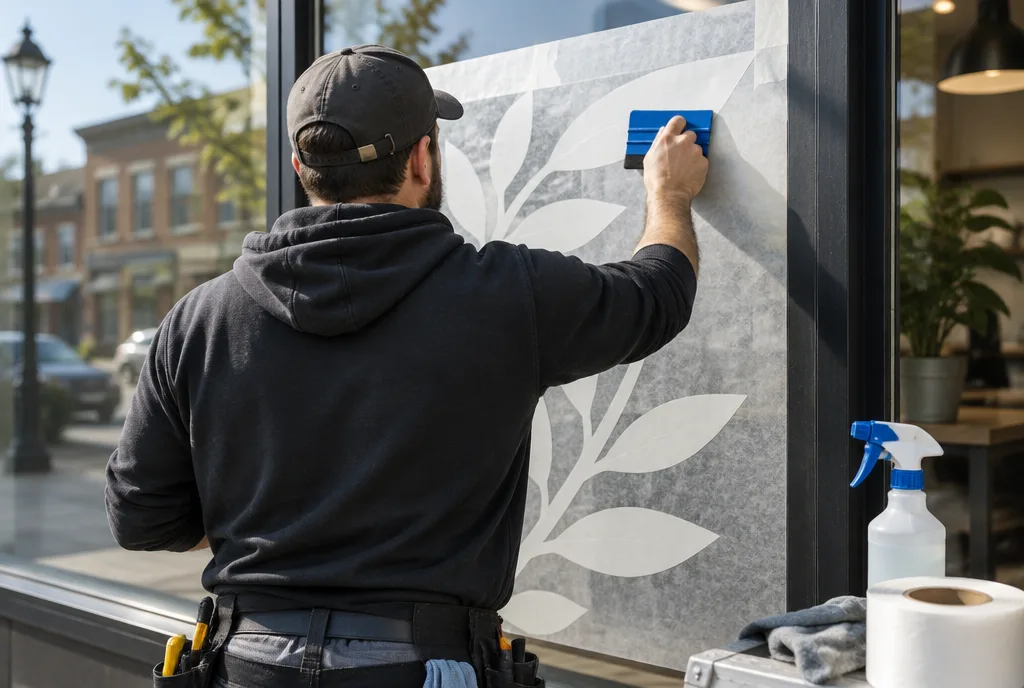
- film applied to dirty or cold glass – the corners lift after a week,
- a graphic designed without the dimensions of the panes, frames and mullions – on site it turns out a frame cuts through the lettering,
- old adhesive and film residue under the new graphic – it has to be removed before application; how to do this is described in our guide how to remove old vinyl from glass.
Rules: some towns have local regulations on advertising and the appearance of shop windows (e.g. landscape regulations, conservation areas), and shopping centres and some historic buildings have management rules. Before ordering large window graphics, check with the local authority or the building manager. We also help shopping centre tenants with night installations – more on the shopping centre tenant page. We do shop window graphics with installation in the Wieluń area and across Poland, and we also ship graphics with installation instructions abroad.