 Signs & Large Format Print
What a fuel price sign is and where it is used
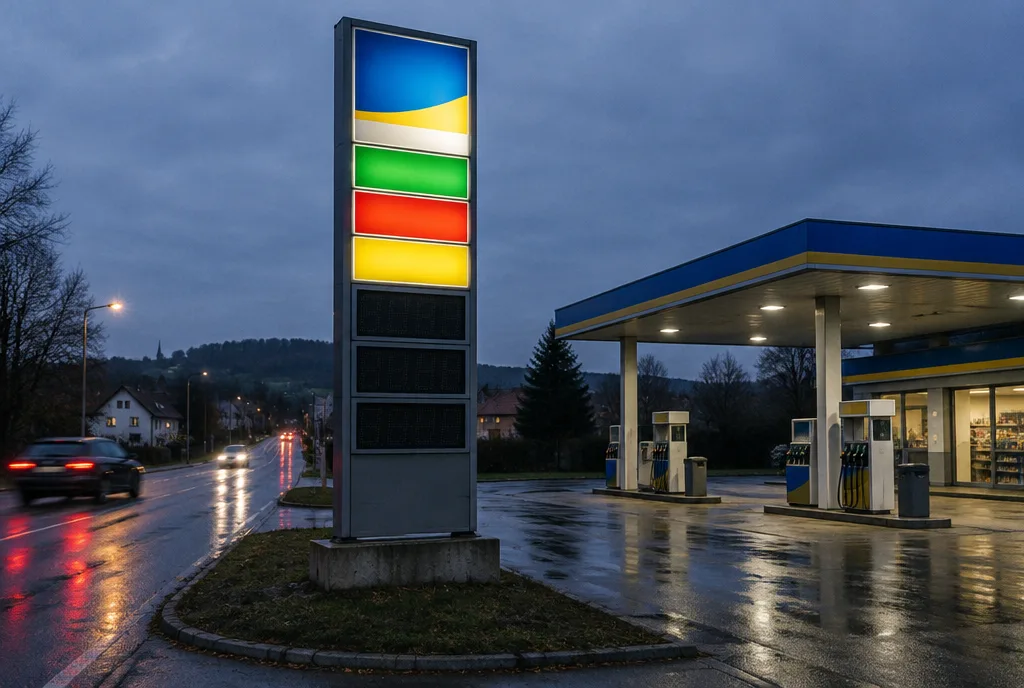
The name says it all: the sign shows the price. It is a variant of the advertising pylon where the key element is not the graphics but a few numbers: petrol, diesel and LPG prices, sometimes AdBlue or car wash prices. A driver doing 70–90 km/h has a few seconds to read them and decide whether to pull in.
You will see them mostly at petrol stations, both branded chains and independents. Similar structures are put up at touchless car washes (programme price lists), charging stations, pay car parks and yards selling fuel or aggregates, where the price of the day is the main selling point.
In practice the price sign is also the station's main landmark. It stands at the entrance, is often the tallest element on the plot and is the first thing drivers see. We cover the full signage of such a site on the page for the petrol station sector.
How a price sign is built: structure, light box and price modules
Every price sign, whatever it looks like, has three layers:
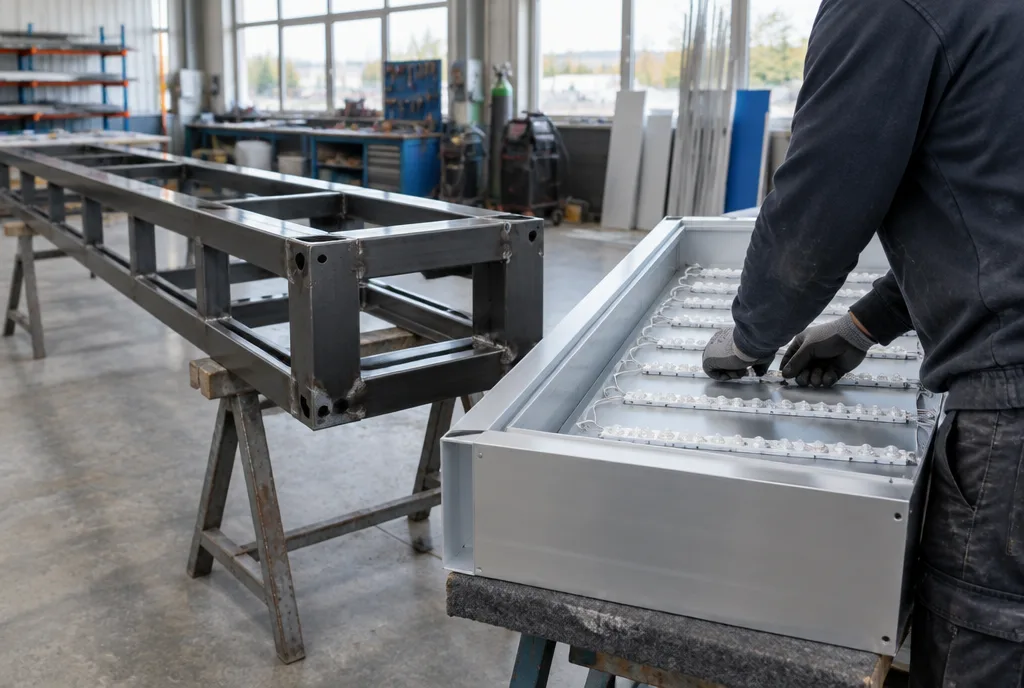
- Load-bearing structure – a galvanised steel post or frame bolted to anchors in a concrete foundation. It is clad in aluminium composite (Dibond) or powder-coated sheet metal.
- Logo light box – usually at the top, LED-lit, with a face of opal acrylic and vinyl or with routed letters. On a double-sided sign, light and graphics are on both faces.
- Price panels – there are three main options, described below.
Slide-in or hook-on digits. The simplest and cheapest. We print the digits on boards (PVC, Dibond, acrylic) and they are slid into rails or hung on hooks. Changing a price means going out with a pole or a step ladder. It works where prices change rarely. The drawbacks are manual handling and the fact that nobody wants to do it in winter.
Illuminated panels with replaceable digits. The digits sit on a light-transmitting face and the panel lights up together with the light box. They are readable at night, but changes are still manual.
LED displays (digital price modules). Seven-segment or matrix digits controlled from the till or a computer. A price change takes seconds and nobody has to go out onto the forecourt. This is the more expensive option and needs a controller and a permanent power supply, but with frequent price changes it pays back in convenience. We select and price digital modules individually for each project; the structure, cladding, light boxes and graphics are made in our own plant.
Dimensions, visibility from the road and number of price lines
| Situation | What to watch | What we usually choose |
|---|---|---|
| Station on a town street | Drivers are slow, but cars and trees block the view | Lower, double-sided pylon with 3–4 price lines |
| Station on a main road | High speed, decision made from far away | Taller pylon, large digits, both faces illuminated |
| Station with a car wash and shop | A lot of information at once | A separate car wash panel or a second, lower totem |
| Plot set back in a lay-by, behind a ditch | Pylon far from the edge of the carriageway | Taller structure and larger price panels |
| Access from both directions | Drivers approach from two sides | Always double-sided, set at right angles to the road |
The height and digit size follow from where the sign has to be read. The faster the road and the further the pylon stands from the carriageway, the larger the digits must be. Before we design anything, we ask for photos taken from the road in both directions, from the distance at which a driver should already see the prices.
The number of price lines is the second issue. Typically there are 3–4 fuel types, but stations with LPG, heating oil or AdBlue need 5–6. Every extra panel means a taller pylon or smaller digits, so it is better to decide upfront what really must be visible from the road and what can go on a board by the pumps.
Foundation, power and permits
A price sign is a structure under heavy wind load. That is why the foundation is not an extra but the basis of the whole project. Its size depends on the height and area of the pylon and on the ground, so a structural engineer should check it. We prepare a technical design of the pylon with drawings and fixing specifications (from approx. €85 net), and the foundation is usually built by the contractor doing the groundworks at the station, to that design, with anchors set to size.
Concrete needs time to cure. We schedule installation of the structure only once the foundation can take the load – this has to be built into the station opening schedule.
Power supply. A cable must be run underground to the pylon, ideally in a protective duct, before the concrete is poured and the paving laid. LED displays also need a signal cable or a communication module. The connection is made by the client's electrician or by our qualified crew.
Formalities. A freestanding roadside sign may require notification or a permit, the consent of the road authority (especially close to the highway) and compliance with local advertising rules. This depends on the country, municipality and location, so always check with the local authority. A general overview is in our guide does a shop sign need permission. We can take care of preparing the documents and arrangements (from approx. €210 net).
- 24 hexpress printing (UV inks need no drying)
- approx. 3 daysstandard lead time
- up to 14 dayslarge and custom projects with installation
Plus courier delivery. Tell us your date — we plan production around it.
Refurbish an old price sign or put up a new one
Very often the structure is in good condition and only the faces, power supplies and digits have aged. Then there is no point scrapping the steel and the foundation. A typical refurbishment covers:
- Site inspection and measurement (from approx. €85 net, refunded when you order production).
- Checking the structure, corrosion and face fixings.
- Replacing the light box face with a new one with backlit film (from approx. €80 net per m²).
- Replacing old fluorescent tubes or worn LED modules and power supplies with new LEDs (from approx. €42 net plus parts).
- New composite cladding and new digits, or swapping manual panels for displays.
When a station changes brand (joining another chain or rebranding its own), such a facelift is the quickest route. If the steel is rusted through at the base or the pylon needs to be taller, we honestly advise a new one. We cover lighting maintenance in the guide how much power an LED light box uses and how long it lasts.
How much a price sign costs and how long it takes
The reference point is a double-sided illuminated pylon about 3 m high – from approx. €2,070 net for the structure, faces and LEDs, without the foundation. The price goes up with greater height, more price panels, LED displays instead of manual digits, an unusual cladding shape and a routed logo. All amounts are indicative; we give a firm price after the survey and design.
Installation comes on top: a two-person crew at approx. €42 net per crew-hour, travel at approx. €1 net per km both ways from Wieluń, and for tall structures a cherry picker from approx. €230 net per day. Removing an old pylon including disposal is from approx. €16 net per m².
Timing: production of a large structure usually takes up to about 14 working days from design approval. Formalities and the foundation usually take longest, so start with those. Details of the offer are on the outdoor pylons and totems page, and the differences between pylon types are covered in advertising pylon – what it is.
Price signs across a station network – one design for many sites
With several or a dozen stations it pays to create one base design and two or three height variants. The structure, face fixing and digit layout are then identical; only the post height and number of panels differ. Spare parts are easier to source, and replacing graphics at the next identity change is done as a series.
Before such a series, collect dimensions and photos from every station – we describe this in site survey before a campaign. We produce in-house and install with our own crews in Poland and abroad, also as white label for agencies.