 Signs & Large Format Print
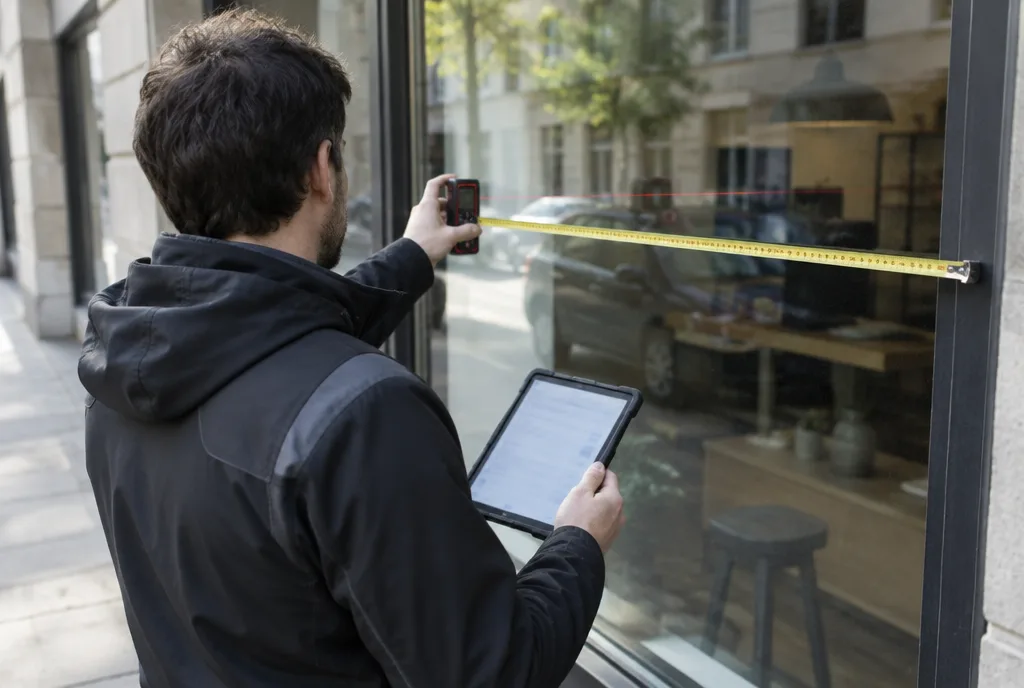
Who measures: store staff or a contractor
The first decision is not how to measure but who. Both routes work, but in different situations.
Measuring by store staff works when windows are simple (flat glass, no glazing bars), there are only a few or a dozen locations, and someone at head office makes sure the forms come back complete. The cost is low, but the risk of error is higher – a sales assistant will measure the glass by eye or give the frame size instead of the visible glass.
Measuring by a contractor pays off when there are many locations, windows are unusual (arches, divisions, light boxes above the entrance) or the campaign includes permanently installed elements: fascia signs, letters, interior signage. The crew doing the survey knows what production and installation need – they check the surface, cherry picker access or hanging height straight away.
In practice we often use a mixed approach: staff fill in the form for all stores, and we visit only those where data is incomplete or the window is unusual. For a retail network rollout this is the fastest route to a complete database.
The survey form: what it must include
The form must be the same for every location, otherwise the data cannot be compared. Below is the list we use as a starting point:
- Site identifier – store number, address, contact person, opening hours.
- Dimensions of each pane separately – width × height of the visible glass, in millimetres, measured in two places, because frames are rarely perfectly rectangular.
- A straight-on photo of each window – with a tape measure in the frame, plus one photo from a distance showing the whole frontage.
- Surface and condition – glass, polycarbonate, wall, old film to remove, seals, alarm or opening-hours stickers that must not be covered.
- Application side – inside or outside. This determines whether the graphic is printed mirror-reversed.
- Access – height of the bottom edge above the pavement, whether a ladder or cherry picker is needed, whether installation is possible during opening hours.
- Constraints – requirements of the shopping centre management, the building owner, a conservation officer; hours when work is permitted.
For window graphics, information about elements that must stay visible is especially useful. More on the technique itself in our guide on shop window graphics.
Window types and assigning graphic variants
| Type | Description | What we do with it |
|---|---|---|
| A | Standard pane, dimensions within ±2 cm of the template | One file, series printing |
| B | Pane narrower or taller than the template | Layout adapted to the proportions, separate file |
| C | Window with divisions (glazing bars, mullion) | Graphic split into fields, separate sheets |
| D | Glazed door, area with mandatory notices | Variant with a cut-out or a blank field |
| X | Unusual (arch, slope, no data) | Survey by us, individual file |
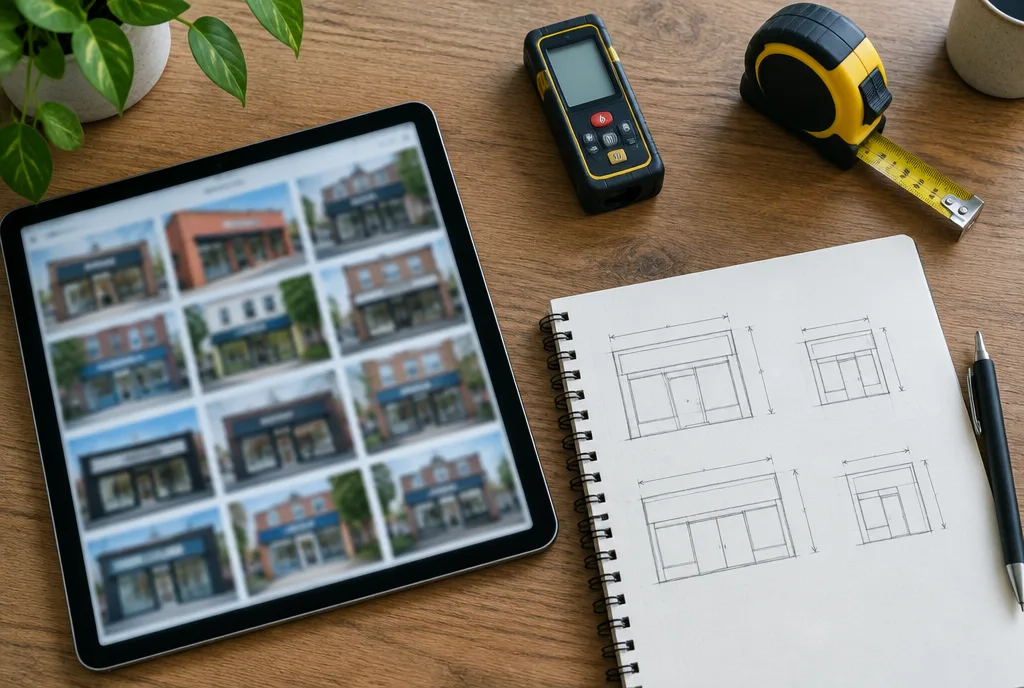
Once surveys from several dozen stores are collected, it usually turns out that there are not several dozen kinds of window, but a handful to a dozen or so types. This split is the most important step of the whole job, because the cost of design and production depends on it: each type is a separate file, a separate approval and a separate line in the schedule.
The rule is simple – the fewer types, the cheaper and faster. That is why for type B we often ask whether the graphic can have a background margin instead of a rebuilt layout. The tolerance within which windows count as the same type is agreed with the client before design, not after printing.
- 01Brief
Description, sizes, site photos and deadline — a few sentences are enough.
- 02Design and quote
Our designers prepare artwork or a visualisation and you get a price.
- 03Approval
You approve the design; for brand colours we provide a proof.
- 04Production
35+ machines in our own plant in Poland: 3.2 m UV print, CNC, laser, 3D, sewing.
- 05Installation or delivery
Own crews and vehicles across Europe, partner network, couriers worldwide.
A location database for future campaigns
A survey is done once and used many times. That is why the data is best kept in one spreadsheet or system, not in emails from store managers. A good database contains: the site identifier, the type of each window, dimensions, photos, the survey date and what has changed since the last visit (refit, new door, change of neighbouring tenant).
For the next campaign the designer gets a list of types instead of a list of stores, and production gets ready-made quantities for each variant. After each campaign we update the database with what the installation crew noticed on site. If the network has a store signage manual, window types are worth recording in it as part of the standard.
The same database helps with shipping: we know which set goes to which store and can prepare campaign sets for retail chains packed and labelled for a specific address.
- 24 hexpress printing (UV inks need no drying)
- approx. 3 daysstandard lead time
- up to 14 dayslarge and custom projects with installation
Plus courier delivery. Tell us your date — we plan production around it.
Common survey mistakes and what they cost
Survey errors do not show up at the desk but at installation – when the crew is already on site and the graphic does not fit. The ones we see most often:
- Frame size instead of visible glass. The graphic is a few centimetres too big and has to be trimmed on site or reprinted.
- Rounding to 10 cm. With full-coverage film a 3–4 cm difference is immediately visible.
- No information on the application side. The film is printed to go on the outside, but can only be applied inside – the text is mirror-reversed.
- Fixed elements overlooked. An alarm sensor, an opening-hours sticker, a lock – the graphic lands right on it.
- Old data. A survey from two years ago, and in the meantime the store has replaced its door.
Each such error means reprinting one graphic plus a second crew visit. For a distant location the travel cost can be higher than the graphic itself – which is why an accurate survey pays for itself quickly.
How long an audit takes and how to commission it
The time depends on the number of locations, their geographical spread and whether we measure ourselves or verify forms from staff. A few locations in one region usually take a single trip. For a larger network we plan routes so that one crew covers several stores a day, and the survey can be combined with removing old graphics.
To quote for an audit we need:
- the list of site addresses,
- information on what will be produced (window film, fascia signs, interior signage),
- the campaign start date,
- any existing data – even if incomplete.
We price an on-site survey and inventory from approx. €85 net per location, and refund the cost if production is ordered from us. Crew travel is charged at approx. €1 net per km both ways from Wieluń. These are indicative prices – we give the exact amount once we receive the site list. We survey in Poland and other European countries; details in the description of our network rollout with reporting and advertising installation in Poland and Europe services.